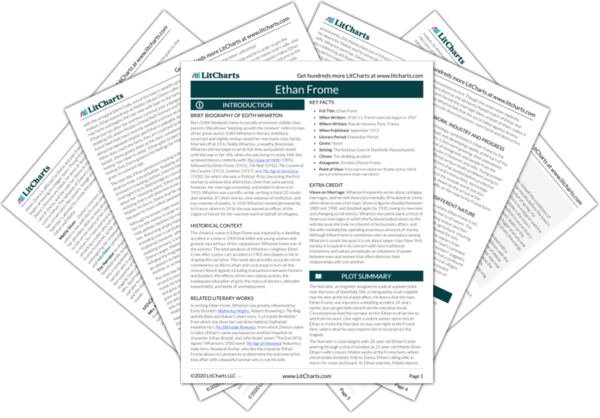
Ethan Frome: Themes

In LitCharts, each theme gets its own corresponding color, which you can use to track where the themes occur in the work. There are two ways to track themes:

  • Refer to the color-coded bars next to each plot point throughout the Summary and Analysis sections.
  • Use the ThemeTracker section to get a quick overview of where the themes appear throughout the entire work.


 Determinism and Free Will

In Ethan Frome, Wharton explores the concept of determinism—the idea that human lives are determined by outside forces, including social customs, heredity, environment, history, and laws of nature. For instance, Ethan’s life is “determined” in a variety of ways: his desire to become an engineer is thwarted by the moral necessity of returning to Starkfield to care for his dying parents; his plans to leave Starkfield after his marriage are thwarted by the infertility of his farm, which no one wants to buy, and his wife Zeena’s “sickliness;” and Ethan‘s desire to abandon Zeena in favor of Mattie is blocked by the feeling, imbued in him by his New England culture with its Puritan roots, that such an action would be immoral. As a result, Ethan has the sense that he is helpless to affect his own life and, rather than acting, he indulges in his naïve wish that Mattie will always live at the farm without him having to do anything decisive at all.

Despite all these factors, Ethan could act decisively. Other characters in the novel do: Ruth Varnum and Ned Hale kiss secretly even though they aren’t yet married; Mr. Hale turns down Ethan’s request for an advance because he can’t afford it at the time; and Zeena summarily acts to replace Mattie with a new girl. Yet every time Ethan seems on the verge of action, he finds himself facing some obstacle and instead of facing it gives in, all the while blaming the external forces that are thwarting him without ever recognizing his own lack of courage.

 Duty and Morality vs. Desire

Ethan struggles against the customs and rules of society, fighting an inner battle between what he feels he needs in order to be happy and what he feels he must do to appease his family and society. Most prominently, this theme plays out in Ethan’s struggle between his desire for Mattie and his sense of duty toward Zeena, his wife. Wharton portrays Zeena as horribly shrewish, devoid of any redeeming attributes, while Mattie is kind, gentle, radiant, and a perfect match for Ethan. Ethan’s desire to leave Zeena for Mattie is therefore completely understandable. Yet, because Ethan knows that society would severely judge a man who abandoned his wife, and because he knows that without him Zeena would suffer in poverty, he can’t bring himself to leave her. Similarly, Ethan avoids entering into an affair with Mattie because he knows that an affair would ruin Mattie’s reputation. He therefore continually thinks of their relationship in terms of marriage, takes great pleasure in their domesticity, and displays an intense physical shyness, avoiding even touching Mattie when they are alone together in the house.

Ethan’s sense of duty and morality conflict with his desires in a variety of other ways. His desire to leave Starkfield to pursue a career in engineering conflicts with his obligation to provide for his wife and continue running the family farm. His strict code of ethics won’t allow him to lie to the Hales to get the money to run away with Mattie. Even in his great act of defiance, when Ethan and Mattie decide to commit suicide to try to escape the constraints placed on them by the world, Ethan can’t stop thinking about his duties. As the sled speeds downhill, he remembers that he must feed his horse and thinks of Zeena—these distractions make him lose control of the sled and botch the suicide attempt, crippling instead of killing himself and Mattie, and condemning them both to a kind of living death.

 Gender Roles and Marriage

As in many of Wharton’s novels, Ethan Frome makes the case that traditional gender roles limit the potential of men and women, and destroy male-female relationships. Through Mattie, the novel critiques gender expectations that resulted in young women being raised to become nothing more than domestic servants and companions for men. Mattie is an example of a middle-class girl who was educated only to trim a hat, make molasses candy, recite poetry, and play the piano, accomplishments that would have helped her to attract a husband but were of little practical use when it came to earning a living. The novel also shows how the traditional division of labor in marriage resulted in women staying at home much of the time, occupied with dull household chores, while men were out working. In the novel, the isolation women suffer is literally maddening: Ethan’s mother goes insane from loneliness. Through the passive aggressive “sickliness” that Zeena uses to control Ethan, and Ethan’s own feelings of inferiority and revulsion for Zeena that result from his lack of control, the novel shows how traditional marriage sets up a destructive power struggle between man and wife. In fact, Ethan’s attraction to Mattie depends in part on her submissiveness to him. Though the novel never explicitly mentions divorce, the obviously flawed match of Ethan and Zeena, and the toll the marriage takes on both of them, makes it clear that Wharton felt that the social taboo against divorce and, in particular divorced women, were harsh and destructive.

 Work, Industry and Progress

Technology, symbolized in Ethan Frome by the railroad, was developing rapidly at the turn of the century. Cities were growing, their populations swelled by the arrival of immigrants and people from the countryside, lured by jobs in factories and mills. Young women in particular often suffered serious health problems owing to the harsh working conditions that existed before protective labor laws were passed. In rural communities, technology provided new connections to the outside world, but also caused upset and change, as shown by the arrival of the railroad, which eliminates traffic on the road to the Frome farm.

 Hostile or Indifferent Nature

In the rural Berkshires where Ethan Frome is set, the characters are at the mercy of nature. The short New England growing season and thin mountain soils discouraged large-scale agriculture, ensuring that most farms, like the Frome farm, allowed for only “subsistence” farming that prevented farm owners from overcoming poverty. In addition, as Harmon Gow’s comment that Ethan has “been in Starkfield too many winters” suggests, the prolonged and brutal winters of the region had a profound effect on the personalities of the inhabitants of rural villages, resulting in reserved social behavior, a tendency toward pathological illness (especially in women), and a sense of disconnectedness from the larger world.