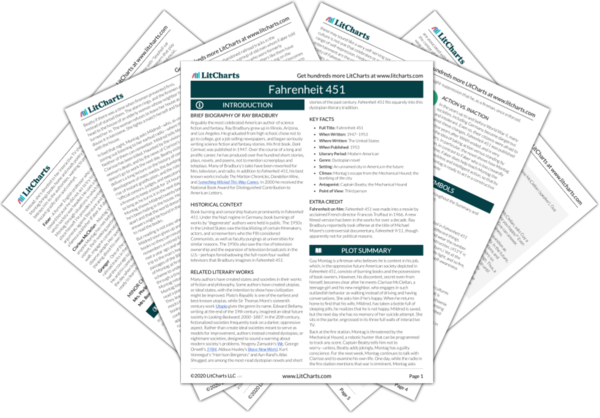
Fahrenheit 451: Background Info

Author Bio

Full Name: Ray Douglas Bradbury

Pen Name: Ray Bradbury

Date of Birth: August 22, 1920

Place of Birth: Waukegan, Illinois, United States

Brief Life Story: Arguably the most celebrated American author of science fiction and fantasy, Ray Bradbury grew up in Illinois, Arizona, and Los Angeles. He graduated from high school, chose not to go to college, got a job selling newspapers, and began seriously writing science fiction and fantasy stories. His first book, Dark Carnival, was published in 1947. Over the course of a long and prolific career, he has produced over five hundred short stories, plays, novels, and poems, not to mention screenplays and teleplays. Many of Bradbury’s tales have been reworked for film, television, and radio. In addition to Fahrenheit 451, his best known works include The Martian Chronicles, Dandelion Wine, and Something Wicked This Way Comes. In 2000 he received the National Book Award for Distinguished Contribution to American Letters.

Key Facts

Full Title: Fahrenheit 451

Genre: Dystopian novel

Setting: An unnamed city in America in the future

Climax: Montag’s escape from the Mechanical Hound; the bombing of the city

Antagonist: Captain Beatty; the Mechanical Hound

Point of View: Third person

Historical and Literary Context

When Written: 1947–1953

Where Written: The United States

When Published: 1953

Literary Period: Modern American

Related Literary Works: Many authors have created states and societies in their works of fiction and philosophy. Some authors have created utopias, or ideal states, with the intention to show how civilization might be improved. Plato’s Republic is one of the earliest and best-known utopias, while Sir Thomas More’s sixteenth century work Utopia gives the genre its name. Edward Bellamy, writing at the end of the 19th century, imagined an ideal future society in Looking Backward: 2000–1887. In the 20th century, fictionalized societies frequently took on a darker, oppressive aspect. Rather than create ideal societies meant to serve as models for improvement, authors instead created dystopias, or nightmare societies, designed to sound a warning about modern society’s problems. Yevgeny Zamyatin’s We, George Orwell’s 1984, Aldous Huxley’s Brave New World, Kurt Vonnegut’s “Harrison Bergeron,” and Ayn Rand’s Atlas Shrugged, are among the most-read dystopian novels and short stories of the past century. Fahrenheit 451 fits squarely into this dystopian literary tradition.

Related Historical Events: Book burning and censorship feature prominently in Fahrenheit 451. Under the Nazi regime in Germany, book burnings of works by “degenerate” authors were held in public. The 1950s in the United States saw the blacklisting of certain filmmakers, actors, and screenwriters who the FBI considered Communists, as well as faculty purgings at universities for similar reasons. The 1950s also saw the rise of television ownership and the expansion of television broadcasts in the U.S.—perhaps foreshadowing the full-room four-walled televisors that Bradbury imagines in Fahrenheit 451.

Extra Credit

Fahrenheit on film: Fahrenheit 451 was made into a movie by acclaimed French director Francois Truffaut in 1966. A new filmed version has been in the works for over a decade. Ray Bradbury reportedly took offense at the title of Michael Moore’s controversial documentary, Fahrenheit 9/11, though apparently not for political reasons.