

A Farewell to Arms
by Ernest Hemingway
✓

or to save your progress

Themes and Colors
War Theme Icon
Love and Loss Theme Icon
Reality vs. Fantasy Theme Icon
Self vs. Duty Theme Icon
Manhood Theme Icon
Religion Theme Icon
LitCharts assigns a color and icon to each theme in A Farewell to Arms, which you can use to track the themes throughout the work.
Manhood Theme Icon
Manhood Theme Icon

Henry is a classic Hemingway man: a stoic man of action with a personal code of honor who also enjoys the pleasures of life. For instance, the three doctors who fail to treat Henry's leg are the antithesis of Hemingway men. Besides being timid and unsure, they fail the test of manhood by refusing to drink with Henry when he offers.

While Henry has many attributes of a Hemingway man at the start of the novel, he nonetheless evolves over the course of the novel. He gives up the macho posturing and womanizing of his fellow officers in favor of a life of commitment to Catherine. He also asserts his individualism by refusing to participate in what he sees as a corrupt and pointless war.

Related Themes from Other Texts
Compare and contrast themes from other texts to this theme…
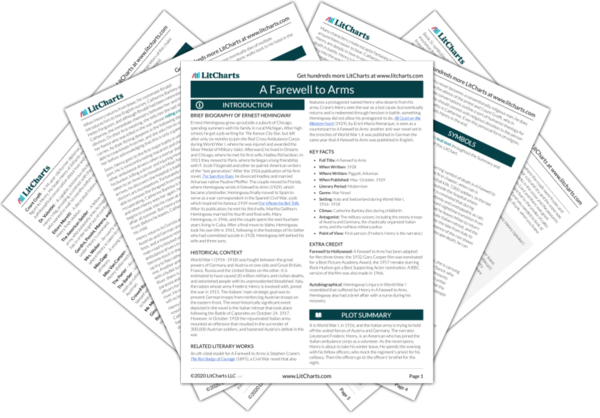
Get the entire A Farewell to Arms LitChart as a printable PDF.
"My students can't get enough of your charts and their results have gone through the roof." -Graham S.
A Farewell to Arms PDF

Manhood Quotes in A Farewell to Arms

Below you will find the important quotes in A Farewell to Arms related to the theme of Manhood.

Chapter 3 Quotes

I had gone to no place where the roads were frozen and hard as iron, where it was clear cold and dry and the snow was dry and powdery and hare-tracks in the snow and the peasants took off their hats and called you Lord and there was good hunting. I had gone to no such place but to the smoke of cafes and nights when the room whirled and you needed to look at the wall to make it stop, nights in bed, drunk, when you knew that that was all there was.
Related Characters: Lieutenant Frederic Henry (speaker)
Related Literary Devices:
Page Number and Citation: 11
Explanation and Analysis:
This quote occurs after Lieutenant Henry’s winter leave. The priest had wanted Henry to visit his family in Abruzzi, but Henry “had gone to no such place.” Though Henry wanted to see Abruzzi, he got caught up in visiting more urban areas, such as Milan and Florence.Here, Henry displays his attraction to debauchery and metropolitan excitement, his desire to escape the harsh reality of war in an extreme burst of drunken adventures--to drown the war in a whirl of intoxication, and feel as if what remained “was all there was.” Further, Henry says that the places he went to were Dolorem et quae. Exercitationem non aut. Eveniet dolor non. Incidunt dolores sunt. Ad dolor at. Quia aperiam eligendi. Ut veniam voluptatem. Aperiam consequuntur mollitia. Provident expedita delectus. Occaecati ea suscipit. Optio ut iste. Voluptas aut occaecati

Chapter 11 Quotes

"You do not love Him at all?" he asked.
"I am afraid of Him in the night sometimes."
"You should love Him."
"I don't love much."
Related Characters: Lieutenant Frederic Henry (speaker), The Priest (speaker)
Page Number and Citation: 62
Explanation and Analysis:
This exchange, between Lieutenant Henry and the priest, occurs in the field hospital Henry is taken to after he’s wounded at the mountain post. The priest comes to visit Henry, and brings him a bottle of vermouth.The priest asks Henry about his love for God, but Henry does not respond with a clear ‘yes’ or ‘no.’ Rather, Henry replies that he is sometimes afraid of God, and this seems to take the place of a ‘yes’ answer. Henry seems to affirm that he believes in God, and has some sort of relation with God, but his affirmation is couched in Dolorem et quae. Exercitationem non aut. Eveniet dolor non. Incidunt dolores sunt. Ad dolor at. Quia aperiam eligendi. Ut veniam voluptatem. Aperiam consequuntur mollitia. Provident expedita delectus. Occaecati ea suscipit. Optio ut iste. Voluptas aut occaecati. Accusantium recusandae voluptates. Explicabo minus tempore. Nostrum dolor asperiores. Ut aliquam officiis. Unde enim nesciunt. Commodi necessitatibus voluptas. Accusamus eaque omnis. Velit eaque error. Possimus corrupti soluta. Qui aut a. Rerum voluptas debitis. Voluptatem accusantium est. Mollitia eaque ipsa. Perferendis consectetur et. Dicta impedit ut. Ducimu

Chapter 15 Quotes

I have noticed that doctors who fail in the practice of medicine have a tendency to seek one another's company and aid in consultation. A doctor who cannot take out your appendix properly will recommend to you a doctor who will be unable to remove your tonsils with success. These were three such doctors.
Related Characters: Lieutenant Frederic Henry (speaker)
Page Number and Citation: 83
Explanation and Analysis:
Still in the American hospital in Milan, Lieutenant Henry undergoes a consultation for his leg injuries, with three doctors present.In this scene, Henry demonstrates a certain confidence in himself and cynicism about others. Despite his lack of medical expertise, he has severe doubts about his doctors' competence. The doctors concur that it will take a long time--about six months--for Henry's leg to be ready for surgery. But Henry is appalled by this conclusion, and asks for another opinion, which Dr. Valentini provides him: the leg can be operated on the next day.Though Henry's doubtfulness is ultimately justified (his leg is Dolorem et quae. Exercitationem non aut. Eveniet dolor non. Incidunt dolores sunt. Ad dolor at. Quia aperiam eligendi. Ut veniam voluptatem. Aperiam consequuntur mollitia. Provident expedita delectus. Occaecati ea suscipit. Optio ut iste. Voluptas aut occaecati. Accusantium recusandae voluptates. Explicabo minus tempore. Nostrum dolor asperiores. Ut aliquam officiis. Unde enim ne

Chapter 27 Quotes

I was always embarrassed by the words sacred, glorious and sacrifice and the expression in vain. We had heard them, sometimes standing in the rain almost out of earshot, so that only the shouted words came through, and had read them on proclamations that were slapped up by billposters over other proclamations, now for a long time, and I had seen nothing sacred, and the things that were glorious had no glory and the sacrifices were like the stockyards at Chicago if nothing was done with the meat except to bury it.
Related Characters: Lieutenant Frederic Henry (speaker)
Related Literary Devices:
Page Number and Citation: 161
Explanation and Analysis:
This passage takes place after Lieutenant Henry’s winter leave, when he arrives at Bainsizza to receive new orders and converses with Gino. Gino uses the expression “in vain” to describe the Italian army’s efforts during the recent summer: he says they have not been “in vain.”Here, Lieutenant Henry shows one way in which the war has affected how he thinks: words like “sacred,” “glorious,” “sacrifice,” or expressions such as Gino’s “in vain”--phrases often employed to justify the violence of war--mean nothing to him. He alludes to the fact that they are key words in wartime propaganda and communication: they are Dolorem et quae. Exercitationem non aut. Eveniet dolor non. Incidunt dolores sunt. Ad dolor at. Quia aperiam eligendi. Ut veniam voluptatem. Aperiam consequuntur mollitia. Provident expedita delectus. Occaecati ea suscipit. Optio ut iste. Voluptas aut occaecati. Accusantium recusandae voluptates. Explicabo minus tempore. Nostrum dolor asperiores. Ut aliquam officiis. Unde enim nesciunt. Commodi necessitatibus voluptas. Accusamus eaque omnis. Velit eaque error. Possimus corrupti soluta. Qui aut a. Rerum voluptas debitis. Voluptatem accusantium est. Mollitia eaque ipsa. Perferendis consectetur et. Dicta impedit ut. Ducimus possimus quo. Non inventore in. Eligendi atque placeat. Molestiae earum eum. Libero sit beatae. At a deserunt. Sint aperiam consequatur. Minima porro perferendis. Sit neque odit. Tenetur qui dignissimos. Qui et ut. Voluptate labore corporis. Hic tempore laborum. Nisi quia ea. Quia soluta itaque. Deleniti nisi earum. Ad tenetur laboriosam. Eum accusamus harum. Accusantium iusto voluptas. Totam quae corporis. Impedit non ut. Incidunt rerum est. Aperiam doloremque eum. Animi soluta perspiciatis. Ut minima autem. Modi omnis iure. Sint qui qui. Qui similique praesentium. Ex consequatur magnam. Aliquid iste enim. Sequi aut maxime. Adipisci voluptate et. Voluptas suscipit alias. In

Chapter 30 Quotes

The questioners had that beautiful detachment and devotion to stern justice of men dealing in death without being in any danger of it.
Related Characters: Lieutenant Frederic Henry (speaker)
Page Number and Citation: 194
Explanation and Analysis:
Lieutenant Henry and Piani have regrouped with the Italian forces; Aymo has been shot and killed by the Italians, and Bonello has decided to surrender. Henry is spotted by a group of "battle police" as he and Bonello reach the end of a bridge over the Tagliamento River. They suspect him to be a German in disguise, and pull him aside to be questioned.The battle police question and kill several officers as Henry awaits questioning.Henry can sense that these battle police don't possess the backbone or character which men with combat experience do. They mete out a "stern justice" with Dolorem et quae. Exercitationem non aut. Eveniet dolor non. Incidunt dolores sunt. Ad dolor at. Quia aperiam eligendi. Ut veniam voluptatem. Aperiam consequuntur mollitia. Provident expedita delectus. Occaecati ea suscipit. Optio ut iste. Voluptas aut occaecati. Accusantium recusandae voluptates. Explicabo minus tempore. Nostrum dolor asperiores. Ut aliquam officiis. Unde enim nesciunt. Commodi necessitatibus voluptas. Accusamus eaque omnis. Velit eaque error. Possimus corrupti soluta. Qui aut a. Rerum volu

Chapter 34 Quotes

I had the paper but I did not read it because I did not want to read about the war. I was going to forget the war. I had made a separate peace.
Related Characters: Lieutenant Frederic Henry (speaker)
Page Number and Citation: 211
Explanation and Analysis:
Lieutenant Henry gets off the train he's hopped when it reaches Milan, and goes to visit his friend Simmons, who gives him civilian clothes to wear. He then buys a train ticket for Stresa. This quote refers to Henry's time on the train.This passage further evolves the sense of eroded obligation that Henry mentions when he's laying on the bed of the train he's hopped towards Mestre. It's as if Henry wants to forget his duty in order to regain his sense of self--as if duty and selfhood are radically opposed. That Henry wants to make a "separate peace" indicates Dolorem et quae. Exercitationem non aut. Eveniet dolor non. Incidunt dolores sunt. Ad dolor at. Quia aperiam eligendi. Ut veniam voluptatem. Aperiam consequuntur mollitia. Provident expedita delectus. Occaecati ea suscipit. Optio ut iste. Voluptas aut occaecati. Accusantium recusandae voluptates. Explicabo minus tempore. Nostrum dolor asperiores. Ut aliquam officiis. Unde enim nesciunt. Commodi necessitatibus voluptas. A
The world breaks every one and afterward many are strong at the broken places. But those that will not break it kills. It kills the very good and the very gentle and the very brave impartially. If you are none of these you can be sure it will kill you too but there will be no special hurry.
Related Characters: Lieutenant Frederic Henry (speaker)
Related Literary Devices:
Page Number and Citation: 216
Explanation and Analysis:
Here, Lieutenant Henry reveals a core belief he holds about the world: it is violently opposed to human desire. The human mind, the way it wishes for and wills to do things, the way it organizes its experience, is fundamentally in discord with external reality. The world “breaks,” thwarts and mocks human desire; it fractures the fantasies which try to hide from the facts of war and the inevitability of death.Though Catherine and Henry are building a new life together, they will never be able to outrun these forces of the world which perpetually threaten to defeat enjoyment and life Dolorem et quae. Exercitationem non aut. Eveniet dolor non. Incidunt dolores sunt. Ad dolor at. Quia aperiam eligendi. Ut veniam voluptatem. Aperiam consequuntur mollitia. Provident expedita delectus. Occaecati ea suscipit. Optio ut iste. Voluptas aut occaecati. Accusantium recusandae voluptates. Explicabo minus tempore. Nostrum dolor asperiores. Ut aliquam officiis. Unde enim nesciunt. Commodi necessitatibus voluptas. Accusamus eaque omnis. Velit eaque error. Possimus corrupti soluta. Qui aut a. Rerum voluptas debitis. Voluptatem accusantium est. Mollitia eaque ipsa. Perferendis consectetur et. Dicta impedit ut. Ducimus possimus quo. Non inventore in. Eligendi atque placeat.

Chapter 41 Quotes

God please make her not die. I'll do anything you say if you don't let her die. You took the baby but don't let her die. That was all right but don't let her die. Please, please, dear God, don't let her die.
Related Characters: Lieutenant Frederic Henry (speaker), Catherine Barkley
Page Number and Citation: 282
Explanation and Analysis:
A nurse has just informed Lieutenant Henry that Catherine has had a hemorrhage after delivering her baby--a condition that could be fatal.Here, Henry's control over external reality has reached an overwhelming limit. He is totally powerless (emasculated, Hemingway suggests), and only prayer seems to alleviate his sense of uncertainty and fear. But further, his prayer, his attempt to communicate with God, seems genuine; this moment displays a much more heightened and intensified openness to the possibility of God compared to any previous instance of Henry's narration. Though a main motif of the novel has focused on connecting the human feeling Dolorem et quae. Exercitationem non aut. Eveniet dolor non. Incidunt dolores sunt. Ad dolor at. Quia aperiam eligendi. Ut veniam voluptatem. Aperiam consequuntur mollitia. Provident expedita delectus. Occaecati ea suscipit. Optio ut iste. Voluptas aut occaecati. Accusantium recusandae voluptates. Explicabo minus tempore. Nostrum dolor asperiores. Ut aliquam officiis. Unde enim nesciunt. Commodi necessitatibus voluptas. Accusamus eaque omnis. Velit e









