

A Wrinkle in Time
by Madeleine L'Engle
✓

or to save your progress

Nonconformity Theme Analysis

Themes and Colors
Nonconformity Theme Icon
The Value of Love Theme Icon
Deceptive Appearances Theme Icon
Language and Knowing Theme Icon
Christian References Theme Icon
LitCharts assigns a color and icon to each theme in A Wrinkle in Time, which you can use to track the themes throughout the work.
Nonconformity Theme Icon

At the beginning of the book, Meg is unhappy because she doesn't fit in at school, and desperately wishes she could be the same as everyone else. She's smarter than most kids, but her unorthodox way of thinking is not understood by her school, and she reacts by being sulky and stubborn. Her five-year-old brother, Charles Wallace, is also made fun of for being abnormally intelligent and different. But then the two meet Calvin, a "cool" kid who is unhappy because he hides his differences, and the Mrs. W's, who are the weirdest and most wonderful people they have ever met, and Meg begins to reconsider the value of her "differences".

The final nail in the coffin of Meg's desires for sameness come when the children visit the planet Camazotz, which has been entirely taken over by the Black Thing. On Camazotz, everyone is the same, everyone conforms to the standards set by IT, and it is the unhappiest place in the book. When Charles Wallace gets assimilated IT and becomes the same as everyone on Camazotz, Meg realizes just how much she doesn't want herself or anyone she loves to have their differences taken away.

The novel also contains many quotes from and references to great writers, thinkers, and scientists of the past (Shakespeare, Einstein, Goethe, etc.), all of whom were very "different" but accomplished great things for the good and the light through their work, and who are presented as the Earth's greatest fighter's against the Black Thing. In other words, the novel presents difference as not just a fact of life, but as a vital thing, the most important thing in the fight against evil.

Related Themes from Other Texts
Compare and contrast themes from other texts to this theme…

Nonconformity ThemeTracker

The ThemeTracker below shows where, and to what degree, the theme of Nonconformity appears in each chapter of A Wrinkle in Time. Click or tap on any chapter to read its Summary & Analysis.
How often theme appears:
chapter length:
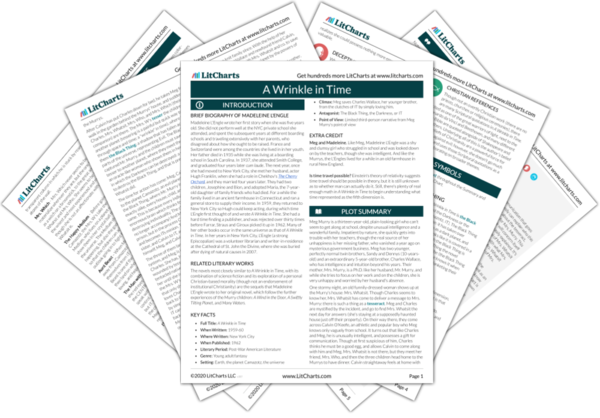
Get the entire A Wrinkle in Time LitChart as a printable PDF.
"My students can't get enough of your charts and their results have gone through the roof." -Graham S.
A Wrinkle in Time PDF

Nonconformity Quotes in A Wrinkle in Time

Below you will find the important quotes in A Wrinkle in Time related to the theme of Nonconformity.

Chapter 1 Quotes

How did Charles Wallace always know about her? How could he always tell? He never knew—or seemed to care—what Dennys or Sandy were thinking. It was his mother's mind, and Meg's that he probed with frightening accuracy.

Related Characters: Meg Murry (speaker), Sandy and Dennys Murry, Charles Wallace Murry
Page Number and Citation: 13
Explanation and Analysis:
One of the major concerns of A Wrinkle in Time is with powers beyond rational knowledge. This quote establishes Meg's character as someone who is perturbed when confronted with phenomena that she doesn't understand. Meg's preference for the comprehensible (as opposed to mystery) tempts her to jump to easy conclusions based on appearances, which is something Charles Wallace is less prone to. As shown in this quote, this is part of Charles Wallace's gif: understanding things about people that they aren't explicitly communicating, or knowing essential truths about other people that aren't readily apparent. Charles Wallace's gift is also important Dolorem et quae. Exercitationem non aut. Eveniet dolor non. Incidunt dolores sunt. Ad dolor at. Quia aperiam eligendi. Ut veniam voluptatem. Aperiam consequuntur mollitia. Provident expedita delectus. Occaecati ea suscipit. Optio ut iste. Voluptas aut occaecati. Accusantium recusandae voluptates. Explicabo minus tempore. Nostrum dolor asperiores. Ut aliquam officiis. Unde enim nesciunt. Commodi necessitatibus voluptas. Accusamus eaque omnis. Velit eaque error. Possimus corrupti soluta. Qui aut a. Rerum voluptas debitis. Voluptatem accusantium est. Mollitia eaque ipsa. Perferendis consectetur et. Dicta impedit ut. Ducimus possimus quo. Non inventore in. Eligendi atque placeat. Molestiae earum eum. Libero sit beatae. At a deserunt. Sint ape

"The tesseract—" Mrs. Murry whispered. "What did she mean? How could she have known?"

Related Characters: Mrs. Murry (speaker)
Related Symbols: Tesseract
Page Number and Citation: 27
Explanation and Analysis:
This is yet another instance of communication that goes beyond reason. Nobody in Meg's family can explain who this woman is or why she knows anything about the tesseract, which clearly has extreme significance for Mrs. Murry. This scene is another indication that the book will concern itself with the power of knowledge that is not easily explained. It's important to note, too, that Meg is skeptical of Mrs. Whatsit because of her appearance. Meg's concern with what Mrs. Whatsit looks like – her concern about how Mrs. Whatsit doesn't conform – blinds her to the importance of Mrs. Whatsit's Dolorem et quae. Exercitationem non aut. Eveniet dolor non. Incidunt dolores sunt. Ad dolor at. Quia aperiam eligendi. Ut veniam voluptatem. Aperiam consequuntur mollitia. Provident expedita delectus. Occaecati ea suscipit. Optio ut iste. Voluptas aut occaecati. Accusantium recusandae voluptates. Explicabo minus tempore. Nostrum dolor asperiores. Ut aliquam officiis. Unde enim nesciunt. Commodi necessitatibus voluptas. Accusamus eaque omnis. Velit eaque error. Possimus corrupti soluta. Qui aut a. Rerum voluptas debitis. Voluptatem accusantium est. Mollitia eaque ipsa.

Chapter 2 Quotes

"…I'm a sport."
At that Charles Wallace grinned widely. "So ‘m I."
"I don't mean like in baseball," Calvin said.
"Neither do I."
"I mean like in biology," Calvin said suspiciously.
"A change in gene," Charles Wallace quoted, "resulting in the appearance in the offspring of a character which is not present in the parents but which is potentially transmissible to the its offspring."

Related Characters: Charles Wallace Murry (speaker), Calvin O'Keefe (speaker)
Page Number and Citation: 38
Explanation and Analysis:
In this passage, we see the effects of the kind of appearance-based stereotyping that the book is committed to debunking. Calvin, who knows that everyone just sees him as an athletic popular kid who lacks anything interesting beyond those qualities, does not believe that Charles Wallace truly understands who he is. For this reason, Calvin is suspicious and over-explains what he means when he says he's a sport (he's actually using a technical term from biology). This shows how restrictive Calvin's popularity and public image has been to his inner life and individuality. Charles Wallace, on the other hand, is Dolorem et quae. Exercitationem non aut. Eveniet dolor non. Incidunt dolores sunt. Ad dolor at. Quia aperiam eligendi. Ut veniam voluptatem. Aperiam consequuntur mollitia. Provident expedita delectus. Occaecati ea suscipit. Optio ut iste. Voluptas aut occaecati. Accusantium recusandae voluptates. Explicabo minus tempore. Nostrum dolor asperiores. Ut aliquam officiis. Unde enim nesciunt. Commodi necessitatibus voluptas. Accusamus eaque omnis. Velit eaque error. Possimus corrupti soluta. Qui aut a. Rerum voluptas debitis. Vo

Chapter 3 Quotes

"But you're good at basketball and things," Meg protested. "You're good in school. Everybody likes you."
"For all the most unimportant reasons," Calvin said. "There hasn't been anybody, anybody in the world I could talk to. Sure, I can function on the same level as everybody else, I can hold myself down, but it isn't me."

Related Characters: Meg Murry (speaker), Calvin O'Keefe (speaker)
Page Number and Citation: 52
Explanation and Analysis:
Of all the characters, it is perhaps Calvin who is most articulate about the ways in which conformity and difference affect people. Meg, for much of the book, is entrapped by the idea that she is somehow inferior because of her superficial differences from others, and Charles Wallace seems so above the notion of superficial difference that it wouldn't occur to him to talk about it this way. Calvin, however, is a complicated character who respects and likes his own differences, but still hides them in order to fit in. Here, Meg is incredulous that Calvin could be someone other Dolorem et quae. Exercitationem non aut. Eveniet dolor non. Incidunt dolores sunt. Ad dolor at. Quia aperiam eligendi. Ut veniam voluptatem. Aperiam consequuntur mollitia. Provident expedita delectus. Occaecati ea suscipit. Optio ut iste. Voluptas aut occaecati. Accusantium recusandae voluptates. Explicabo minus tempore. Nostrum dolor asperiores. Ut aliquam officiis. Unde enim nesciunt. Commodi necessitatibus voluptas. Accusamus eaque omnis. Velit eaque error. Possimus

"But Charles Wallace doesn't look different from anybody else."
"No, Meg, but people are more than just the way they look. Charles Wallace's difference isn't physical. It's in essence."

Related Characters: Meg Murry (speaker), Mrs. Murry (speaker), Charles Wallace Murry
Page Number and Citation: 54
Explanation and Analysis:
This is another example of Meg's tendency to place too much importance on superficial appearance. Even her own brother, whom she loves deeply, is in some way unseen by her because of it – Meg doesn't understand his "essence" because she can't look past his appearance. Meg's mother, on the other hand, does understand that Charles Wallace is different, and she is able to love him for it. She recognizes that his individuality is a gift and that it has given him powers of understanding that cannot be explained. This chapter has made it clear that Meg is uniquely adept Dolorem et quae. Exercitationem non aut. Eveniet dolor non. Incidunt dolores sunt. Ad dolor at. Quia aperiam eligendi. Ut veniam voluptatem. Aperiam consequuntur mollitia. Provident expedita delectus. Occaecati ea suscipit. Optio ut iste. Voluptas aut occaecati. Accusantium recusandae voluptates. Explicabo minus tempore. Nostrum dolor asperiores. Ut aliquam officiis. Und

Chapter 6 Quotes

"We are the most oriented city on the planet. There has been no trouble of any kind for centuries. All Camazotz knows our record. That is why we are the capital city of Camazotz. That is why CENTRAL Central Intelligence is located here. That is why IT makes ITs home here." There was something about the way he said "IT" that made a shiver run up and down Meg's spine.

Related Characters: IT (speaker), Meg Murry
Page Number and Citation: 121
Explanation and Analysis:
In this scene, the paper boy on Camazotz is explaining to Meg, Charles Wallace, and Calvin the nature of the city in which they have found themselves. His description is chilling to the characters because it is a dystopian vision of perfect conformity and efficiency that evokes sinister government bureaucracy and the all-consuming power of technology. The Mrs. W's have just finished explaining that the forces for good in the universe are love and individuality, but Camazotz is the opposite. Instead of valuing artists, it values people who conform strictly to norms and don't make trouble. Human relationships on Camazotz Dolorem et quae. Exercitationem non aut. Eveniet dolor non. Incidunt dolores sunt. Ad dolor at. Quia aperiam eligendi. Ut veniam voluptatem. Aperiam consequuntur mollitia. Provident expedita delectus. Occaecati ea suscipit. Optio ut iste. Voluptas aut occaecati. Accusantium recusandae voluptates. Explicabo minus tempore. Nostrum dolor asperiores. Ut aliquam officiis. Unde enim nesciunt. Commodi necessitatibus voluptas. Accusamus eaque omnis. Velit eaque error. Possimus corrupti soluta. Qui aut a. Rerum voluptas debitis. Volupt

Chapter 7 Quotes

"For why should you wish to fight someone who is here only to save you pain and trouble? For you, as well as for the rest of all the happy, useful people on this planet, I, in my own strength, am willing to assume all the pain, all the responsibility, all the burdens of thought and decision."

Related Characters: The Man with the Red Eyes (speaker)
Page Number and Citation: 135
Explanation and Analysis:
In this sinister scene, The Man with the Red Eyes is trying to convince the characters to stop resisting and conform to the norms of Camazotz. While he frames this as a way for them to find happiness, it is clear that the presence of these nonconforming people is a threat to The Man with the Red Eyes. L'Engle gives the man a soothing and delicate voice to stress, again, the disjunction between appearance and reality and the importance of looking to the essence of things rather than relying on their superficial appearance for judgment.This scene is also symbolic of Dolorem et quae. Exercitationem non aut. Eveniet dolor non. Incidunt dolores sunt. Ad dolor at. Quia aperiam eligendi. Ut veniam voluptatem. Aperiam consequuntur mollitia. Provident expedita delectus. Occaecati ea suscipit. Optio ut iste. Voluptas aut occaecati. Accusantium recusandae voluptates. Explicabo minus tempore. Nostrum dolor asperiores. Ut aliquam officiis. Unde enim nesciunt. Commodi necessitatibus voluptas. Accusamus eaque omnis. Velit eaque error. Pos

Chapter 8 Quotes

"I'm different, and I like being different." Calvin's voice was unnaturally loud.
"Maybe I don't like being different," Meg said, "but I don't want to be like everybody else, either."

Related Characters: Meg Murry (speaker), Calvin O'Keefe (speaker)
Page Number and Citation: 155
Explanation and Analysis:
Meg was introduced in Chapter 1 as someone suffering from her differences. She did not appreciate her unique talents and personality because they separated her from her peers and she thought she would be happier if she were more popular. Calvin, who knows the loneliness of popularity that comes from stifling his individuality, has a more nuanced perspective on difference – all he wants is to find people who are able to relate to him as he is rather than accept him for who he isn't. This scene is a turning point for Meg in which she is beginning to Dolorem et quae. Exercitationem non aut. Eveniet dolor non. Incidunt dolores sunt. Ad dolor at. Quia aperiam eligendi. Ut veniam voluptatem. Aperiam consequuntur mollitia. Provident expedita delectus. Occaecati ea suscipit. Optio ut iste. Voluptas aut occaecati. Accusantium recusandae voluptates. Explicabo minus tempore. Nostrum dolor asperiores. Ut aliquam officiis. Unde enim nesciunt. Commodi necessitatibus voluptas. Accusamus eaqu

"Nobody suffers here," Charles intoned. "Nobody is ever unhappy."
"But nobody's ever happy, either," Meg said earnestly. "Maybe if you aren't unhappy sometimes you don't know how to be happy."

Related Characters: Charles Wallace Murry (speaker), IT (speaker), Meg Murry
Page Number and Citation: 157
Explanation and Analysis:
Here, Charles Wallace's body (though not him as a person, as his essence is different than his appearance) is trying to talk Meg and Calvin into submitting to the conformity of Camazotz. He does this by offering the kind of easy happiness that The Man with the Red Eyes offered. This is a moment in which Meg is beginning to realize that the kinds of easy solutions that she craves are not always the correct ones (in contrast to math, which she is so good at). She begins to understand that happiness and unhappiness are linked – you can't have Dolorem et quae. Exercitationem non aut. Eveniet dolor non. Incidunt dolores sunt. Ad dolor at. Quia aperiam eligendi. Ut veniam voluptatem. Aperiam consequuntur mollitia. Provident expedita delectus. Occaecati ea suscipit. Optio ut iste. Voluptas aut occaecati. Accusantium recusandae voluptates. Explicabo minus tempore. Nostrum dolor asperiores. Ut aliquam officiis. Unde enim nesciunt. Commodi necessitatibus voluptas. Accusamus eaque omnis. Velit eaque error. Possimus corrupti soluta. Qui aut a. Rerum voluptas debiti

Chapter 9 Quotes

"But that's exactly what we have on Camazotz. Complete equality. Everybody exactly alike."
For a moment her brain reeled with confusion. Then came a moment of blazing truth. "No!" she cried triumphantly. "Like and equal are not the same thing at all!"

Related Characters: Meg Murry (speaker), IT (speaker), Charles Wallace Murry (speaker)
Page Number and Citation: 177
Explanation and Analysis:
In this passage, Meg is reciting the Declaration of Independence in order to fight off IT. She believes that this document can be an effective weapon against IT because it is the foundational document of a society built on individuality and freedom of expression. When she says that "all men are created equal," though, IT tries to manipulate those words by twisting them to support IT's point of view. However, when he tells Meg that everyone on Camazotz is equal because they are exactly alike, Meg recognizes that this is nonsense, and she tells him that "like and equal are Dolorem et quae. Exercitationem non aut. Eveniet dolor non. Incidunt dolores sunt. Ad dolor at. Quia aperiam eligendi. Ut veniam voluptatem. Aperiam consequuntur mollitia. Provident expedita delectus. Occaecati ea suscipit. Optio ut iste. Voluptas aut occaecati. Accusantium re

Chapter 10 Quotes

"You don't even know where we are!" she cried out at her father. "We'll never see Mother or the twins again! We don't know where earth is!...What are you going to do!" She did not realize that she was as much in the power of the Black Thing as Charles Wallace.

Related Characters: Meg Murry (speaker), Mr. Murry
Page Number and Citation: 190
Explanation and Analysis:
At this point in the book, Meg, Calvin, and Mr. Murry have tessered away from Camazotz and materialized on another planet. When Meg realizes that Charles Wallace is not with them she loses her temper at her father, whom she blames for everything that has gone wrong. Though Meg has come very far in understanding the importance of nonconformity and accepting (even embracing) her own eccentricities, she is still failing at the most important thing, love. In A Wrinkle in Time, love for the self (which means being true to individuality) and love for others are the two most important Dolorem et quae. Exercitationem non aut. Eveniet dolor non. Incidunt dolores sunt. Ad dolor at. Quia aperiam eligendi. Ut veniam voluptatem. Aperiam consequuntur mollitia. Provident expedita delectus. Occaecati ea suscipit. Optio ut iste. Voluptas aut occaecati. Accusantium recusandae voluptates. Explicabo minus tempore. Nostrum dolor asperiores. Ut aliquam officiis. Unde enim nesciunt. Commodi ne

Chapter 12 Quotes

"You mean you're comparing our lives to a sonnet? A strict form, but freedom within it?"
"Yes." Mrs. Whatsit said. "You're given the form, but you have to write the sonnet yourself. What you say is completely up to you."


Related Characters: Mrs. Whatsit (speaker), Calvin O'Keefe (speaker)
Page Number and Citation: 219
Explanation and Analysis:
In this passage, Meg has gone to Camazotz to try to save Charles Wallace. Calvin, scared about what will happen to them, is struggling with what he perceives to be the incompatibility between the ideas of fate and free will. If something is fated in the universe, how can an individual still have free choice in the decisions he or she makes? Mrs. Whatsit, then, gives a lovely metaphor of sonnets – poems with a strict form and rhyme scheme. Despite the constraints of the form, individual sonnets have different words, ideas, and meanings within them.Human beings, Mrs. Whatsit seems Dolorem et quae. Exercitationem non aut. Eveniet dolor non. Incidunt dolores sunt. Ad dolor at. Quia aperiam eligendi. Ut veniam voluptatem. Aperiam consequuntur mollitia. Provident expedita delectus. Occaecati ea suscipit. Optio ut iste. Voluptas aut occaecati. Accusantium recusandae voluptates. Explicabo minus tempore. Nostrum dolor asperiores. Ut aliquam officiis. Unde enim nesciunt. Commodi necessitatibus voluptas. Accusamus eaque omnis. Velit eaque error. Possimus corrupti soluta. Qui aut a. Rerum voluptas debitis. Voluptatem accusantium est. Mollitia eaque ipsa. Perferendis consectetur et. Dicta impedit ut. Ducimus possimus quo. Non inventore in. Eligendi atque placeat. Molestiae earum eum. Libe






