Chinese Cinderella
by Adeline Yen Mah

or to save your progress

Themes and Colors
Physical and Emotional Abuse Theme Icon
Coming of Age and Self-Worth Theme Icon
The Power of Stories Theme Icon
Toxic Family Theme Icon
Friendship Theme Icon
LitCharts assigns a color and icon to each theme in Chinese Cinderella, which you can use to track the themes throughout the work.
Toxic Family Theme Icon

Although Adeline is abused most often, Father and Niang’s cruelty affects everyone in the family. The life of the family entirely revolves around the parents’ demands, desires, and preferences, creating a toxic family dynamic in which everyone is bent towards serving the whims of one or two people. Niang and Father’s demand for total control and their utter selfishness has the greatest negative impact on their children, ultimately causing most of the children to become resentful of each other and similarly mean as individuals. The effects of Niang and Father’s cruelty demonstrate the way in which wrathful, controlling leadership of a family can lead to an utterly toxic family dynamic, amplifying the misery of each individual and encouraging them to become similarly cruel.

Niang, with Father’s cooperation, heavily favors her own biological children over the children of Father’s first marriage, creating immediate division and resentment among the seven children of the household. This dynamic illustrates the way that favoritism and unequal treatment creates enmity among siblings and pits them against each other. Niang is resentful of her stepchildren’s existence and goes out of her way to show that she despises them in comparison with her own biological children. Although the family is affluent and she spoils her own children with good food, new clothes, and luxurious rooms, she refuses her stepchildren even basic amenities like clothes that fit, their own rooms, and proper food. Niang even denies her stepchildren money to take the tram to school, forcing them to walk for miles through the cold winter.

This favoritism divides her children and her stepchildren. The stepchildren know that Niang hates them, and thus they view both her and her biological children as their enemies. The household fosters hatred and spite, demonstrating the terrible effects of such unjust and divisive parenting. Niang is also ruthlessly manipulative. Although Big Sister initially hates Niang since she is a stepchild, Niang buys her loyalty by treating her almost as well as her own children, turning Big Sister against the other stepchildren to break up their resistance. Big Sister becomes Niang’s informant and betrays her biological siblings with whom she was once close, earning them severe punishments from Niang. Niang’s connivance and manipulation further demonstrate how a toxic parent can destroy even the relationships between siblings who may once have been united.

Almost all of the children learn to imitate the cruelty modeled by Niang and Father, demonstrating how such toxic and cruel behavior can be passed down generationally. Both the stepchildren and Niang’s biological children gradually act more vicious towards Adeline, since she is the most hated by Niang, in order to curry favor from her and gain small benefits to relieve their own suffering, such as money to pay the tram fare to take them to school. This demonstrates the way in which such wretched behavior is often inherited by children from their parents. The only time that Father pays any positive attention to Adeline is when she brings him honor by excelling in school. However, this brief admiration from Father brings the hatred of the other siblings down upon Adeline, who are jealous of Father’s rare praise and embarrassed that their young sister is outperforming them academically. For Adeline to even be briefly acknowledged by her Father, she must face the torment of her siblings, further demonstrating the manner in which cruel, toxic behavior may be passed down from parent to child, creating an utterly dysfunctional and malicious family dynamic.

The goodness of Ye Ye, Aunt Baba, Adeline, and even kind Third Brother are all suffocated whenever they are in Niang and Father’s household. Their example shows how such a toxic family environment makes it difficult to cultivate any other personal qualities beyond cruelty or detachment. Both Ye Ye and Aunt Baba, seeing that the stepchildren are suffering, secretly give them money for basic necessities and occasional small gifts. However, this earns them the wrath of both Niang and Father, until they are dissuaded from offering the stepchildren any more aid. Ye Ye becomes defeated and resigned to the will of Niang and Father even though, as the family patriarch, he should be honored and respected. Similarly, Aunt Baba is separated from Adeline so that she cannot continue to influence Adeline with her kindness. Although Aunt Baba and Ye Ye desire to love and care for the stepchildren, Niang and Father’s ruthless efforts make it clear than such an overwhelmingly toxic family environment tends to suffocate any good-natured individuals who live there. Third Brother is kind to Adeline when the others are not around, and he seems conflicted about the brutal way she is treated. However, in the presence of his older brothers or his parents, Third Brother succumbs to the pressure to be cruel to Adeline, suggesting that even for a child who wants to be kind and virtuous, the pressure to survive in such a family environment fosters cruelty and malice, rather than compassion. In light of these overall trends, it is rather extraordinary that Adeline does not succumb to such wickedness and self-serving cruelty herself. Adeline’s resilience is proof that, even in the most toxic of family environments, a kind-hearted individual may still survive, though not without experiencing extraordinary pain.

Related Themes from Other Texts
Compare and contrast themes from other texts to this theme…
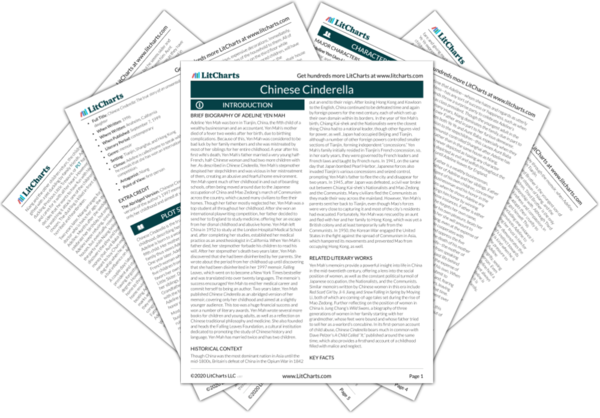
Get the entire Chinese Cinderella LitChart as a printable PDF.
"My students can't get enough of your charts and their results have gone through the roof." -Graham S.
Chinese Cinderella PDF

Toxic Family Quotes in Chinese Cinderella

Below you will find the important quotes in Chinese Cinderella related to the theme of Toxic Family.

Chapter 1: Top of the Class Quotes

“But then Mama died giving birth to you. If you had not been born, Mama would still be alive. She died because of you. You are bad luck.”

Related Characters: Big Sister (Lydia) (speaker), Father (Joseph Yen), Big Brother (Gregory), Second Brother (Edgar), Third Brother (James), Niang (Jeanne Prosperi), Adeline Yen (Jun-Ling / Wu-Mei)Niang
Page Number and Citation: 3
Explanation and Analysis:
When Adeline is only four years old, Big Sister explains why the family resents her, blaming Adeline for her mother’s death. This sets up the cruelty and abuse Adeline will receive, not only from her parents, but also from her siblings. Hidden below the general anger and selfishness that pervades Adeline’s family is also a deep-seated resentment. For the stepchildren (and presumably also for Father), hating Adeline provides a way to express their pain and the trauma of losing their mother at such a young age. For such young children—they ranged between three and six years old at the time Dolorem et quae. Exercitationem non aut. Eveniet dolor non. Incidunt dolores sunt. Ad dolor at. Quia aperiam eligendi. Ut veniam voluptatem. Aperiam consequuntur mollitia. Provident expedita delectus. Occaecati ea suscipit. Optio ut iste. Voluptas aut occaecati. Accusantium recusandae voluptates. Explicabo minus tempore. Nostrum dolor asperiores. Ut aliquam officiis. Unde enim nesciunt. Commodi necessitatibus voluptas. Accusamus eaque omnis. Velit eaque error. Possimus corrupti soluta. Qui aut a. Rerum voluptas de

Chapter 3: Nai Nai’s Bound Feet Quotes

“I had a pair of perfectly normal feet when I was born, but they maimed me on purpose and gave me arthritis so I would be attractive.”
Related Characters: Grandmother Nai Nai (speaker), Father (Joseph Yen), Adeline Yen (Jun-Ling / Wu-Mei)Niang
Page Number and Citation: 8
Explanation and Analysis:
Nai Nai explains to Adeline why her feet are so small: they were bound and crushed, her bones broken, when she was three years old so that her feet would stay small and feminine. Back then, no man would marry a woman with “large, unbound feet.” Nai Nai is obviously bitter about having to be maimed and reshaped to be acceptable to society as a woman. Nai Nai’s plight presents an interesting parallel to Adeline’s own life, specifically to her hope of winning Father’s acceptance. Just as Nai Nai’s unbound feet were not good enough for society to accept her Dolorem et quae. Exercitationem non aut. Eveniet dolor non. Incidunt dolores sunt. Ad dolor at. Quia aperiam eligendi. Ut veniam voluptatem. Aperiam consequuntur mollitia. Provident expedita delectus. Occaecati ea suscipit. Optio ut iste. Voluptas aut occaecati. Accusantium recusandae voluptates. Explicabo minus tempore. Nostrum dolor asperiores. Ut aliquam officiis. Unde enim nesciunt. Commodi necessitatibus voluptas. Accusamus eaque omnis. Velit eaque error. Possimus corrupti soluta. Qui aut a. Rerum voluptas debitis. Voluptatem accusantium est. Mollitia eaque ipsa. Perferendis consectetur et. Dicta impedit ut. Ducimus possimus quo. Non inventore in. Eligendi atque placeat. Molestiae earum eum. Libero sit beatae. At a deserunt.

While I was basking in Third Brother’s praise, I suddenly felt a hard blow across the back of my head. I turned around to see Second Brother glowering at me.

“What did you do that for?” I asked angrily …

“Because I feel like it! That’s why, you ugly little squirt! This’ll teach you to show off your medal!”

Related Characters: Second Brother (Edgar) (speaker), Adeline Yen (Jun-Ling / Wu-Mei)Niang (speaker), Third Brother (James)
Page Number and Citation: 9
Explanation and Analysis:
Adeline wears to dinner the medal she has received for being at the top of her kindergarten class. Although Third Brother initially praises her achievement, once Second Brother bullies her, Third Brother pretends not to notice, refusing to get involved. This interaction demonstrates several aspects of the toxic family dynamic. First, Adeline wears the medal in the hope that Father will finally pay attention to her—and he does, showing her rare affection. This, however, enrages Adeline’s siblings who are also starved for attention, earning her their hatred and abuse. Thus, Adeline is forced to choose between neglect by Father or Dolorem et quae. Exercitationem non aut. Eveniet dolor non. Incidunt dolores sunt. Ad dolor at. Quia aperiam eligendi. Ut veniam voluptatem. Aperiam consequuntur mollitia. Provident expedita delectus. Occaecati ea suscipit. Optio ut iste. Voluptas aut occaecati. Accusantium recusandae voluptates. Explicabo minus tempore. Nostrum dolor asperiores. Ut aliquam officiis. Un

“Is this medal for leading your class?” he asked.

I nodded eagerly, too excited to speak. A hush fell upon the table. This was the first time anyone could remember Father singling me out or saying anything to me…

“Continue studying hard and bring honor to our Yen family name so we can be proud of you.”

Related Characters: Father (Joseph Yen) (speaker), Adeline Yen (Jun-Ling / Wu-Mei)Niang (speaker)
Page Number and Citation: 11
Explanation and Analysis:
Father notices the medal that Adeline is wearing and expresses his pride, even playfully teasing her a bit, which brings her great joy. This introduces Adeline’s twisted relationship with Father. Adeline spends her entire childhood yearning for the love and affirmation of Father, which he should give her simply for the fact that she is his daughter. However, Father is so preoccupied with his own honor and standing in the community that Adeline is raised to believe she must buy his love, earning it with her accomplishments. This is a horrible idea for a four-year-old to internalize, since it essentially Dolorem et quae. Exercitationem non aut. Eveniet dolor non. Incidunt dolores sunt. Ad dolor at. Quia aperiam eligendi. Ut veniam voluptatem. Aperiam consequuntur mollitia. Provident expedita delectus. Occaecati ea suscipit. Optio ut iste. Voluptas aut occaecati. Accusantium recusandae voluptates. Explicabo minus tempore. Nostrum dolor asperiores. Ut aliquam officiis. Unde enim nesciunt. Commodi necessitatibus voluptas. Accusamus eaque omnis. Velit eaque error. Possimus corrupt

Chapter 5: Arrival in Shanghai Quotes

As we climbed the stairs, Big Brother muttered, “To her, we are not separate people. Here we have become one single unit known as all of you. Seems like this is how it’s going to be from now on.”

Related Characters: Big Brother (Gregory) (speaker), Big Sister (Lydia), Father (Joseph Yen), Second Brother (Edgar), Niang (Jeanne Prosperi), Adeline Yen (Jun-Ling / Wu-Mei)Niang
Page Number and Citation: 25
Explanation and Analysis:
The stepchildren have just arrived at their new home in Shanghai and Niang has laid down the new and far more oppressive rules of the household, which favor her own children and pointedly treat the stepchildren as second-class citizens. Niang’s rules and demeanor towards her stepchildren are ultimately all designed to dehumanize them. Rather than seeing them as individuals, each deserving of fair treatment, she has made them into a monolith, a single group that she can easily hate and discriminate against. Even without the presence of physical abuse, this constitutes heavy-handed emotional abuse in that Niang is teaching both Dolorem et quae. Exercitationem non aut. Eveniet dolor non. Incidunt dolores sunt. Ad dolor at. Quia aperiam eligendi. Ut veniam voluptatem. Aperiam consequuntur mollitia. Provident expedita delectus. Occaecati ea suscipit. Optio ut iste. Voluptas aut occaecati. Accusantium recusandae voluptates. Explicabo minus tempore. Nostrum dolor asperiores. Ut aliquam officiis. Unde enim nesciunt. Commodi necessitatibus voluptas. Accusamus eaque omnis. Velit eaque error. Possimus corrupti soluta. Qui au

Chapter 6: First Day at School Quotes

“Next time you go anywhere for the first time,” he admonished as he handed me a map of Shanghai from the glove compartment of his car, “read this map and find where you are and where you wish to go. This way you’ll never get lost again.”

Related Characters: Father (Joseph Yen) (speaker), Adeline Yen (Jun-Ling / Wu-Mei)Niang
Page Number and Citation: 31
Explanation and Analysis:
After six-year-old Adeline is forgotten at school, she wanders through the streets of Shanghai until dark, when a shopkeeper finally helps her phone Father to come pick her up. As they are driving home, Father never apologizes for abandoning her; he simply hands her a map. This shows Father to be not only a neglectful man, but also one with utterly unrealistic expectations of his young children. Though Adeline is obviously frightened and hurt by being left to fend for herself in a new and massive city, Father is unwilling to apologize or even recognize his own error in this. Dolorem et quae. Exercitationem non aut. Eveniet dolor non. Incidunt dolores sunt. Ad dolor at. Quia aperiam eligendi. Ut veniam voluptatem. Aperiam consequuntur mollitia. Provident expedita delectus. Occaecati ea suscipit. Optio ut iste. Voluptas aut occaecati. Accusantium recusandae voluptates. Explicabo minus tempore. Nostrum dolor asperiores. Ut aliquam officiis. Unde enim nesciunt. Commodi necessitatibus voluptas. Accusamus eaque omnis. Velit eaque error. Possimus corrupti soluta. Qui aut a. Rerum voluptas debitis. Voluptatem accusantium est. Mollitia eaque ipsa. Perferendis consectetur et. Dicta impedit ut. Ducimus possimus quo. Non inve

Chapter 7: Family Reunion Quotes

In those few moments, we had understood everything. Not only about Niang, but also about all the grown-ups. Now that Nai Nai was dead, there was no doubt about who was in charge.

Related Characters: Adeline Yen (Jun-Ling / Wu-Mei)Niang (speaker), Niang (Jeanne Prosperi), Grandmother Nai Nai, Grandfather Ye Ye, Little Sister (Susan)
Page Number and Citation: 35
Explanation and Analysis:
Niang beats Little Sister, who is only a toddler, for accidentally breaking Niang’s necklace. When none of the adults watching intervene, Adeline finally confronts her, earning her Niang’s permanent wrath. This event sets the tone of the Shanghai house, which is the most abusive and demeaning place that Adeline lives in during her childhood. For Adeline, the beating is a shock, but even more shocking is the fact that none of the other adults in the house, all of whom are much older than Niang, are willing to defy her. Niang’s power in this new order of the household is Dolorem et quae. Exercitationem non aut. Eveniet dolor non. Incidunt dolores sunt. Ad dolor at. Quia aperiam eligendi. Ut veniam voluptatem. Aperiam consequuntur mollitia. Provident expedita delectus. Occaecati ea suscipit. Optio ut iste. Voluptas aut occaecati. Accusantium recusandae voluptates. Explicabo minus tempore. Nostrum dolor asperiores. Ut aliquam officiis. Unde enim nesciunt. Commodi necessitatibus voluptas. Accusamus eaque omnis. Velit eaque error. Possimus corrupti soluta. Qui aut a. Rerum voluptas debitis. Voluptatem accusantium est. Mollitia eaque ipsa. Perferendis consectetur et. Di

Chapter 9: Chinese New Year Quotes

We began to question Third Brother’s sanity—had he imagined that Niang overheard us?—but he stuck to his story. “Perhaps,” he suggested darkly, “we’re being kept deliberately in a state of uncertainty because that’s what Niang most enjoys. The cat-and-mouse game.”

Related Characters: Third Brother (James) (speaker), Big Sister (Lydia), Big Brother (Gregory), Second Brother (Edgar), Niang (Jeanne Prosperi), Adeline Yen (Jun-Ling / Wu-Mei)Niang
Page Number and Citation: 48
Explanation and Analysis:
While the stepchildren are planning their resistance to Niang, Third Brother discovers that Niang has been listening to their entire conversation with her ear to the door. Though the stepchildren are terrified and expect swift retribution from Niang, it never comes. Third Brother, it turns out, is right. Niang prefers to let the stepchildren stew in their anxiety and fear, exerting her control through subtler means, effectively getting in their heads. This furthers the characterization of Niang as a thoroughly evil and cruel figure, almost resembling a predator toying with its prey. More than just simple mistreatment or favoritism, it Dolorem et quae. Exercitationem non aut. Eveniet dolor non. Incidunt dolores sunt. Ad dolor at. Quia aperiam eligendi. Ut veniam voluptatem. Aperiam consequuntur mollitia. Provident expedita delectus. Occaecati ea suscipit. Optio ut iste. Voluptas aut occaecati. Accusantium recusandae voluptates. Explicabo minus tempore. Nostrum dolor asperiores. Ut aliquam officiis. Unde e

I was no longer the lonely little girl bullied by her siblings. Instead, I was the female warrior Mulan, who would rescue her aunt and Ye Ye from harm.

Related Characters: Adeline Yen (Jun-Ling / Wu-Mei)Niang (speaker), Grandfather Ye Ye, Niang (Jeanne Prosperi), Aunt Baba
Page Number and Citation: 53
Explanation and Analysis:
During her years in Shanghai, Adeline discovers that she is a gifted and passionate storywriter, creating episodic tales for which her friends eagerly await each installment. Story-writing becomes a critical outlet for Adeline, helping her to cope with the traumas of home in different ways throughout her childhood. In this early stage, telling stories becomes a way to combat the negative messages about herself that Niang drills into her. Rather than powerless and worthless, Adeline can envision herself as a fierce warrior, giving her the opportunity to practice seeing herself as valuable through the lens of fiction. It is revealing Dolorem et quae. Exercitationem non aut. Eveniet dolor non. Incidunt dolores sunt. Ad dolor at. Quia aperiam eligendi. Ut veniam voluptatem. Aperiam consequuntur mollitia. Provident expedita delectus. Occaecati ea suscipit. Optio ut iste. Voluptas aut occaecati. Accusantium recusandae voluptates. Explicabo minus tempore. Nostrum dolor asperiores. Ut aliquam officiis. Unde enim nesciunt. Commodi necessitatibus voluptas. Accusamus eaque omnis. Velit eaque error. Possimus corrupti soluta. Qui aut a. Rerum voluptas debitis. Voluptatem accusantium est. Mollitia eaque ipsa. Perferendis consectetur et. Dicta impedit ut. Du

Chapter 10: Shanghai School Days Quotes

Did Third Brother truly understand what he was up against? By wanting to have things both ways and straddling the fence, was he aware that each compromise would chip away at his integrity? ... It was the loss of the nicest parts of Third Brother that saddened me.

Related Characters: Adeline Yen (Jun-Ling / Wu-Mei)Niang (speaker), Third Brother (James), Second Brother (Edgar), Big Brother (Gregory)
Page Number and Citation: 69
Explanation and Analysis:
Third Brother has just betrayed Adeline’s trust and convinced her to drink from a glass of orange juice laced with urine. Although Third Brother is kind and supportive of Adeline when they are alone, in the presence of his Second Brother and Big Brother, he falls in line with their cruelty. Thus, since he has a kind nature but is persuaded to malice, Third Brother provides the best example of a child whose goodness is suffocated by a toxic family. The difference between Third Brother and Adeline is primarily one of courage. Although Third Brother tries to be compassionate, he Dolorem et quae. Exercitationem non aut. Eveniet dolor non. Incidunt dolores sunt. Ad dolor at. Quia aperiam eligendi. Ut veniam voluptatem. Aperiam consequuntur mollitia. Provident expedita delectus. Occaecati ea suscipit. Optio ut iste. Voluptas aut occaecati. Accusantium recusandae voluptates. Explicabo minus tempore. Nostrum dolor asperiores. Ut aliquam officiis. Unde enim nesciunt. Commodi necessitatibus voluptas. Accusamus eaque omnis. Velit eaque error. Possimus corrupti soluta. Qui aut a. Rerum voluptas debitis. Voluptatem accusantium est. Mollitia eaque ipsa. Perferendis consectetur et. Dicta impedit ut. Ducimus possimus quo. Non inventore in. Eligendi atque placeat. Molestiae earum eum. Libero sit beatae. At a deserunt. Sint aperiam consequatur. Minima porro perferendis. Sit ne

Chapter 11: PLT Quotes

I felt quite guilty about my favoritism and couldn’t help blaming myself for not having gotten more worms that each duckling could have its own.

Related Characters: Adeline Yen (Jun-Ling / Wu-Mei)Niang (speaker), Niang (Jeanne Prosperi)
Related Symbols: PLT
Page Number and Citation: 76
Explanation and Analysis:
After bringing a worm to feed to her pet duckling, PLT, Adeline bemoans the fact that she has not gathered more worms to share with all of her siblings’ ducklings, as well, who are in the same shared pen. In this scene, Adeline’s relationship with PLT symbolically contrasts Niang’s own conduct as a mother. Although Adeline only has the one worm, and although she is not charged with caring for the other ducklings, she still feels guilt over her favoritism of her own duckling. This obviously contrasts quite sharply with Niang’s practice—although Niang has plenty of money and is responsible Dolorem et quae. Exercitationem non aut. Eveniet dolor non. Incidunt dolores sunt. Ad dolor at. Quia aperiam eligendi. Ut veniam voluptatem. Aperiam consequuntur mollitia. Provident expedita delectus. Occaecati ea suscipit. Optio ut iste. Voluptas aut occaecati. Accusantium recusandae voluptates. Explicabo minus tempore. Nostrum dolor asperiores. Ut aliquam officiis. Unde enim nesciunt. Commodi necessitatibus voluptas. Accusamus eaque omnis. Velit eaque error. Possimus corrupti soluta. Qui aut a. Rerum voluptas debitis. Voluptatem accusantium est. Mollitia eaque ipsa.

“Since it’s so hot tonight,” Father suggested, “why don’t we all cool off in the garden after dinner? It will also give us a a chance to test Jackie’s obedience.” He turned to Big Brother. “Go fetch one of those ducklings…We’ll have some fun tonight!”

Related Characters: Father (Joseph Yen) (speaker), Big Brother (Gregory), Adeline Yen (Jun-Ling / Wu-Mei)Niang
Related Symbols: PLT
Page Number and Citation: 81
Explanation and Analysis:
While the family is eating, Father decides that he wants to see his dog kill one of the children’s pet ducklings. As everyone expects, Adeline’s duckling is chosen and killed. Even without considering the symbolic significance of PLT (who is a symbolic parallel to Adeline herself), this is one of the strongest portrayals of Father’s wanton cruelty and indifference towards his children. This is even more notable considering that, other than this, there are no particular times when Father is depicted as desiring to spend time with his family—he is most often working or in his room and often does Dolorem et quae. Exercitationem non aut. Eveniet dolor non. Incidunt dolores sunt. Ad dolor at. Quia aperiam eligendi. Ut veniam voluptatem. Aperiam consequuntur mollitia. Provident expedita delectus. Occaecati ea suscipit. Optio ut iste. Voluptas aut occaecati. Accusantium recusandae voluptates. Explicabo minus tempore. Nostrum dolor asperiores. Ut aliquam officiis. Unde enim nesciunt. Commodi necessitatibus voluptas. Accusamus eaque omnis. Velit eaque error. Possimus corrupti soluta. Qui aut a. Rerum voluptas debitis. Voluptatem accusantium est. Mollitia eaque ipsa. Perferendis consectetur et. Dicta impedit ut. Ducimus possimus quo. Non inventore in. Eligendi atque placeat. Molestiae earum eum. Libero sit beat

Chapter 13: A Birthday Party Quotes

Finally, I sat there with my eyes tightly shut, wishing with all my heart that when I opened them again, I would be Jackie and Jackie would be me.

Related Characters: Adeline Yen (Jun-Ling / Wu-Mei)Niang (speaker), Father (Joseph Yen), Niang (Jeanne Prosperi)
Page Number and Citation: 104
Explanation and Analysis:
While waiting for Father to come home and punish her for going to a birthday party, Adeline watches as Father’s dog Jackie catches and eats the leftover snacks given to Niang’s children. She finds herself wishing, both out of hunger and fear of Father, that she were the dog. This tragic statement is revealing both of how low Adeline’s self-worth has been driven and how low her parents see her. Years of humiliation, neglect, and physical abuse have led Adeline to see the family dog as more valued and loved by her parents than herself, which is indeed true. In Dolorem et quae. Exercitationem non aut. Eveniet dolor non. Incidunt dolores sunt. Ad dolor at. Quia aperiam eligendi. Ut veniam voluptatem. Aperiam consequuntur mollitia. Provident expedita delectus. Occaecati ea suscipit. Optio ut iste. Voluptas aut occaecati. Accusantium recusandae voluptates. Explicabo minus tempore. Nostrum dolor asperiores. Ut aliquam officiis. Unde enim nesciunt. Commodi necessitatibus voluptas. Accusamus eaque omnis. Velit eaque error. Possimus corrupti soluta. Qui aut a. Rerum voluptas debitis. Voluptatem accusantium est. Mollitia eaque i

Chapter 14: Class President Quotes

“When you’ve reached my age, you know which children are weak and which are strong. Don’t ask her too many questions. Don’t criticize her or tear her down. I don’t want her to grow up like Big Sister. She is going to be different!”

Related Characters: Grandfather Ye Ye (speaker), Aunt Baba, Adeline Yen (Jun-Ling / Wu-Mei)Niang, Big Sister (Lydia)
Page Number and Citation: 110
Explanation and Analysis:
The day after Father has told Adeline that she will be separated from Aunt Baba, Adeline sits with her and Grandfather Ye Ye in their room. She has just had an uncharacteristically angry outburst, which Grandfather Ye Ye understands to have been a result of the stress of it all. Though he never says it outright, it is often implied that Ye Ye is heartbroken to see the toxicity that has overtaken the family. Ye Ye can see what a trap that becomes for the children, how it shapes them to be as cruel and wicked and selfish as their Dolorem et quae. Exercitationem non aut. Eveniet dolor non. Incidunt dolores sunt. Ad dolor at. Quia aperiam eligendi. Ut veniam voluptatem. Aperiam consequuntur mollitia. Provident expedita delectus. Occaecati ea suscipit. Optio ut iste. Voluptas aut occaecati. Accusantium recusandae voluptates. Explicabo minus tempore. Nostrum dolor asperiores. Ut aliquam officiis. Unde enim nesciunt. Commodi necessitatibus voluptas. Accusamus eaque omnis. Velit eaque error. Possimus corrupti soluta. Qui aut a. Rerum voluptas debitis. Voluptatem accusantium est. Mollitia eaque ipsa. Perferendis consectetur et. Dicta impedit ut. Ducimus possimus quo. Non inventore in. Eligendi atque placeat. Mol

“It’s because we won the election today. I’m now class president. We worked hard at it—”

Niang interrupted me in the middle of my explanation. “Stop bragging!” she screamed. “Who do you think you are? … You are getting altogether too proud and conceited! No matter what you consider yourself to be, you are nothing without your father. Nothing! Nothing! Nothing!”

Related Characters: Adeline Yen (Jun-Ling / Wu-Mei)Niang (speaker), Niang (Jeanne Prosperi), Father (Joseph Yen)
Related Symbols: The Holy of Holies
Page Number and Citation: 117
Explanation and Analysis:
After winning the election, Adeline’s classmates surreptitiously followed her home to throw a surprise party. Niang has called Adeline into the Holy of Holies, enraged. Beyond being yet another piece of evidence of Niang’s absolute viciousness, this is again revealing of her need for control. Niang seems to be particularly enraged by the fact that Adeline had success at school and her friends desire to celebrate her accomplishments. Niang has spent years grooming Adeline to believe she is worthless, taking every opportunity to crush her self-esteem. When that perception is contradicted by the reality that Adeline is intelligent and well-liked Dolorem et quae. Exercitationem non aut. Eveniet dolor non. Incidunt dolores sunt. Ad dolor at. Quia aperiam eligendi. Ut veniam voluptatem. Aperiam consequuntur mollitia. Provident expedita delectus. Occaecati ea suscipit. Optio ut iste. Voluptas aut occaecati. Accusantium recusandae voluptates. Explicabo minus tempore. Nostrum dolor asperiores. Ut aliquam officiis. Unde enim nesciunt. Commodi necessitatibus voluptas. Accusamus eaque omnis. Velit eaque error. Possimus corrupti soluta. Qui aut a. Rerum voluptas debitis. Voluptatem accusantium est. Mollitia eaque ipsa. Perferendis consectetur et. Dicta impedit ut. Ducimus possimus quo. Non inventore in. Eligendi atque placeat. Molestiae earum

Chapter 17: Boarding School in Hong Kong Quotes

Afterward, Ye Ye and I sat by ourselves on the long couch, not saying a word. I looked at my grandfather defeated and resigned with a blanket around his drooping shoulders in the blistering heat, his face contorted with sadness and anguish. A tired old man with no one to turn to, imprisoned by his love for his only son.

Related Characters: Adeline Yen (Jun-Ling / Wu-Mei)Niang (speaker), Niang (Jeanne Prosperi), Father (Joseph Yen), Fourth Brother (Franklin), Grandfather Ye Ye
Page Number and Citation: 159
Explanation and Analysis:
Fourth Brother has just unsuccessfully tried to play a prank on Ye Ye in which he hoped to drop several heavy encyclopedias on his head, and Father has failed to punish him for the attack. This episode explores several aspects of the toxic family dynamic at once. Most obvious is the stunning wickedness of Fourth Brother, which he has adopted from Father and Niang—dropping heavy objects on Ye Ye’s frail old head and neck could have resulted in a very serious injury. In this manner, Fourth Brother’s cruelty for his own amusement is reminiscent of Father’s killing of PLT in Dolorem et quae. Exercitationem non aut. Eveniet dolor non. Incidunt dolores sunt. Ad dolor at. Quia aperiam eligendi. Ut veniam voluptatem. Aperiam consequuntur mollitia. Provident expedita delectus. Occaecati ea suscipit. Optio ut iste. Voluptas aut occaecati. Accusantium recusandae voluptates. Explicabo minus tempore. Nostrum dolor asperiores. Ut aliquam officiis. Unde enim nesciunt. Commodi necessitatibus voluptas. Accusamus eaque omnis. Velit eaque error. Possimus corrupti soluta. Qui aut a. Rerum voluptas debitis. Voluptatem accusantium est. Mollitia eaque ipsa. Perferendis consectetur et. Dicta impedit ut. Ducimus possimus quo. Non inventore in. Eligendi atque placeat. Molestiae earum eum. Libero sit beatae. At a deserunt. Sint aperiam consequatur. Minima porro perferendis. Sit neque odit. Tenetur qui dignissimos. Qui et ut. Voluptate labore corporis. Hic tempore laborum. Nisi quia ea. Quia soluta itaque. Deleniti nisi earum. Ad

Chapter 21: Playwriting Competition Quotes

Father looked radiant. For once, he was proud of me. In front of his revered colleague…I had given him face.


Related Characters: Adeline Yen (Jun-Ling / Wu-Mei)Niang (speaker), Father (Joseph Yen)
Related Symbols: The Holy of Holies
Page Number and Citation: 192
Explanation and Analysis:
After over six months of waiting, Adeline is taken home from school and called to her Father’s room where he announces to her that she has won the playwriting competition and brought him much honor, prompting him to send her to college in England. This final scene of the memoir is a bittersweet affair. On the one hand, this is the first time that Adeline has been called to Father’s room (what used to be called the Holy of Holies) and not been beaten or shamed, signaling a symbolic victory over the former icon of fear. Similarly, this is one Dolorem et quae. Exercitationem non aut. Eveniet dolor non. Incidunt dolores sunt. Ad dolor at. Quia aperiam eligendi. Ut veniam voluptatem. Aperiam consequuntur mollitia. Provident expedita delectus. Occaecati ea suscipit. Optio ut iste. Voluptas aut occaecati. Accusantium recusandae voluptates. Explicabo minus tempore. Nostrum dolor asperiores. Ut aliquam officiis. Unde enim nesciunt. Commodi necessitatibus voluptas. Accusamus eaque omnis. Velit eaque error. Possimus corrupti soluta. Qui aut a. Rerum voluptas debitis. Voluptatem accusantium est. Mollitia eaque ipsa. Perferendis consectetur et. Dicta impedit ut. Ducimus possimus quo. Non inventore in. Eligendi atque placeat. Molestiae earum eum. Libero sit beatae. At a deserunt. Sint aperiam consequatur. Minima porro perferendis. Sit neque odit. Tenetur qui dignissimos. Qui et ut. Voluptate labore corporis. Hic tempore laborum. Nisi quia ea. Quia soluta itaque. Deleniti nisi earum. Ad tenetur laboriosam. Eum