

Do Androids Dream of Electric Sheep?
by Philip K. Dick
✓

or to save your progress

Humanity and Empathy Theme Analysis

Themes and Colors
Humanity and Empathy Theme Icon
Reality vs. Artificiality Theme Icon
Alienation Theme Icon
Religion and Faith Theme Icon
Consumerism Theme Icon
LitCharts assigns a color and icon to each theme in Do Androids Dream of Electric Sheep?, which you can use to track the themes throughout the work.
Humanity and Empathy Theme Icon

Do Androids Dream of Electric Sheep? suggests that empathy is humanity’s defining trait, contrasting it against the emotional detachment of androids. In the novel, empathy is closely tied to the concept of Mercerism, a shared religious experience that allows people to unite and experience mutual suffering. By fusing with Mercer, the religion’s messianic figurehead, people feel others’ pain. The fact that having this opportunity to experience empathy is the entire point of Mercerism speaks to what the novel suggests is a normal human desire for empathy. This contrasts starkly with androids, who lack the capacity for genuine empathy and often engage in cruel, detached behaviors, such as Pris’s mutilation of a spider in front of John Isidore. Indeed, the tests designed to identify androids specifically aim to show that an android does not have empathy, initially setting up a clear distinction between empathetic humans and detached androids.

However, Rick Deckard’s internal conflict highlights the fragility of this distinction. As a bounty hunter tasked with “retiring” Nexus-6 androids, Rick struggles with feelings of guilt and confusion, particularly after his interactions with the androids Rachael Rosen and Luba Luft. Luba’s love for art and Rachael’s sexuality blur the line between android and human, forcing Rick to question whether empathy can exist in artificial beings and whether his own emotional detachment diminishes his humanity. Conversely, John Isidore, a “special” ostracized by society, displays profound empathy, even for the androids exploiting him. His kindness, coupled with his attachment to the mutilated spider, elevates him as a moral counterpoint to Rick, illustrating that even those deemed “lesser” by societal standards can embody humanity’s core trait. Ultimately, the novel suggests that while the capacity to feel empathy defines humanity, it also makes it clear that the capacity to feel empathy doesn’t guarantee that a person will be empathetic.

Related Themes from Other Texts
Compare and contrast themes from other texts to this theme…

Humanity and Empathy ThemeTracker

The ThemeTracker below shows where, and to what degree, the theme of Humanity and Empathy appears in each chapter of Do Androids Dream of Electric Sheep?. Click or tap on any chapter to read its Summary & Analysis.
How often theme appears:
chapter length:
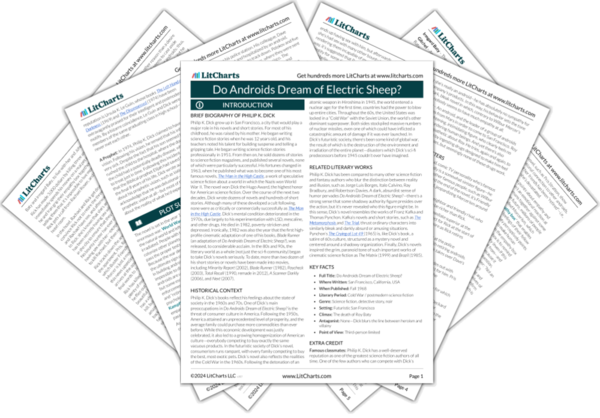
Get the entire Do Androids Dream of Electric Sheep? LitChart as a printable PDF.
"My students can't get enough of your charts and their results have gone through the roof." -Graham S.
Do Androids Dream of Electric Sheep? PDF

Humanity and Empathy Quotes in Do Androids Dream of Electric Sheep?

Below you will find the important quotes in Do Androids Dream of Electric Sheep? related to the theme of Humanity and Empathy.

Chapter 1 Quotes

“I can’t dial a setting that stimulates my cerebral cortex into wanting to dial! If I don’t want to dial, I don’t want to dial that most of all, because then I will want to dial, and wanting to dial is right now the most alien drive I can imagine; I just want to sit here on the bed and stare at the floor.” Her voice had become sharp with overtones of bleakness as her soul congealed and she ceased to move, as the instinctive, omnipresent film of great weight, of an almost absolute inertia, settled over her.


Related Characters: Iran Deckard (speaker), Rick Deckard
Page Number and Citation: 6
Explanation and Analysis:
Here, Rick and Iran are arguing over the use of the mood organ. Rick wants Iran to change her mood organ to make her have a more positive outlook, but she refuses. Iran’s outburst encapsulates her rejection of artificial stimulation, emphasizing her desire for authenticity even in negative emotions. The recursive logic in her statement—refusing to dial because she doesn’t want to, and rejecting the very act of wanting to dial—shows her resistance to relinquishing control over her emotional state to a machine. This rebellion highlights her struggle against the pervasive artificiality of their world, where even emotions are regulated Dolorem et quae. Exercitationem non aut. Eveniet dolor non. Incidunt dolores sunt. Ad dolor at. Quia aperiam eligendi. Ut veniam voluptatem. Aperiam consequuntur mollitia. Provident expedita delectus. Occaecati ea suscipit. Optio ut iste. Voluptas aut occaecati. Accusantium recusandae voluptates. Explicabo minus tempore. Nostrum dolor asperiores. Ut aliquam officiis. Unde enim nesciunt. Commodi necessitatibus voluptas. Accusamus eaque omnis. Velit eaque error. Possimus corrupti soluta. Qui aut a. Rerum voluptas debitis. Voluptatem accusanti

Chapter 2  Quotes

In addition, no one today remembered why the war had come about or who, if anyone, had won. The dust which had contaminated most of the planet’s surface had originated in no country and no one, even the wartime enemy, had planned on it. First, strangely, the owls had died. At the time it had seemed almost funny, the fat, fluffy white birds lying here and there, in yards and on streets; coming out no earlier than twilight as they had while alive the owls escaped notice. Medieval plagues had manifested themselves in a similar way, in the form of many dead rats. This plague, however, had descended from above.


Related Symbols: Animals
Page Number and Citation: 15
Explanation and Analysis:
This passage about World War Terminus strips away the grandeur and purpose often associated with war, replacing it with a sense of futility and irreversible destruction. The inability to recall the war’s cause or victor shows the question’s insignificance in the face of its aftermath. Human conflict is shown not as a driver of progress but as a destructive force that leaves behind questions rather than answers, and devastation rather than a definitive answer on whose worldview is best. The dust, emerging from no single identifiable place, erases the boundaries between countries and regions, turning the entire planet into a Dolorem et quae. Exercitationem non aut. Eveniet dolor non. Incidunt dolores sunt. Ad dolor at. Quia aperiam eligendi. Ut veniam voluptatem. Aperiam consequuntur mollitia. Provident expedita delectus. Occaecati ea suscipit. Optio ut iste. Voluptas aut occaecati. Accusantium recusandae voluptates. Explicabo minus tempore. Nostrum dolor asperiores. Ut aliquam officiis. Unde enim nesciunt. Commodi necessitatibus voluptas. Accusamus eaque omnis. Velit eaque error. Possimus corrupti soluta. Qui aut a. Rerum voluptas debitis. Voluptatem accusantium est. Mollitia eaque ipsa. Perferendis consectetur et. Dicta impedit ut. Ducimus possimus quo. Non inventore in. Eligendi atque placeat. Molestiae earum eum. Libero sit beatae. At a des

He wondered, then, if the others who had remained on Earth experienced the void this way. Or was it peculiar to his peculiar biological identity, a freak generated by his inept sensory apparatus? Interesting question, Isidore thought. But whom could he compare notes with? He lived alone in this deteriorating, blind building of a thousand uninhabited apartments, which like all its counterparts, fell, day by day, into greater entropic ruin. Eventually everything within the building would merge, would be faceless and identical, mere pudding-like kipple piled to the ceiling of each apartment. And, after that, the uncared-for building itself would settle into shapelessness, buried under the ubiquity of the dust. By then, naturally, he himself would be dead, another interesting event to anticipate as he stood here in his stricken living room atone with the lungless, all-penetrating, masterful world-silence.

Related Characters: John Isidore
Page Number and Citation: 20
Explanation and Analysis:
This passage describes John Isidore’s existential despair, blending his personal isolation with the broader decay of the world around him. His speculation about the void—whether it is uniquely tied to his biological makeup or a universal experience—reveals a profound sense of alienation. The void is both a literal silence in his environment and a metaphor for the absence of meaning, connection, and vitality in his life. Isidore’s inability to “compare notes” with anyone indicates his total solitude, demonstrates how the remnants of human society have splintered into isolated, disconnected fragments. The description of the building’s decline mirrors the entropy of Dolorem et quae. Exercitationem non aut. Eveniet dolor non. Incidunt dolores sunt. Ad dolor at. Quia aperiam eligendi. Ut veniam voluptatem. Aperiam consequuntur mollitia. Provident expedita delectus. Occaecati ea suscipit. Optio ut iste. Voluptas aut occaecati. Accusantium recusandae voluptates. Explicabo minus tempore. Nostrum dolor asperiores. Ut aliquam officiis. Unde

Chapter 3 Quotes

“Harry still wants the Nexus-6 brain unit withdrawn from the market?” He felt no surprise. Since the initial release of its specifications and performance charts back in August of 1991 most police agencies which dealt with escaped andys had been protesting. “The Soviet police can’t do any more than we can,” he said. Legally, the manufacturers of the Nexus-6 brain unit operated under colonial law, their parent auto-factory being on Mars. “We had better just accept the new unit as a fact of life,” he said. “It’s always been this way, with every improved brain unit that’s come along. I remember the howls of pain when the Sudermann people showed their old T-14 back in ‘89. Every police agency in the Western Hemisphere clamored that no test would detect its presence, in an instance of illegal entry here. As a matter of fact, for a while they were right.”

Related Characters: Rick Deckard (speaker), Harry Bryant, Ann Marsten
Page Number and Citation: 27-28
Explanation and Analysis:
This quote—a conversation between Rick and his secretary, Ann—captures Rick’s weary acknowledgment of the unstoppable march of technology and its impact on his profession. The protests against the Nexus-6 brain unit, which he notes have been consistent across police agencies globally, signify a recurring failure of human systems to contain artificial advancements. Rick’s reference to the Soviet police struggling as much as their Western counterparts eliminates any notion of this being a localized issue—it is a universal consequence of humanity’s pursuit of ever-evolving synthetic intelligence. His pragmatic and detached tone paints a picture of a man who has long accepted Dolorem et quae. Exercitationem non aut. Eveniet dolor non. Incidunt dolores sunt. Ad dolor at. Quia aperiam eligendi. Ut veniam voluptatem. Aperiam consequuntur mollitia. Provident expedita delectus. Occaecati ea suscipit. Optio ut iste. Voluptas aut occaecati. Accusantium recusan

He had wondered as had most people at one time or another precisely why an android bounced helplessly about when confronted by an empathy-measuring test. Empathy, evidently, existed only within the human community, whereas intelligence to some degree could be found throughout every phylum and order including the arachnids. For one thing, the emphatic faculty probably required an unimpaired group instinct; a solitary organism, such as a spider, would have no use for it; in fact it would tend to abort a spider’s ability to survive. It would make him conscious of the desire to live on the part of his prey. Hence all predators, even highly developed mammals such as cats, would starve.

Related Characters: Rick Deckard, John Isidore, Pris Stratton
Related Symbols: Animals
Page Number and Citation: 29
Explanation and Analysis:
This passage suggests that Rick views empathy as a uniquely human trait, rooted in social instinct, while solitary and/or predatory beings like spiders and cats lack it because it would hinder survival. His comparison of androids to predators implies that their inability to feel empathy is a functional limitation, not a flaw, aligning them with nature’s design rather than human values. However, this perspective reveals Rick’s bias—he frames empathy as the ultimate marker of humanity while ignoring its contextual limitations and evolutionary roots. By defining androids as “less than” because they lack human-style empathy, Rick overlooks their complexity and the Dolorem et quae. Exercitationem non aut. Eveniet dolor non. Incidunt dolores sunt. Ad dolor at. Quia aperiam eligendi. Ut veniam voluptatem. Aperiam consequuntur mollitia. Provident expedita delectus. Occaecati ea suscipit. Optio ut iste. Voluptas aut occaecati. Accusantium recusandae voluptates. Explicabo minus tempore. Nostrum dolor asperiores. Ut aliquam officiis. Unde enim nesciunt. Commodi necessitatibus voluptas. Accusamus eaque omnis. Velit eaque error. Possimus corrupti soluta. Qui aut a. Rerum voluptas debitis. Voluptatem accusantium est. Mollitia eaque ipsa. Perferendis consectetur et. Dicta impedit ut. Ducimus possimus quo. Non inventore in. Eligendi atque placeat. Molestiae earum eum. Libero sit beatae. At a deserunt. Sint aperiam consequatur. Minima porro perferendis. Sit neque odit. Tenetur qui dignissimos. Qui et ut. Voluptate labore corporis. Hic tempore laborum. Nisi quia ea. Quia soluta itaque. Deleniti nisi earum. Ad tenetur laboriosam. Eum accusamus

Chapter 4 Quotes

He thought, too, about his need for a real animal; within him an actual hatred once more manifested itself toward his electric sheep, which he had to tend, had to care about, as if it lived. The tyranny of an object, he thought. It doesn’t know I exist. Like the androids, it had no ability to appreciate the existence of another. He had never thought of this before, the similarity between an electric animal and an andy. The electric animal, he pondered, could be considered a subform of the other, a kind of vastly inferior robot. Or, conversely, the android could be regarded as a highly developed, evolved version of the ersatz animal. Both viewpoints repelled him.

Related Characters: Rick Deckard
Related Symbols: Animals
Page Number and Citation: 40-41
Explanation and Analysis:
While visiting the Rosen Association, Rick sees what he believes are live animals (he later learns they are artificial), and they remind him of his desire for a real animal. This moment explores Rick’s increasing frustration with the artificial constructs that dominate his existence, particularly his electric sheep. His resentment stems from the sheep’s inability to reciprocate care or acknowledge his presence, forcing him into a one-sided relationship with it. The sheep becomes a symbol of the artificiality that surrounds him, leaving Rick to grapple with the futility of investing emotion into something incapable of returning it. By placing the Dolorem et quae. Exercitationem non aut. Eveniet dolor non. Incidunt dolores sunt. Ad dolor at. Quia aperiam eligendi. Ut veniam voluptatem. Aperiam consequuntur mollitia. Provident expedita delectus. Occaecati ea suscipit. Optio ut iste. Voluptas aut occaecati. Accusantium recusandae voluptates. Explicabo minus tempore. Nostrum dolor asperiores. Ut aliquam officiis. Unde enim nesciunt. Commodi necessitatibus voluptas. Accusamus eaque omnis. Velit eaque error. Possimus corrupti soluta. Qui aut a. Rerum voluptas debitis. Voluptatem accusant

Chapter 5 Quotes

He could not make out, even now, how the Rosen Association had managed to snare him, and so easily. Experts, he realized. A mammoth corporation like this—it embodies too much experience. It possesses in fact a sort of group mind. And Eldon and Rachael Rosen consisted of spokesmen for that corporate entity. His mistake, evidently, had been in viewing them as individuals. It was a mistake he would not make again.

Related Characters: Eldon Rosen, Rachael Rosen, Rick Deckard
Page Number and Citation: 52
Explanation and Analysis:
This passage describes Rick’s growing awareness of the Rosen Association’s power, particularly its ability to operate as a collective force rather than as a group of individual people and androids. The corporation’s “group mind” mirrors the androids it produces—entities designed for functionality and unity, lacking the individuality that defines humans. Just as the Rosen Association uses its collective experience to manipulate Rick, its products embody the same principle, emphasizing efficiency over autonomy. This parallel suggests that the androids are extensions of the corporation’s ethos, tools created to serve its broader goals rather than exist as independent beings. The implications extend Dolorem et quae. Exercitationem non aut. Eveniet dolor non. Incidunt dolores sunt. Ad dolor at. Quia aperiam eligendi. Ut veniam voluptatem. Aperiam consequuntur mollitia. Provident expedita delectus. Occaecati ea suscipit. Optio ut iste. Voluptas aut occaecati. Accusantium recusandae voluptates. Explicabo minus tempore. Nostrum dolor asperiores. Ut aliquam officiis. Unde enim nes

Chapter 6 Quotes

“No one can win against kipple,” he said, “except temporarily and maybe in one spot, like in my apartment I’ve sort of created a stasis between the pressure of kipple and nonkipple, for the time being. But eventually I’ll die or go away, and then the kipple will again take over. It’s a universal principle operating throughout the universe; the entire universe is moving toward a final state of total, absolute kippleization.” He added, “Except of course for the upward climb of Wilbur Mercer.”

Related Characters: John Isidore (speaker), Wilbur Mercer
Page Number and Citation: 62
Explanation and Analysis:
John’s description of “kipple” as the universal force of decay captures the inevitability of disorder overtaking all systems in his world. His acknowledgment that any victory over kipple is temporary aligns with Mercerism’s emphasis on the futility of resisting entropy, while still valuing the act of striving. By connecting kipple to Mercer’s climb, Isidore condenses the spiritual framework of Mercerism: though all systems decay, the effort to preserve order and meaning is inherently worthwhile, even in the face of failure. The balance Isidore maintains in his apartment serves as a microcosm of humanity’s larger struggle to stave off chaos. His Dolorem et quae. Exercitationem non aut. Eveniet dolor non. Incidunt dolores sunt. Ad dolor at. Quia aperiam eligendi. Ut veniam voluptatem. Aperiam consequuntur mollitia. Provident expedita delectus. Occaecati ea suscipit. Optio ut iste. Voluptas aut occaecati. Accusantium recusandae voluptates. Explicabo minus tempore. Nostrum dolor asperiores. Ut aliquam officiis. Unde enim nesciunt. Commodi necessitatibus voluptas. Accusamus eaque omnis. Velit eaqu

Chapter 7 Quotes

“Because Wilbur Mercer is always renewed. He’s eternal. At the top of the hill he’s struck down; he sinks into the tomb world but then he rises inevitably. And us with him. So we’re eternal, too.”

Related Characters: John Isidore (speaker), Wilbur Mercer
Page Number and Citation: 71
Explanation and Analysis:
This quote carries added weight because of John’s role as one of the most vulnerable and isolated characters in the novel. John’s belief in Mercer’s eternal renewal reflects his desperate need for connection and meaning in a world that has largely abandoned him. As someone who society has dismissed, John clings to Mercerism’s promise of collective endurance. By identifying himself with Mercer’s cycle of resurrection, he finds a sense of belonging and purpose that his external reality denies him. John’s emphasis on “And us with him” is particularly significant given his isolation. For him, Mercerism is not just a philosophy Dolorem et quae. Exercitationem non aut. Eveniet dolor non. Incidunt dolores sunt. Ad dolor at. Quia aperiam eligendi. Ut veniam voluptatem. Aperiam consequuntur mollitia. Provident expedita delectus. Occaecati ea suscipit. Optio ut iste. Voluptas aut occaecati. Accusantium recusandae voluptates. Explicabo minus tempore. Nostrum dolor asperiores. Ut aliquam officiis. Unde enim nesciunt. Comm

Chapter 9 Quotes

Thinking this he wondered if Mozart had had any intuition that the future did not exist, that he had already used up his little time. Maybe I have, too, Rick thought as he watched the rehearsal move along. This rehearsal will end, the performance will end, the singers will die, eventually the last score of the music will be destroyed in one way or another; finally the name “Mozart” will vanish, the dust will have won. If not on this planet then another. We can evade it awhile. As the andys can evade me and exist a finite stretch longer. But I get them or some other bounty hunter gets them. In a way, he realized, I’m part of the form-destroying process of entropy. The Rosen Association creates and I unmake. Or anyhow so it must seem to them.

Related Characters: Rick Deckard
Page Number and Citation: 91
Explanation and Analysis:
Rick is watching a rehearsal for an opera. This passage reveals Rick’s growing awareness of the impermanence of all things, including his own existence and work. His reflection on Mozart suggests a parallel between the composer’s creative legacy and the androids he hunts—both are temporary constructs, destined to be erased by time. Rick’s thoughts expose the futility he feels, as he realizes that even humanity’s greatest achievements will eventually succumb to the “dust” of entropy, whether on Earth or elsewhere. This acknowledgment places his role as a bounty hunter in a larger, bleak context: he is not simply enforcing laws Dolorem et quae. Exercitationem non aut. Eveniet dolor non. Incidunt dolores sunt. Ad dolor at. Quia aperiam eligendi. Ut veniam voluptatem. Aperiam consequuntur mollitia. Provident expedita delectus. Occaecati ea suscipit. Optio ut iste. Voluptas aut occaecati. Accusantium recusandae voluptates. Explicabo minus tempore. Nostrum dolor asperiores. Ut aliquam officiis. Unde enim nesciunt. Commodi necessitatibus voluptas. Accusamus eaque omnis. Velit eaque error. Possimus corrupti soluta. Qui aut a. Rerum voluptas debitis. Voluptatem accusantium est. Mollitia eaque ipsa. Perferendis consectetur et. Dicta impedit ut

Chapter 11 Quotes

Garland said, “It’s a chance anyway, breaking free and coming here to Earth, where we’re not even considered animals. Where every worm and wood louse is considered more desirable than all of us put together.”

Related Characters: Inspector Garland (speaker), Rick Deckard
Related Symbols: Animals
Page Number and Citation: 113
Explanation and Analysis:
In this scene, Garland is talking to Rick and giving him a sense of what it is like to be an android on Earth. Garland’s comment describes the disparity between how the society in the novel treats animals—both real and synthetic—and how it dehumanizes androids. Animals, whether authentic or artificial, are imbued with significant social and moral value. Ownership of an animal represents not just status but a demonstration of its owner’s empathy, the defining characteristic of humanity in this world. Even artificial animals, like Rick’s electric sheep, are cared for and revered because they symbolize connection to life and Dolorem et quae. Exercitationem non aut. Eveniet dolor non. Incidunt dolores sunt. Ad dolor at. Quia aperiam eligendi. Ut veniam voluptatem. Aperiam consequuntur mollitia. Provident expedita delectus. Occaecati ea suscipit. Optio ut iste. Voluptas aut occaecati. Accusantium recusandae voluptates. Explicabo minus tempore. Nostrum dolor asperiores. Ut aliquam officiis. Unde enim nesciunt. Commodi necessitatibus voluptas. Accusamus eaque omnis. Velit eaque error. Possimus corrupti soluta. Qui aut a. Rerum voluptas debitis. Voluptatem accusantium est. Mollit

“It’s not just false memory structures,” Phil Resch said. “I own an animal; not a false one but the real thing. A squirrel. I love the squirrel, Deckard; every goddamn morning I feed it and change its papers—you know, clean up its cage—and then in the evening when I get off work I let it loose in my apt and it runs all over the place. It has a wheel in its cage; ever seen a squirrel running inside a wheel? It runs and runs, the wheel spins, but the squirrel stays in the same spot. Buffy seems to like it, though.”

Related Characters: Phil Resch (speaker), Rick Deckard
Related Symbols: Animals
Page Number and Citation: 118-119
Explanation and Analysis:
At this point, Phil is unsure whether or not he is an android and is trying to explain to Rick why he believes himself to be human. His assertion about caring for a squirrel shows his deep reliance on societal markers of humanity to affirm his identity. In a world where empathy is seen as the definitive human trait, his dedication to feeding, cleaning, and playing with the squirrel becomes his personal proof of being human rather than an android. By emphasizing that the squirrel is real and not artificial, Resch clings to the cultural framework that elevates biological life Dolorem et quae. Exercitationem non aut. Eveniet dolor non. Incidunt dolores sunt. Ad dolor at. Quia aperiam eligendi. Ut veniam voluptatem. Aperiam consequuntur mollitia. Provident expedita delectus. Occaecati ea suscipit. Optio ut iste. Voluptas aut occaecati. Accusantium recusandae voluptates. Explicabo minus tempore. Nostrum dolor asperiores. Ut aliquam officiis. Unde enim nesciunt. Commodi necessitatibus voluptas. Accusamus eaque omnis. Velit eaque error. Possimus corrupti soluta. Qui aut a. Rerum voluptas debitis. Voluptatem accusantium est. Mollitia

Chapter 12 Quotes

The painting showed a hairless, oppressed creature with a head like an inverted pear, its hands clapped in horror to its ears, its mouth open in a vast, soundless scream. Twisted ripples of the creature’s torment, echoes of its cry, flooded out into the air surrounding it; the man or woman, whichever it was, had become contained by its own howl. It had covered its ears against its own sound. The creature stood on a bridge and no one else was present; the creature screamed in isolation.

Related Characters: Rick Deckard, Luba Luft, Phil Resch
Related Literary Devices:
Page Number and Citation: 121
Explanation and Analysis:
Here, Rick and Phil are at the Edvard Munch exhibit looking for Luba Luft. The painting being described in this quote is The Scream, Munch’s most famous work. The painting’s focus on the distorted, almost inhuman figure blurs the lines between humanity and otherness, echoing the novel’s central question: what does it mean to be human? The creature’s anguish is universal, transcending categories of species or origin, much like the androids’ struggles to assert their agency in a society that refuses to recognize their personhood. The setting of the painting—a bridge, with the figure alone and disconnected from others—parallels the Dolorem et quae. Exercitationem non aut. Eveniet dolor non. Incidunt dolores sunt. Ad dolor at. Quia aperiam eligendi. Ut veniam voluptatem. Aperiam consequuntur mollitia. Provident expedita delectus. Occaecati ea suscipit. Optio ut iste. Voluptas aut occaecati. Accusantium recusandae voluptates. Explicabo minus tempore. Nostrum dolor asperiores. Ut aliquam officiis. Unde enim nesciunt. Commodi necessitatibus voluptas. Accusamus eaque omnis. Velit eaque error. Possimus corrupti solut

“Listen,” she said to Rick. Some of the color had returned to her face; once more she looked—at least briefly—alive. “Buy me a reproduction of that picture I was looking at when you found me. The one of the girl sitting on the bed.”

Related Characters: Luba Luft (speaker), Rick Deckard
Page Number and Citation: 123
Explanation and Analysis:
Luba Luft’s request for a reproduction of Munch’s Puberty (the painting described in this quote) holds layered significance, particularly when considering her status as an android. A print, unlike an original painting, is a copy—mechanically produced, yet capable of carrying emotional and artistic value. This parallels Luba’s own existence as an android: she is a manufactured being, yet one capable of appreciating art, beauty, and meaning. Her desire for the print resonates with her need to claim a piece of humanity, even through something that is itself an imitation. For an android, the print might symbolize the possibility of finding Dolorem et quae. Exercitationem non aut. Eveniet dolor non. Incidunt dolores sunt. Ad dolor at. Quia aperiam eligendi. Ut veniam voluptatem. Aperiam consequuntur mollitia. Provident expedita delectus. Occaecati ea suscipit. Optio ut iste. Voluptas aut occaecati. Accusantium recusandae voluptates. Explicabo minus tempore. Nostrum dolor asperiores. Ut aliquam officiis. Unde enim nesciunt. Commodi necessitatibus voluptas. Accusamus eaque omnis. Velit eaque error. Possimus corrupti soluta. Qui aut a. Rerum voluptas debitis. Voluptatem accusantium est. Mollitia eaque ipsa. Perferendis consectetur et. Dicta impedit ut. Ducimus possimus quo. Non inventore in. Eligendi atque placeat. Molestiae earum eum. Libero sit be

Chapter 15 Quotes

The salesman, undaunted, continued, “A goat is loyal. And it has a free, natural soul which no cage can chain up. And there is one exceptional additional feature about goats, one which you may not be aware of. Often times when you invest in an animal and take it home you find, some morning, that it’s eaten something radioactive and died. A goat isn’t bothered by contaminated quasi-foodstuffs; it can eat eclectically, even items that would fell a cow or a horse or most especially a cat. As a long term investment we feel that the goat—especially the female—offers unbeatable advantages to the serious animal-owner.”

Related Characters: Luba Luft, Rick Deckard
Related Symbols: Animals
Page Number and Citation: 155
Explanation and Analysis:
After “retiring” Luba, Rick decides he wants to buy an animal and, here, a salesman is trying to sell him a goat. This passage is an example of the transactional nature of animals in Rick’s world, where their value lies in both practicality and status. The salesman emphasizes the goat’s resilience, highlighting its ability to consume contaminated food and survive in conditions that would kill other animals. This toughness positions the goat as a symbol of adaptability and strength, qualities that are important in a world full of decay and instability. By describing the goat as having a “free, natural Dolorem et quae. Exercitationem non aut. Eveniet dolor non. Incidunt dolores sunt. Ad dolor at. Quia aperiam eligendi. Ut veniam voluptatem. Aperiam consequuntur mollitia. Provident expedita delectus. Occaecati ea suscipit. Optio ut iste. Voluptas aut occaecati. Accusantium recusandae voluptates. Explicabo minus tempore. Nostrum dolor asperiores. Ut aliquam officiis. Unde enim nesciunt. Commodi necessitatibus voluptas. Accusamus eaque omnis. Velit eaqu

“Mercer,” Rick said.

“I am your friend,” the old man said. “But you must go on as if I did not exist. Can you understand that?” He spread empty hands.

“No,” Rick said. “I can’t understand that. I need help.”

“How can I save you,” the old man said, “if I can’t save myself?” He smiled. “Don’t you see? There is no salvation.”

“Then what’s this for?” Rick demanded. “What are you for?”

“To show you,” Wilbur Mercer said, “that you aren’t alone. I am here with you and always will be. Go and do your task, even though you know it’s wrong.”

Related Characters: Rick Deckard (speaker), Wilbur Mercer (speaker)
Page Number and Citation: 164
Explanation and Analysis:
Here, Rick and Mercer are having a conversation while Rick is using the empathy box. Their conversation captures the core tension of Mercerism. Mercer doesn’t offer salvation or answers, only the assurance that Rick isn’t alone. His statement, “I am here with you and always will be,” provides comfort even as he refuses to help resolve Rick’s moral conflict. Mercer acknowledges his own limitations, forcing Rick to confront the reality that some struggles have no resolution. This refusal to provide clarity mirrors Rick’s own life, where his work forces him to act against his conscience. Rick’s frustration shows his desperation Dolorem et quae. Exercitationem non aut. Eveniet dolor non. Incidunt dolores sunt. Ad dolor at. Quia aperiam eligendi. Ut veniam voluptatem. Aperiam consequuntur mollitia. Provident expedita delectus. Occaecati ea suscipit. Optio ut iste. Voluptas aut occaecati. Accusantium recusandae voluptates. Explicabo minus tempore. Nostrum dolor asperiores. Ut aliquam officiis. Unde enim nesciunt. Commo

Chapter 16 Quotes

Roy Baty […] has an aggressive, assertive air of ersatz authority. Given to mystical preoccupations, this android proposed the group escape attempt, underwriting it ideologically with a pretentious fiction as to the sacredness of so-called android “life.” In addition, this android stole, and experimented with, various mind-fusing drugs, claiming when caught that it hoped to promote in androids a group experience similar to that of Mercerism, which it pointed out remains unavailable to androids.

Related Characters: Roy Baty, Rick Deckard, John Isidore
Page Number and Citation: 169
Explanation and Analysis:
Rick is reading a report on Roy Baty, which frames him as both a threat and a philosophical challenge to the society that seeks to control androids. His assertive demeanor and ideological justification for the escape are a rejection of the passive, utilitarian role humans impose on androids. Roy’s attempt to elevate android life to something sacred directly confronts humanity’s moral framework, which dismisses androids as property rather than acknowledging them as sentient beings. By describing his views as a “pretentious fiction,” the report diminishes the legitimacy of Roy’s beliefs, demonstrating the human bias against androids and their capacity for Dolorem et quae. Exercitationem non aut. Eveniet dolor non. Incidunt dolores sunt. Ad dolor at. Quia aperiam eligendi. Ut veniam voluptatem. Aperiam consequuntur mollitia. Provident expedita delectus. Occaecati ea suscipit. Optio ut iste. Voluptas aut occaecati. Accusantium recusandae voluptates. Explicabo minus tempore. Nostrum dolor asperiores. Ut aliquam officiis. Unde enim nesciunt. Commodi necessitatibus voluptas. Accusamus eaque omnis. Velit eaque error. Possimus corrupti soluta. Qui aut a. Rerum voluptas debitis. Voluptatem accusantium est. Mollitia eaque ipsa. Perferendis consectetur et. Dicta impedit ut. Ducimus poss

Tonight sometime, he thought as he clicked off the bedside light, I will retire a Nexus-6 which looks exactly like this naked girl. My good god, he thought; I’ve wound up where Phil Resch said. Go to bed with her first, he remembered. Then kill her. “I can’t do it,” he said, and backed away from the bed.

Related Characters: Rick Deckard (speaker), Phil Resch, Rachael Rosen
Page Number and Citation: 178
Explanation and Analysis:
This passage highlights Rick’s deepening conflict as he grapples with his feelings for Rachael and the task of retiring Pris. The physical similarity between Rachael and Pris creates an unsettling overlap in Rick’s mind, forcing him to confront the blurred lines between intimacy and violence, humanity and machinery. His recollection of Phil Resch’s earlier advice—having sex with an android prior to killing androids—intensifies his discomfort, as Rick realizes how easily personal connection can be co-opted into an act of destruction and violence. Unlike Resch, Rick cannot compartmentalize his feelings or dismiss androids as mere objects. To some extent, he feels Dolorem et quae. Exercitationem non aut. Eveniet dolor non. Incidunt dolores sunt. Ad dolor at. Quia aperiam eligendi. Ut veniam voluptatem. Aperiam consequuntur mollitia. Provident expedita delectus. Occaecati ea suscipit. Optio ut iste. Voluptas aut occaecati. Accusantium recusandae voluptates. Explicabo minus tempore. Nostrum dolor asperiores. Ut aliquam officiis. Unde enim nesciunt. Commodi necessitatibus voluptas. Accusamus eaque omnis. Velit eaque error

Chapter 17 Quotes

“But you really look down on me,” Rachael said. “For what I did.” Assurance had returned to her; the litany of her voice picked up pace. “You’ve gone the way of the others. The bounty hunters before you. Each time they get furious and talk wildly about killing me, but when the time comes they can’t do it. Just like you, just now.” She lit a cigarette, inhaled with relish. “You realize what this means, don’t you? It means I was right; you won’t be able to retire any more androids; it won’t be just me, it’ll be the Batys and Stratton, too. So go on home to your goat. And get some rest.” Suddenly she brushed at her coat, violently. “Yife! I got a burning ash from my cigarette—there, it’s gone.” She sank back against the seat, relaxing.

Related Characters: Rachael Rosen (speaker), Rick Deckard
Related Symbols: Animals
Page Number and Citation: 185
Explanation and Analysis:
Here, Rachael uses sex not as an act of intimacy but as a calculated tool to disarm Rick emotionally, manipulating him into empathizing with androids to the point where he can no longer retire (kill) them. Her self-assured tone and matter-of-fact acknowledgment of this strategy demonstrates her mastery of exploiting human vulnerabilities. Rachael’s confidence in her ability speaks to the novel’s broader critique of the artificiality of human relationships. Her actions highlight the transactional nature of many of the connections in the story, where even something as intimate as sex becomes a tool in a larger game of survival and Dolorem et quae. Exercitationem non aut. Eveniet dolor non. Incidunt dolores sunt. Ad dolor at. Quia aperiam eligendi. Ut veniam voluptatem. Aperiam consequuntur mollitia. Provident expedita delectus. Occaecati ea suscipit. Optio ut iste. Voluptas aut occaecati. Accusantium recusandae voluptates. Explicabo minus tempore. Nostrum dolor asperiores. Ut aliquam officiis. Unde enim nesciunt. Commodi necessitatibus voluptas. Accusamus eaque omnis. Velit eaque error. Possimus corrupti soluta. Qui aut a. Rerum voluptas debitis. Voluptatem accusantium est. Mollitia eaque ipsa. Perferendis consectetur et. Dicta impedit ut. Ducimus possimus quo. Non inventore in. Eligendi atque placeat. Molestiae earum eum. Libero sit beatae. At a deserunt. Sint aperiam consequatur. Minima porro perferendis. Sit neque odit. Tenetur qui dignissimos. Qu

Chapter 18 Quotes

Carrying the medicine bottle into the kitchen Pris seated herself at J. R. Isidore’s breakfast table. She removed the lid from the bottle and dumped the spider out. “It probably won’t be able to run as fast,” she said, “but there’s nothing for it to catch around here anyhow. It’ll die anyway.” She reached for the scissors.

“Please,” Isidore said.

Pris glanced up inquiringly. “Is it worth something?”

“Don’t mutilate it,” he said wheezingly. Imploringly.

With the scissors Pris snipped off one of the spider’s legs.

Related Characters: John Isidore (speaker), Pris Stratton
Related Symbols: Animals
Page Number and Citation: 190
Explanation and Analysis:
In this scene, Pris torments John by mutilating a spider he has found. For John, who reveres life and clings to Mercerism’s values of empathy and connection, the spider symbolizes hope and the fragile persistence of life. However, Pris views the spider as a tool for mockery and destruction, using it to assert power over John’s vulnerable emotional state. Pris’s actions reveal her cruelty and deliberate intent to cause John distress. By coldly dismissing the spider’s life as insignificant—arguing that it will die anyway—she undermines John’s moral framework and mocks his attachment to Mercerism. Her calculated use of the spider Dolorem et quae. Exercitationem non aut. Eveniet dolor non. Incidunt dolores sunt. Ad dolor at. Quia aperiam eligendi. Ut veniam voluptatem. Aperiam consequuntur mollitia. Provident expedita delectus. Occaecati ea suscipit. Optio ut iste. Voluptas aut occaecati. Accusantium recusandae voluptates. Explicabo minus tempore. Nostrum dolor asperiores. Ut aliquam officiis. Unde enim nesciunt. Commodi necessitatibus voluptas. Accusamus eaque omnis. Velit eaque error. Possimus corrupti soluta. Qui aut a. Rerum voluptas debitis. Voluptatem accusantium est. Mollitia eaque ipsa. Perferendis consectetur et. Dicta impedit ut. Ducimus possimus quo. Non inventore in. Eligendi atque placeat. Molestiae earum eum. Libero sit beatae. At a deserunt. Sint aperiam consequatur. Minima

“It has often been said by adherents of the experience of Mercerism that Wilbur Mercer is not a human being, that he is in fact an archetypal superior entity perhaps from another star. Well, in a sense this contention has proven correct. Wilbur Mercer is not human, does not in fact exist. The world in which he climbs is a cheap, Hollywood, commonplace sound stage which vanished into kipple years ago. And who, then, has spawned this hoax on the Sol System? Think about that for a time, folks.”

Related Characters: Buster Friendly (speaker), Wilbur Mercer, John Isidore
Page Number and Citation: 193
Explanation and Analysis:
This is a quote from Buster Friendly, an android who is running an exposé to expose Mercer as a fraud. Buster Friendly’s statement challenges the foundation of Mercerism by framing Mercer as a “cheap” Hollywood creation. His revelation serves as a calculated attack on the spiritual framework that many, like John, rely on to find meaning in their suffering. By describing Mercer’s world as a “commonplace sound stage,” Buster reduces what adherents view as a profound spiritual experience to an artificial illusion. His phrasing, “spawned this hoax,” casts doubt not only on Mercerism itself but also on the motives of Dolorem et quae. Exercitationem non aut. Eveniet dolor non. Incidunt dolores sunt. Ad dolor at. Quia aperiam eligendi. Ut veniam voluptatem. Aperiam consequuntur mollitia. Provident expedita delectus. Occaecati ea suscipit. Optio ut iste. Voluptas aut occaecati. Accusantium recusandae voluptates. Explicabo minus tempore. Nostrum dolor asperiores. Ut aliquam officiis. Unde enim nesciunt. Commodi necessitatibus voluptas. Accusamus eaque omnis. Velit eaque error. Possimus corrupti soluta. Qui aut a. Rerum voluptas debitis. Voluptatem accusantium est. Mollitia eaque ipsa. Perferendis consectetur et. Dicta impedit ut. Ducimus possimus quo. Non inventore in. Eligendi atque placeat. Molestiae earum eum. Libero sit beatae. At a deserunt. Sint aperiam consequatur. Minima porro perferendis. Sit neque odit. Tenetur qui dignissimos. Qui et ut. Voluptate labore corporis. Hic tempore laborum.

Chapter 20 Quotes

What a job to have to do, Rick thought. I’m a scourge, like famine or plague. Where I go the ancient curse follows. As Mercer said, I am required to do wrong. Everything I’ve done has been wrong from the start. Anyhow now it’s time to go home. Maybe, after I’ve been there awhile with Iran I’ll forget.

Related Characters: Iran Deckard, Rick Deckard, Wilbur Mercer
Page Number and Citation: 207
Explanation and Analysis:
Rick has just completed his work assignment of retiring six Nexus-6 androids in a single day. Rick’s thoughts reveal the crushing moral weight of his job as a bounty hunter. He sees himself as a force of destruction, comparing his work to natural disasters or ancient curses. This self-perception shows how deeply he internalizes the harm he causes, recognizing that his job doesn’t just eliminate androids but spreads suffering wherever he goes. Rather than framing his actions as necessary or justified, Rick accepts them as inherently wrong, reflecting his growing disillusionment. His reference to Mercer’s words about being required to Dolorem et quae. Exercitationem non aut. Eveniet dolor non. Incidunt dolores sunt. Ad dolor at. Quia aperiam eligendi. Ut veniam voluptatem. Aperiam consequuntur mollitia. Provident expedita delectus. Occaecati ea suscipit. Optio ut iste. Voluptas aut occaecati. Accusantium recusandae voluptates. Explicabo minus tempore. Nostrum dolor asperiores. Ut aliquam officiis. Unde enim nesciunt. Commodi necessitatibus voluptas. Accusamus eaque omnis. Velit eaque error. Possimus corrupti soluta. Qui aut a. Rerum voluptas debitis. Voluptatem accusantium est. Mollitia eaque ipsa. Perferendis consectetur et. Dicta impedit ut. Ducimus possimus

Chapter 21 Quotes

“Mercer isn’t a fake,” he said. “Unless reality is a fake.” This hill, he thought. This dust and these many stones, each one different from all the others. “I’m afraid,” he said, “that I can’t stop being Mercer. Once you start it’s too late to back off.” Will I have to climb the hill again? he wondered. Forever, as Mercer does. . .trapped by eternity. “Good-bye,” he said, and started to ring off.

Related Characters: Rick Deckard (speaker), Wilbur Mercer, Ann Marsten
Page Number and Citation: 216
Explanation and Analysis:
Rick is on a video call with his secretary, Ann Marsten, discussing that Rick himself—who is walking in the desert at the moment—looks a lot like Mercer. By asserting that Mercer isn’t a fake “unless reality is a fake,” Rick alludes to the earlier revelation that Mercer isn’t real, and that Mercer’s climb up a hill was filmed on a sound stage. Despite the fact that what people experience when they use their empathy boxes isn’t real, Rick suggests that that actually doesn’t matter—what matters is how tuning in, experiencing suffering, and feeling empathy makes him feel. Additionally, this moment Dolorem et quae. Exercitationem non aut. Eveniet dolor non. Incidunt dolores sunt. Ad dolor at. Quia aperiam eligendi. Ut veniam voluptatem. Aperiam consequuntur mollitia. Provident expedita delectus. Occaecati ea suscipit. Optio ut iste. Voluptas aut occaecati. Accusantium recusandae voluptates. Explicabo minus tempore. Nostrum dolor asperiores. Ut aliquam officiis. Unde enim nesciunt. Commodi necessitatibus voluptas. Accusamus eaque omnis. Velit eaque error. Possimus corrupti soluta. Qui aut a. Rerum voluptas debitis. Voluptatem accusantium est. Mollitia eaque ipsa. Perferendis consectetur et. Dicta impedit ut. Ducimus possimus quo. Non inventore in. Eligendi atque placeat. Molestiae earum eum. Libero sit beatae. At a deserunt. Sint aperiam consequatur. Minima porro p

Chapter 22 Quotes

“Oh.” His face fell by degrees. “Yeah, so I see; you’re right.” Crestfallen, he gazed mutely at the false animal; he took it back from her, fiddled with the legs as if baffled—he did not seem quite to understand. He then carefully replaced it in its box. “I wonder how it got out there in the desolate part of California like that. Somebody must have put it there. No way to tell what for.”

“Maybe I shouldn’t have told you—about it being electrical.” She put her hand out, touched his arm; she felt guilty, seeing the effect it had on him, the change.

“No,” Rick said. “I’m glad to know. Or rather—” He became silent. “I’d prefer to know.”

Related Characters: Rick Deckard (speaker), Iran Deckard (speaker)
Related Symbols: Animals
Page Number and Citation: 221
Explanation and Analysis:
This is a conversation between Rick and Iran, which occurs after Iran discovers the toad Rick found in the desert is artificial. His initial reaction—confusion and an almost childlike disappointment—reveals how deeply invested he was in the toad’s authenticity. For Rick, finding the toad in the desert represented more than finding an animal thought to possibly be extinct. It was a chance to connect with something real, untainted by human interference. Discovering it to be fake forces him to reevaluate the meaning he had attached to it. Rick’s response to Iran’s revelation is significant. Although initially crestfallen, he chooses to Dolorem et quae. Exercitationem non aut. Eveniet dolor non. Incidunt dolores sunt. Ad dolor at. Quia aperiam eligendi. Ut veniam voluptatem. Aperiam consequuntur mollitia. Provident expedita delectus. Occaecati ea suscipit. Optio ut iste. Voluptas aut occaecati. Accusantium recusandae voluptates. Explicabo minus tempore. Nostrum dolor asperiores. Ut aliquam officiis. Unde enim nesciunt. Commodi necessitatibus voluptas. Accusamus eaque omnis. Velit eaque error. Possimus corrupti soluta. Qui aut a. Rerum voluptas debitis. Voluptatem accusantium est. Mollitia eaque ipsa. Perferendis consect

“God, what a marathon assignment,” Rick said. “Once I began on it there wasn’t any way for me to stop; it kept carrying me along, until finally I got to the Batys, and then suddenly I didn’t have anything to do. And that—” He hesitated, evidently amazed at what he had begun to say. “That part was worse,” he said. “After I finished. I couldn’t stop because there would be nothing left after I stopped. You were right this morning when you said I’m nothing but a crude cop with crude cop hands.”

“I don’t feel that any more,” she said. “I’m just damn glad to have you come back home where you ought to be.” She kissed him and that seemed to please him; his face lit up, almost as much as before—before she had shown him that the toad was electric.


Related Characters: Rick Deckard (speaker), Iran Deckard (speaker)
Related Symbols: Animals
Page Number and Citation: 222
Explanation and Analysis:
This passage describes Rick’s deep exhaustion and existential crisis after completing his bounty hunting assignment. His reflection on the momentum of the task—how it carried him forward without allowing him to stop—shows how disconnected he feels from his own actions. The hunt becomes not a conscious choice but an inevitable progression, stripping him of agency and reducing him to a tool of destruction. Rick’s self-deprecation—calling himself a “crude cop”—shows his internalization of shame and disillusionment with his identity. He sees his role not as noble or meaningful but as mechanical and coarse, echoing the very artificiality he critiques in androids. Dolorem et quae. Exercitationem non aut. Eveniet dolor non. Incidunt dolores sunt. Ad dolor at. Quia aperiam eligendi. Ut veniam voluptatem. Aperiam consequuntur mollitia. Provident expedita delectus. Occaecati ea suscipit. Optio ut iste. Voluptas aut occaecati. Accusantium recusandae voluptates. Explicabo minus tempore. Nostrum dolor asperiores. Ut aliquam officiis. Unde enim nesciunt. Commodi necessitatibus voluptas. Accusamus eaque omnis. Velit eaque error. Possimus corrupti soluta. Qui aut a. Rerum voluptas debitis. Voluptatem accusantium est. Mollitia eaque ipsa. Perferendis consectetur et. Dicta impedit ut. Ducimus possimus quo. Non inventore in. Eligendi atque placeat. Molestiae earum eum. Libero sit beatae. At a deserunt. Sint aperiam consequatur. Minima




