

Next
Summary
Henry VI Part 1 Study Guide
New! Understand every line of Henry VI Part 1.
Read our
modern English translation.
|
Next
Summary
|
Welcome to the LitCharts study guide on William Shakespeare's Henry VI Part 1. Created by the original team behind SparkNotes, LitCharts are the world's best literature guides.
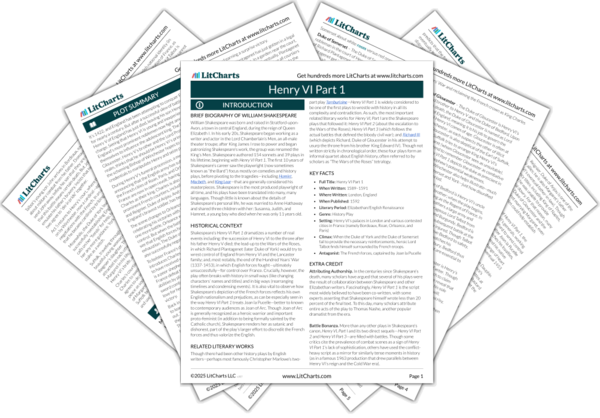
Attributing Authorship. In the centuries since Shakespeare’s death, many scholars have argued that several of his plays were the result of collaboration between Shakespeare and other Elizabethan writers. Fascinatingly, Henry VI Part 1 is the script most widely believed to have been co-written, with some experts asserting that Shakespeare himself wrote less than 20 percent of the final text. To this day, many scholars attribute entire acts of the play to Thomas Nashe, another popular dramatist from the era.
Battle Bonanza. More than any other plays in Shakespeare’s canon, Henry VI, Part I and its two direct sequels—Henry VI Part 2 and Henry VI Part 3—are filled with battles. Though some critics cite the prevalence of combat scenes as a sign of Henry VI Part 1’s lack of sophistication, others have used the conflict-heavy script as a mirror for similarly tense moments in history (as in a famous 1963 production that drew parallels between Henry VI’s reign and the Cold War era).

 Quote explanations,
with page numbers, for over 50,642 quotes.
 PDF downloads
of all 2,269 LitCharts guides.
 Expert analysis
to take your reading to the next level.
 Advanced search
to help you find exactly what you're looking for.
Expert analysis
to take your reading to the next level.
Advanced search
to help you find exactly what you're looking for.
