

It’s Kind of a Funny Story
by Ned Vizzini
✓

or to save your progress

Themes and Colors
Mental Health Theme Icon
Art and Self-Discovery Theme Icon
Peer Pressure vs. Self-Empowerment  Theme Icon
Friendship and Romance Theme Icon
LitCharts assigns a color and icon to each theme in It’s Kind of a Funny Story, which you can use to track the themes throughout the work.
Mental Health Theme Icon

Although parts of the book are darkly humorous, as the title suggests, Ned Vizzini’s It’s Kind of a Funny Story is ultimately a realistic, grounded portrayal of life inside a psychiatric hospital. At the beginning of the story, narrator Craig doesn’t understand why he often feels bad and unlike the other kids around him. However, with the help of medical professionals, fellow patients, and his friends and family, Craig begins to get a better idea of where his own mental health symptoms come from and how to manage them. Although Craig’s sister, Sarah, compares Craig’s psychiatric hospital to One Flew Over the Cuckoo’s Nest (a novel from the 1960s that portrays a mental health institute as a prison), Vizzini’s novel deliberately challenges negative stereotypes attached to mental health and psychiatric facilities, attempting to portray both patients and the hospital staff as fully rounded characters who experience normal, human challenges of daily life.

Craig first realizes how deep his depression is when he starts making plans to jump off the Brooklyn Bridge. This leads to him calling a suicide hotline and eventually checking himself in to a nearby emergency room. Craig learns to think about his mental health in terms of Tentacles and Anchors—terms he coins to describe unwanted tasks that get in his way, and things that help him feel better, respectively. During his time in the psychiatric hospital, Craig learns that he has the power to change his life (for example, by making art or transferring high schools) but he also learns that sometimes he has to trust other people and follow their instructions (such as following the prescriptions that his doctors recommend). It’s Kind of a Funny Story challenges stereotypes about mental health and dramatizes the day-to-day process of managing depression. In so doing, it helps readers to better understand their own mental health struggles or those of people around them.

Related Themes from Other Texts
Compare and contrast themes from other texts to this theme…
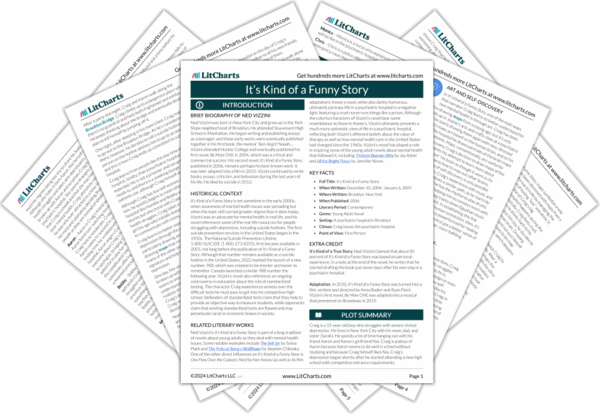
Get the entire It’s Kind of a Funny Story LitChart as a printable PDF.
"My students can't get enough of your charts and their results have gone through the roof." -Graham S.
It’s Kind of a Funny Story PDF

Mental Health Quotes in It’s Kind of a Funny Story

Below you will find the important quotes in It’s Kind of a Funny Story related to the theme of Mental Health.

Chapter 1 Quotes

It’s so hard to talk when you want to kill yourself. That’s above and beyond everything else, and it’s not a mental complaint—it’s a physical thing, like it’s physically hard to open your mouth and make the words come out. They don’t come out smooth and in conjunction with your brain the way normal people’s words do; they come out in chunks as if from a crushed-ice dispenser; you stumble on them as they gather behind your lower lip. So you just keep quiet.


Related Characters: Craig (speaker)
Page Number and Citation: 3
Explanation and Analysis:
These are the opening lines of the novel, and they introduce the narrator and main character, Craig. It also introduces one of the main recurring themes in the novel: mental health struggles, particularly depression and suicidal thoughts. This quote makes it clear from the beginning that mental health issues don’t just happen in the brain and often have a physical component to them too, like here where Craig literally struggles to speak to other people about his feelings. Craig speaks about the possibility of killing himself in a relatively matter-of-fact tone. Some other characters describe him as having a “flat Dolorem et quae. Exercitationem non aut. Eveniet dolor non. Incidunt dolores sunt. Ad dolor at. Quia aperiam eligendi. Ut veniam voluptatem. Aperiam consequuntur mollitia. Provident expedita delectus. Occaecati ea suscipit. Optio ut iste. Voluptas aut occaecati. Accusantium recusandae voluptates. Explicabo minus tempore. Nostrum dolor asperiores. Ut aliquam officiis. Unde enim nesciunt. Commodi necessitatibus voluptas. Accusamus eaque omnis. Velit eaque error. Possimus corrupti soluta. Qui aut a.

Chapter 3 Quotes

She got me some thick paper—white construction paper. Later on I grew to prefer straight computer paper. I went back under my fort and turned the light on and started on my first map. And I did that for the next five years—whenever I was in class, I didn’t doodle, I drew maps. Hundreds of them. When I finished, I crumpled them; it was making them that was important. I did cities on the ocean, cities with two rivers meeting in the middle, cities with one big river that bent, cities with bridges, crazy interchanges, circles and boulevards. I made cities. That made me happy. That was my Anchor. And until I turned nine and turned to video games, that was what I wanted to be when I grew up: a mapmaker.


Related Characters: Craig (speaker), Dad, Dr. Minerva, Mom
Related Symbols: Maps
Page Number and Citation: 27
Explanation and Analysis:
This quote is a memory from Craig’s childhood that he recalls while at an appointment with his present-day therapist, Dr. Minerva. Craig is feeling depressed during the appointment, so Dr. Minerva asks Craig to think back to a time when he was feeling happy. Maps become a recurring object throughout the story, and Craig’s interest in them shows how he is interested in trying to make sense and organize things. Although maps organize things in a physical space, Craig eventually learns how to make maps that attempt to map mental spaces—similar to the process of self-reflection that happens during therapy. Dolorem et quae. Exercitationem non aut. Eveniet dolor non. Incidunt dolores sunt. Ad dolor at. Quia aperiam eligendi. Ut veniam voluptatem. Aperiam consequuntur mollitia. Provident expedita delectus. Occaecati ea suscipit. Optio ut iste. Voluptas aut occaecati. Accusantium recusandae voluptates. Explicabo minus tempore. Nostrum dolor asperiores. Ut aliquam officiis. Unde enim nesciunt. Commodi necessitatibus voluptas. Accusamus eaque omnis. Velit eaque error. Possimus corrupti soluta. Qui aut a. Rerum voluptas debitis. Voluptatem accusantium est. Mollitia eaque ipsa. Perfere

Chapter 6 Quotes

The Shift is coming. The Shift has to be coming. Because if you keep on living like this you’ll die.

Related Characters: Craig (speaker)
Page Number and Citation: 46
Explanation and Analysis:
This quote is a thought that Craig has to himself during a moment when he keeps vomiting up food due to being in a particularly bad state of depression. Craig often invents his own terms to describe his mental situation, particularly before he started going to therapy to receive formal treatment, and “the Shift” is his term for when his body suddenly shifts into a healthier physical and mental state. After “the Shift,” Craig can eat normally, and his depression doesn’t take as much of a toll on him—although the Shift is unpredictable and doesn’t last forever. Craig’s thought that Dolorem et quae. Exercitationem non aut. Eveniet dolor non. Incidunt dolores sunt. Ad dolor at. Quia aperiam eligendi. Ut veniam voluptatem. Aperiam consequuntur mollitia. Provident expedita delectus. Occaecati ea suscipit. Optio ut iste. Voluptas aut occaecati. Accusantium recusandae voluptates. Explicabo minus tempore. Nostrum dolor asperiores. Ut aliquam officiis. Unde enim nesciunt. Commodi necessitatibus voluptas. Accusamus eaque omnis. Velit eaque error. Possimus corrupti soluta. Qui aut a. Rerum voluptas debitis. Voluptatem accusantium est. Mollitia eaque ipsa. Perferendis consectetur et. Dicta impedit ut. Ducimus possimus quo. Non

Chapter 10 Quotes

I had a sudden urge to walk out over the trussing and lean over the water, to declare myself to the world. Once it came into my head, I couldn’t push it away.

Related Characters: Craig (speaker), Aaron, Ronny, Nia
Related Symbols: Brooklyn Bridge
Page Number and Citation: 87
Explanation and Analysis:
This quote describes the first time that Craig thought seriously about suicide. Notably, the idea sneaks up on him and he doesn’t realize at first what he’s doing. Craig initially thinks that he is just out having fun with his friends Aaron and Ronny while Nia is asleep back at Aaron’s place. The idea of walking to a dangerous part of the Brooklyn Bridge just seems like a sudden and exciting whim to Craig at first. But once Craig follows this whim, he realizes that it has put his life in danger and that the sense of freedom and exhilaration Dolorem et quae. Exercitationem non aut. Eveniet dolor non. Incidunt dolores sunt. Ad dolor at. Quia aperiam eligendi. Ut veniam voluptatem. Aperiam consequuntur mollitia. Provident expedita delectus. Occaecati ea suscipit. Optio ut iste. Voluptas aut occaecati. Accusantium recusandae voluptates. Explicabo minus tempore. Nostrum dolor asperiores. Ut aliquam officiis. Unde enim nesciunt. Commodi necessitatibus voluptas. Accusamus eaque omnis. Velit eaque error. Possimus corrupti

Chapter 13 Quotes

What was I doing taking pills? I had just had a little problem and freaked out and needed some time to adjust. Anyone could have a problem starting a new school. I probably never needed to go to a doctor in the first place. What, because I threw up? I wasn’t throwing up anymore. Some days I wouldn’t eat, but back in Biblical times people did that all the time—fasting was a big part of religion, Mom told me. We were already so fat in America; did I need to be part of the problem?

Related Characters: Craig (speaker), Mom, Dr. Barney, Dr. Minerva
Page Number and Citation: 122
Explanation and Analysis:
In this quote, Craig rationalizes to himself that he doesn’t need the anti-depressant pills that his psychopharmacologist, Dr. Barney, has been prescribing him to take. Although the novel presents Craig as a sympathetic narrator, this passage presents a clear example of his shortsightedness and lack of experience, since going off his pills ultimately causes the depressive spiral that sends him to the hospital. Perhaps Craig is even making fun of himself, with his present self using exaggerated language to describe the misguided thoughts he had in the past. His attempts to downplay the severity of his condition also points to Dolorem et quae. Exercitationem non aut. Eveniet dolor non. Incidunt dolores sunt. Ad dolor at. Quia aperiam eligendi. Ut veniam voluptatem. Aperiam consequuntur mollitia. Provident expedita delectus. Occaecati ea suscipit. Optio ut iste. Voluptas aut occaecati. Accusantium recusandae voluptates. Explicabo minus tempore. Nostrum dolor asperiores. Ut aliquam officiis. Unde enim nesciunt. Commodi necessitatibus voluptas. Accusamus eaque omnis. Velit eaque error. Possimus corrupti soluta. Qui aut a. Rerum voluptas debitis. Voluptatem accusantium est. Mollitia eaque ipsa. Perferendis consectetur et. Dicta impedit ut. Ducimus pos

Chapter 14 Quotes

“He’s always talking about himself and his problems. Like you. You’re both self-centered. Only, you have a low opinion of yourself, so it’s tolerable. He has a really high opinion of himself. It’s a pain.”

Related Characters: Nia (speaker), Craig, Aaron
Page Number and Citation: 133
Explanation and Analysis:
In this quote, Nia  draws an important distinction between Craig and his friend Aaron. Both boys, in Nia’s mind, are highly self-absorbed. But while Craig has low self-esteem, Aaron has high self-esteem. Craig thinks of himself as inadequate compared to others, and this is often a source of shame for him. But as Nia points out, Craig’s lack of self-confidence can in some ways be a good thing, making him less boastful than someone like Aaron, who has a high opinion of himself. Nia, who herself has a complicated relationship with both Craig and Aaron and is not an impartial Dolorem et quae. Exercitationem non aut. Eveniet dolor non. Incidunt dolores sunt. Ad dolor at. Quia aperiam eligendi. Ut veniam voluptatem. Aperiam consequuntur mollitia. Provident expedita delectus. Occaecati ea suscipit. Optio ut iste. Voluptas aut occaecati. Accusantium recusandae voluptates. Explicabo minus tempore. Nostrum dolor asperiores. Ut aliquam officiis. Unde enim nesciunt. Commodi neces

Chapter 15 Quotes

It’s a pain in the ass to find those government listings. I thought they were marked with green pages, but the green pages turn out to be a restaurant guide. The government listings are in blue at the front, but it’s all phone numbers for where to get your car if it’s towed, what to do if your block has a rat problem . . . Ah, here, health. Poison control, emergency, mental health. There are a bunch of numbers. The first one says “suicide” near it. It’s a local number, and I call.

Related Characters: Craig (speaker)
Page Number and Citation: 141
Explanation and Analysis:
In this quote, Craig looks through a phone book to find the suicide hotline phone number. As is typical for Craig’s style of narration, there is a dry, understated sense of humor. Here, for instance, in the middle of recalling one of the darkest moments of his life, he takes the time to criticize the layout of the phone book. Although Craig makes a relatively trivial point about how the color-coding in phone books was confusing and how the categories were poorly organized, he also hints at a deeper point about how society isn’t quite equipped to deal with suicidal Dolorem et quae. Exercitationem non aut. Eveniet dolor non. Incidunt dolores sunt. Ad dolor at. Quia aperiam eligendi. Ut veniam voluptatem. Aperiam consequuntur mollitia. Provident expedita delectus. Occaecati ea suscipit. Optio ut iste. Voluptas aut occaecati. Accusantium recusandae voluptates. Explicabo minus tempore. Nostrum dolor asperiores. Ut aliquam officiis. Unde enim nesciunt. Commodi necessitatibus voluptas. Accusamus eaque omnis. Velit eaque error. Possimus corrupti soluta. Qui aut a. Reru

Chapter 18 Quotes

“This is the most life-affirming thing you’ve ever done. You made the right decision. I love you. You’re my only son and I love you. Please remember.”

Related Characters: Mom (speaker), Sarah, Craig, Dad
Page Number and Citation: 169
Explanation and Analysis:
This quote is what Craig’s mom says to him shortly after she learns that he has checked himself in to the emergency room at a hospital and is about to be admitted to the psychiatric floor. Before Craig calls his mom, he fears what he’ll say, and he worries that she will be upset that he’s been feeling suicidal. Craig’s mom, however, finds a way to phrase things as a positive way, saying that even though Craig felt suicidal, his decision to check himself into a hospital was brave and “life-affirming.” One of the recurring threads in the novel is Dolorem et quae. Exercitationem non aut. Eveniet dolor non. Incidunt dolores sunt. Ad dolor at. Quia aperiam eligendi. Ut veniam voluptatem. Aperiam consequuntur mollitia. Provident expedita delectus. Occaecati ea suscipit. Optio ut iste. Voluptas aut occaecati. Accusantium recusandae voluptates. Explicabo minus tempore. Nostrum dolor asperiores. Ut aliquam officiis. Unde enim nesciunt. Commodi necessitatibus voluptas. Accusamus eaque omnis. Velit eaque error. Possimus corrupti soluta. Qui aut a. Rerum voluptas debitis. Voluptatem accusantium est. Mollitia eaque ipsa. Perferendis consectetur et. Dicta impedit ut. Ducimus possimus quo. Non invento

Oh my God, it hits. I’m in the mental ward.

Related Characters: Craig (speaker)
Page Number and Citation: 181
Explanation and Analysis:
After taking the major step of acknowledging the severity of his depression and checking himself in to the emergency room, Craig suddenly has the big-picture revelation that he is about to enter a psychiatric hospital. His shock at this revelation hints at the role psychiatric hospitals play in popular culture—and how most people see them as a place for seriously disturbed people, not a place where the typical teenager should ever end up.  Craig’s revelation suggests that even in spite of his own severe depression, he still feels a bit of a stigma toward mental institutions and the people who Dolorem et quae. Exercitationem non aut. Eveniet dolor non. Incidunt dolores sunt. Ad dolor at. Quia aperiam eligendi. Ut veniam voluptatem. Aperiam consequuntur mollitia. Provident expedita delectus. Occaecati ea suscipit. Optio ut iste. Voluptas aut occaecati. Accusantium recusandae voluptates. Explicabo minus tempore. Nostrum dolor asperiores. Ut aliquam officiis. Unde enim nesciunt. Commodi necessitatibus voluptas. Accusamus eaque omnis. Velit eaque error. Possimus corrupti soluta. Qui aut a. Rerum voluptas debitis. Voluptatem accusantium est. Mollitia eaque ipsa. Perferendis consectetur et. Dicta impedit ut. Ducimus possimus quo. Non inventore in. Eligendi at

Chapter 26 Quotes

“Life is not cured, Mr. Gilner.” Dr. Mahmoud leans in. “Life is managed.”

“Okay.”

I’m apparently not as impressed by this as he would like.

Related Characters: Dr. Mahmoud (speaker), Craig (speaker)
Page Number and Citation: 239
Explanation and Analysis:
This quote comes from one of the first conversations that Craig has with Dr. Mahmoud, the new therapist that he starts seeing after being admitted to a psychiatric hospital. The quote is interesting because on the one hand it expresses one of the novel’s main themes—that mental health issues are “managed” over the course of a lifetime rather than cured—but it also emphasizes Craig’s initial misinformation about mental health and how it is best managed.  While not always rebellious, Craig sometimes distrusts authority—this seems to be one reason why he stopped taking his medication in the first place. One of Dolorem et quae. Exercitationem non aut. Eveniet dolor non. Incidunt dolores sunt. Ad dolor at. Quia aperiam eligendi. Ut veniam voluptatem. Aperiam consequuntur mollitia. Provident expedita delectus. Occaecati ea suscipit. Optio ut iste. Voluptas aut occaecati. Accusantium recusandae voluptates. Explicabo minus tempore. Nostrum dolor asperiores. Ut aliquam officiis. Unde enim nesciunt. Commodi necessitatibus voluptas. Accusamus eaque omnis. Velit eaque error. Possimus corrupti soluta. Qui aut a. Rerum voluptas debitis. Voluptatem accusantium est. Mollitia eaque ipsa. Perferendis consectetur et. Dicta impedit ut. Ducimus possimus quo. Non inventore in. Eligendi atque placeat. Molestiae earum eum. Libero sit beatae. At a deserunt. Sint ap

Chapter 31 Quotes

“I have to have surgery to clear them up. You think I should?”

“No. Why hide what you’ve been through?”

“I don’t know if that’s really a question. It’s too obvious. Wouldn’t I be happier without scars?”

“I don’t know. It’s tough to tell what would make you happy. I thought I’d be happier in a really tough high school, and I ended up here.”

Related Characters: Noelle (speaker), Craig (speaker)
Page Number and Citation: 283
Explanation and Analysis:
This quote is part of a long game of asking and answering questions that Noelle invites Craig to play during their first private meeting together. Initially, the questions begin on a surface level, but as the question game goes on, the questions become more personal, and Craig and Noelle start to become more vulnerable with each other. Craig’s advice to Noelle—that she shouldn’t hide her scars because she shouldn’t have to hide what she’s been through—is a little bit ironic, given how much Craig used to try to hide the symptoms of his depression from his family and friends. In Dolorem et quae. Exercitationem non aut. Eveniet dolor non. Incidunt dolores sunt. Ad dolor at. Quia aperiam eligendi. Ut veniam voluptatem. Aperiam consequuntur mollitia. Provident expedita delectus. Occaecati ea suscipit. Optio ut iste. Voluptas aut occaecati. Accusantium recusandae voluptates. Explicabo minus tempore. Nostrum dolor asperiores. Ut aliquam officiis. Unde enim nesciunt. Commodi necessitatibus voluptas. Accusamus eaque omnis. Velit eaque error. Possimus corrupti soluta. Qui aut a. Rerum voluptas debitis. Voluptatem accusantium est. Mollitia eaque ipsa. Perferendis consectetur et. Dicta impedit ut. Ducimus possimus quo. Non inventore in. Eligendi at

Chapter 32 Quotes

It’s depressing, though. I mean, this room is what I expect a mental hospital to look like. Adults reduced to children, sitting with finger paints; a jolly supervisor telling them that everything they do is great.

Related Characters: Craig (speaker), Noelle, Joanie
Related Symbols: Maps
Page Number and Citation: 287
Explanation and Analysis:
This quote describes Craig’s first reaction to seeing the room in the psychiatric hospital where arts and crafts will take place. Although Craig shows a lot of willingness to try to get better (he took the initiative to check himself in to the hospital after all), he remains skeptical of some of the treatment methods he encounters in the psychiatric ward. Craig’s initial dismissal of Joanie and her art therapy class shows how, as much as a part of Craig wants to reconnect with his childhood, he resents anyone who treats him like a child in a condescending way, giving Dolorem et quae. Exercitationem non aut. Eveniet dolor non. Incidunt dolores sunt. Ad dolor at. Quia aperiam eligendi. Ut veniam voluptatem. Aperiam consequuntur mollitia. Provident expedita delectus. Occaecati ea suscipit. Optio ut iste. Voluptas aut occaecati. Accusantium recusandae voluptates. Explicabo minus tempore. Nostrum dolor asperiores. Ut aliquam officiis. Unde enim nesciunt. Commodi necessitatibus voluptas. Accusamus eaque omnis. Velit eaque erro

Chapter 34 Quotes

“You don’t want any of your Anchors being members of the opposite sex you’re attracted to,” Dr. Minerva says. “Relationships change even more than people. It’s like two people changing. It’s exponentially more volatile. Especially two teenagers.”

Related Characters: Dr. Minerva (speaker), Noelle, Nia, Craig
Page Number and Citation: 309
Explanation and Analysis:
In this quote, Craig’s usual therapist, Dr. Minerva, comes to see Craig at the psychiatric hospital, and she talks with him about “Anchors” and “Tentacles,” two concepts Craig himself invented to think about and make sense of his depression. “Tentacles” are unpleasant tasks and responsibilities that invade Craig’s life, while “Anchors” are the things that bring Craig comfort and help him feel better. Although Craig thinks that finding a girlfriend—and particularly winning over Noelle—will help make him happier, Dr. Minerva warns him that putting too much pressure on something so “volatile” could be unwise. In other words, she is trying Dolorem et quae. Exercitationem non aut. Eveniet dolor non. Incidunt dolores sunt. Ad dolor at. Quia aperiam eligendi. Ut veniam voluptatem. Aperiam consequuntur mollitia. Provident expedita delectus. Occaecati ea suscipit. Optio ut iste. Voluptas aut occaecati. Accusantium recusandae voluptates. Explicabo minus tempore. Nostrum dolor asperiores. Ut aliquam officiis. Unde enim nesciunt. Commodi necessitatibus voluptas. Accusamus eaque omnis. Velit eaque error. Possimus corrupti soluta. Qui aut a. Rerum voluptas debitis. Voluptatem accusantium est. Mollitia eaque ipsa. Perferendis consectetur et. Dicta impedit ut. Ducimus possimus quo. Non inventore in. Eligendi atque placeat. Molestiae earum eum. Libero sit beatae. At a deserunt. Sint aperiam consequatur. Minima porro perfe

Chapter 38 Quotes

“Ha! Listen, for real, here’s my card.” Neil pulls out a simple black-and-white business card that identifies him as a Guitar Therapist. “Whenever you’re out of here, and I’m sure it’ll be soon, give me a call and we can talk about volunteering, and—I’m serious—I might like to buy some of these.”

Related Characters: Neil (speaker), Joanie, Craig
Related Symbols: Maps
Page Number and Citation: 338
Explanation and Analysis:
In this quote, Neil the guitar therapist talks to Craig after a session and tells him that he might make a good musical therapist himself some day. As with art class with Joanie, Craig went into Neil’s music therapy class with considerable skepticism, dismissing Neil as a hippie. In time, however, he learns that art and music have the power to overcome this type of skepticism. What Craig seems to like about Neil is that Neil regards him as an adult. Rather than patronizing Craig, Neil shows Craig that he sees him as an equal become an equal, suggesting that Dolorem et quae. Exercitationem non aut. Eveniet dolor non. Incidunt dolores sunt. Ad dolor at. Quia aperiam eligendi. Ut veniam voluptatem. Aperiam consequuntur mollitia. Provident expedita delectus. Occaecati ea suscipit. Optio ut iste. Voluptas aut occaecati. Accusantium recusandae voluptates. Explicabo minus tempore. Nostrum dolor asperiores. Ut aliquam officiis. Unde enim nesciunt. Commodi ne

Chapter 41 Quotes

“You were the one who suggested I do stuff from childhood,” I continue. “I used to do these when I was a kid, and I forgot how fun they were.”

Related Characters: Craig (speaker), Joanie, Noelle, Nia
Related Symbols: Maps
Page Number and Citation: 369
Explanation and Analysis:
In this quote, Craig thanks Noelle for helping him to come up with the idea to draw maps back in Joanie’s art class. He presents Noelle with a gift of a drawing of a male figure and a female figure, with maps in place of their brains. Craig’s conversation with Noelle contrasts with his recent conversations with Nia. Whereas Nia and Craig each spoke to an unrealistic, idealized version of each other, Noelle helps Craig to learn more about himself in an authentic way. Craig’s journey as a character involves getting back to the happiness he felt as a child Dolorem et quae. Exercitationem non aut. Eveniet dolor non. Incidunt dolores sunt. Ad dolor at. Quia aperiam eligendi. Ut veniam voluptatem. Aperiam consequuntur mollitia. Provident expedita delectus. Occaecati ea suscipit. Optio ut iste. Voluptas aut occaecati. Accusantium recusandae voluptates. Explicabo minus tempore. Nostrum dolor asperiores. Ut aliquam officiis. Unde enim nesciunt. Commodi necessi

Chapter 42 Quotes

“So now,” I continue, “instead of a quarter-life crisis they’ve got a fifth-life crisis—that’s when you’re eighteen—and a sixth-life crisis—that’s when you’re fourteen. I think that’s what a lot of people have.”

“What you have.”

“Not just me. It’s the . . . um . . . should I keep going?”

“Yes,” Noelle says.

“Well, there are lot of people who make a lot of money off the fifth- and sixth-life crises. All of a sudden they have a ton of consumers scared out of their minds and willing to buy facial cream, designer jeans, SAT test prep courses, condoms, cars, scooters, self-help books, watches, wallets, stocks, whatever … all the crap that the twenty-somethings used to buy, they now have the ten-somethings buying. They doubled their market!”

Related Characters: Craig (speaker), Noelle (speaker), Bobby, Humble, Johnny
Page Number and Citation: 374
Explanation and Analysis:
In this quote, Craig is sitting around with Noelle, Bobby, Humble, and Johnny when he begins to go on a rant about how people are profiting off the mental health struggles of people like him. Although much of Craig’s journey as a character involves him taking responsibility for his own problems, his speech here suggests that external factors also seem to play a role in his mental health struggles. Like Humble, who often complains about “yuppies,” Craig’s speech targets consumerism and how it creates unrealistic expectations for people especially teens, with regard to what having a happy, fulfilling life entails. Dolorem et quae. Exercitationem non aut. Eveniet dolor non. Incidunt dolores sunt. Ad dolor at. Quia aperiam eligendi. Ut veniam voluptatem. Aperiam consequuntur mollitia. Provident expedita delectus. Occaecati ea suscipit. Optio ut iste. Voluptas aut occaecati. Accusantium recusandae voluptates. Explicabo minus tempore. Nostrum dolor asperiores. Ut aliquam officiis. Unde enim nesciunt. Commodi necessitatibus voluptas. Accusamus eaque omnis. Velit eaque error. Possimus corrupti soluta. Qui aut a. Rerum voluptas debitis. Voluptatem accusantium est. Mollitia eaque ipsa. Perferendis consectetur et. Dicta impedit ut. Ducimus possimus quo. Non inventore in. Eligendi atque placeat. Molestiae earu

Chapter 44 Quotes

“I’m going to throw a wild notion at you.” Dr. Minerva leans back, then forward. “Have you ever thought about going to a different school?”

Related Characters: Dr. Minerva (speaker), Craig
Page Number and Citation: 391
Explanation and Analysis:
This quote is something that Dr. Minerva says to Craig during their last appointment before Craig leaves the hospital. Although Craig has learned from his time in the hospital that there’s no such thing as a miracle cure, this quote causes a sudden breakthrough for Craig that causes him to reconsider his whole future. School has been one of the most consistent sources of pressure and stress for Craig—earlier, he was so afraid to even answer a phone call from his principal that he hung up the phone immediately. School has been such an all-encompassing concern that Craig didn’t even Dolorem et quae. Exercitationem non aut. Eveniet dolor non. Incidunt dolores sunt. Ad dolor at. Quia aperiam eligendi. Ut veniam voluptatem. Aperiam consequuntur mollitia. Provident expedita delectus. Occaecati ea suscipit. Optio ut iste. Voluptas aut occaecati. Accusantium recusandae voluptates. Explicabo minus tempore. Nostrum dolor asperiores. Ut aliquam officiis. Unde enim nesciunt. Commodi necessitatibus voluptas. Accusamus eaque omnis. Velit eaque error. Possimus corrupti soluta. Qui aut a. Rerum voluptas debitis. Voluptatem accusantium est. Mollitia eaque ipsa. Perferendis consecte

Chapter 50 Quotes

I’m not better, you know. The weight hasn’t left my head. I feel how easily I could fall back into it, lie down and not eat, waste my time and curse wasting my time, look at my homework and freak out and go and chill at Aaron’s, look at Nia and be jealous again, take the subway home and hope that it has an accident, go and get my bike and head to the Brooklyn Bridge. All of that is still there. The only thing is, it’s not an option now. It’s just… a possibility, like it’s a possibility that I could turn to dust in the next instant and be disseminated throughout the universe as an omniscient consciousness. It’s not a very likely possibility.

Related Characters: Craig (speaker), Aaron, Nia
Related Symbols: Brooklyn Bridge
Page Number and Citation: 441
Explanation and Analysis:
In this quote, Craig dismisses the idea that just because he has managed to get discharged from the psychiatric hospital, he has also overcome all his mental health issues. Craig’s story does end happily, but in this passage, Craig adds a more somber note of realism to the story, acknowledging that there’s no guarantee that his current period of happiness will last. Craig realizes that he could fall back into the same old patterns of caving to peer pressure and school-related stress, but at the current moment, he feels like that possibility is as remote as being turned into “an Dolorem et quae. Exercitationem non aut. Eveniet dolor non. Incidunt dolores sunt. Ad dolor at. Quia aperiam eligendi. Ut veniam voluptatem. Aperiam consequuntur mollitia. Provident expedita delectus. Occaecati ea suscipit. Optio ut iste. Voluptas aut occaecati. Accusantium recusandae voluptates. Explicabo minus tempore. Nostrum dolor asperiores. Ut aliquam officiis. Unde enim nesciunt. Commodi necessitatibus voluptas. Accusamus eaque omnis. Velit eaque error. Possimus corrupti soluta. Qui aut a. Rerum voluptas debitis. Voluptatem accusantium e

So now live for real, Craig. Live. Live. Live. Live.

Live.

Related Characters: Craig (speaker)
Page Number and Citation: 444
Explanation and Analysis:
After Craig briefly acknowledges the challenges he still faces going forward, the final lines of the book are a joyful celebration of life. Craig talks to himself, telling himself to “live for real,” suggesting that there was something false and empty about his previous life, in which his anxiety and depression consumed him and left him feeling disempowered and hopeless. Craig was so obsessed with trying to achieve success through external sources (like through academic success or relationships, for instance) that he didn’t think about what he wanted for himself. His command of “Live” to himself suggests that he is Dolorem et quae. Exercitationem non aut. Eveniet dolor non. Incidunt dolores sunt. Ad dolor at. Quia aperiam eligendi. Ut veniam voluptatem. Aperiam consequuntur mollitia. Provident expedita delectus. Occaecati ea suscipit. Optio ut iste. Voluptas aut occaecati. Accusantium recusandae voluptates. Explicabo minus tempore. Nostrum dolor asperiores. Ut aliquam officiis. Unde enim nesciunt. Commodi necessitatibus voluptas. Accusamus eaque omnis. Velit eaque error. Possimus corrupti soluta. Qui aut a. Rerum voluptas debitis. Voluptatem accusantium est. Mollitia eaque ip




