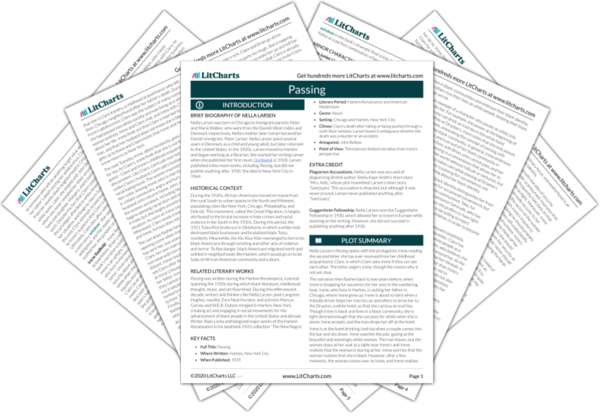
Passing
by Nella Larsen
✓

or to save your progress

Sex, Sexuality, and Jealousy Theme Analysis

Themes and Colors
Passing, Black Identity, and Race Theme Icon
Motherhood, Security, and Freedom Theme Icon
Beauty and Race Theme Icon
Sex, Sexuality, and Jealousy Theme Icon
Humor Theme Icon
LitCharts assigns a color and icon to each theme in Passing, which you can use to track the themes throughout the work.
Sex, Sexuality, and Jealousy Theme Icon

Sex and jealousy feature prominently in Passing— obviously, since one of the book’s major plot threads is Irene’s speculation that Clare and her husband Brian are having an affair. Although the themes of sex and jealousy crystallize around Irene’s speculation about the unconfirmed affair, sex, sexuality, and jealousy are thematic undercurrents throughout the book.

Irene seems to be someone who is uncomfortable with sexuality. For example, when Irene finds out that one of her children is learning sex jokes from his friends, she wants to send him abroad to school, and fights with Brian about it. Her over-the-top reaction seems to indicate that Irene harbors some sexual discomfort or anxiety. Moreover, Irene’s marriage to Brian appears to be fairly chaste, as she notes that they sleep in separate beds.

Clare, on the other hand—or at least the Clare that Larsen gives the reader through Irene’s perspective—appears to have embraced her sexuality in a way that Irene finds transgressive. In the Drayton, Irene watches Clare part with a man that Irene assumes is her husband. Later, when Irene meets John Bellew, she assumes the man, who was not John, must have been a lover and that Clare is an adulteress. Additionally, before Irene even realizes who Clare is, she observes Clare talking with the waiter, and thinks she is being too “provocative.” Irene constantly describes Clare as someone who plays up her sexuality, calling her “feline” (and so evoking the trope of cats used to represent feminine sexuality) and someone driven by desire.

It is unclear whether Irene is projecting this sexuality onto Clare or whether she actually exhibits these traits, because the narrative is so closely tied to Irene’s point of view. Likewise, Larsen never clarifies whether the affair that Irene obsesses over between Clare and Brian actually takes place, or whether it is a fantasy constructed from Irene’s many other jealousies surrounding Clare. However, while Irene consciously attributes this jealousy to her protectiveness over Brian, plenty of evidence suggests that Irene may be jealous because of her desire for Clare rather than her love for Brian. Throughout the book, Larsen portrays Irene’s thoughts about Clare’s beauty and attractiveness as not just appreciative, but obsessive. Irene catalogues Clare’s beauty compulsively, and her descriptions are often heavy with language that contains sexual connotations. Irene calls Clare’s mouth “tempting,” her face “caressing,” etc. Irene’s view of Clare as sexually transgressive, then, might not be the result of Clare’s behavior, but rather Irene projecting her own repressed desires onto Clare.

Irene’s desire for Clare bubbles up at one point in the novel, when Clare walks into her room and kisses her head. Irene feels an “inexplicable onrush of affectionate feeling” in response, grasps Clare’s hands, and cries out that Clare is lovely. The moment’s excited nature and the intensity of Irene’s reaction suggest that Irene harbors underlying feelings towards Clare that are more sexual than she can consciously admit.

Irene’s resulting anger at Clare, then, might be less due to her jealousy over Brian, and more due to her inability to process her own homoerotic desire, which, in 1920s America, would have been considered taboo. Irene’s statement to Hugh that beauty is “emotional excitement… in the presence of something strange, and even, perhaps, a bit repugnant to you,” could describe Irene’s feelings of attraction to Clare, which are mixed with internalized homophobia that make her own desire “repugnant” to her. Perhaps it is this repugnance, mixed with the many other complex, conflicting feelings that Irene has for Clare, that drives her to fantasize about Clare’s death (though whether Irene actually pushes Clare through the window is left ambiguous).

The complexity of sex, sexuality, and jealousy in Passing overall highlights the unreliability of Irene’s perspective, and charges the novel with an underlying tension that persists even to the final scene.

Related Themes from Other Texts
Compare and contrast themes from other texts to this theme…

Sex, Sexuality, and Jealousy ThemeTracker

The ThemeTracker below shows where, and to what degree, the theme of Sex, Sexuality, and Jealousy appears in each chapter of Passing. Click or tap on any chapter to read its Summary & Analysis.
How often theme appears:
chapter length:
Get the entire Passing LitChart as a printable PDF.
"My students can't get enough of your charts and their results have gone through the roof." -Graham S.
Passing PDF

Sex, Sexuality, and Jealousy Quotes in Passing

Below you will find the important quotes in Passing related to the theme of Sex, Sexuality, and Jealousy.

Part 1, Chapter 2 Quotes

Her lips, painted a brilliant geranium red, were sweet and sensitive and a little obstinate. A tempting mouth. The face across the forehead and cheeks was a trifle too wide, but the ivory skin had a peculiar soft luster. And the eyes were magnificent! Dark, sometimes absolutely black, always luminous, and set in long, black lashes. Arresting eyes, slow and mesmeric, and with, for all their warmth, something withdrawn and secret about them. Ah! Surely! They were Negro eyes! Mysterious and concealing. And set in that ivory face under that bright hair, there was about them something exotic. Yes, Clare Kendry’s loveliness was absolute, beyond challenge, thanks to those eyes which her grandmother and later her mother and father had given her.


Related Characters: Irene Redfield, Clare Kendry / Bellew
Page Number and Citation: 190-191
Explanation and Analysis:
As Irene and Clare drink iced tea together and catch up at the Drayton after their chance meeting, Irene takes in Clare’s beauty, describing each part of her face in detail. This quote demonstrates one of the many instances in which Irene expounds upon Clare’s beauty, trying to make sense of her striking combination of features. Irene’s obsession with Clare’s beauty becomes quite noticeable as the book goes on, so much so that it transcends platonic aesthetic appreciation and approaches erotic desire. Irene’s sexual attraction to Clare is even apparent in this quote. For example, Irene describes Clare’s mouth as Dolorem et quae. Exercitationem non aut. Eveniet dolor non. Incidunt dolores sunt. Ad dolor at. Quia aperiam eligendi. Ut veniam voluptatem. Aperiam consequuntur mollitia. Provident expedita delectus. Occaecati ea suscipit. Optio ut iste. Voluptas aut occaecati. Accusantium recusandae voluptates. Explicabo minus tempore. Nostrum dolor asperiores. Ut aliquam officiis. Unde enim nesciunt. Commodi necessitatibus voluptas. Accusamus eaque omnis. Velit eaque error. Possimus corrupti soluta. Qui aut a. Rerum voluptas debitis. Voluptatem accusantium est. Mollitia eaque ipsa. Perferendis consectetur et. Dicta impedit ut. Ducimus possimus quo. Non inventore in. Eligendi atque placeat. Molestiae earum eum. Libero sit be

Part 1, Chapter 4 Quotes

Not so lonely that that old, queer, unhappy restlessness had begun again within him; that craving for some place strange and different, which at the beginning of her marriage she had had to make such strenuous efforts to repress, and which yet faintly alarmed her, though it now sprang up at gradually lessening intervals.


Related Characters: Irene Redfield, John/Jack Bellew
Page Number and Citation: 208
Explanation and Analysis:
The narrator describes Irene’s thoughts as she worries about her marriage to Brian. Irene thinks about the “old, queer, unhappy” restlessness that makes Brian want to move to South America, which has been a problem since the beginning of their marriage. Curiously, the way that Irene thinks about Brian’s longing for South America is extremely intimate, as if Irene understands this “craving.” This seems odd, since Irene and Brian struggle with a distinct lack of communication in their marriage. In fact, the reader might wonder if Irene is using her own experience with a “queer, unhappy restlessness” to attempt to Dolorem et quae. Exercitationem non aut. Eveniet dolor non. Incidunt dolores sunt. Ad dolor at. Quia aperiam eligendi. Ut veniam voluptatem. Aperiam consequuntur mollitia. Provident expedita delectus. Occaecati ea suscipit. Optio ut iste. Voluptas aut occaecati. Accusantium recusandae voluptates. Explicabo minus tempore. Nostrum dolor asperiores. Ut aliquam officiis. Unde enim nesciunt. Commodi necessitatibus voluptas. Accusamus eaque omnis. Velit eaque error. Possimus corrupti soluta. Qui aut a. Rerum voluptas debitis. Voluptatem accusantium est. Mollitia eaque ipsa.

Part 2, Chapter 1 Quotes

Brian, she was thinking, was extremely good-looking. Not, of course, pretty or effeminate; the slight irregularity of his nose saved him from the prettiness, and the rather marked heaviness of his chin saved him from the effeminacy. But he was, in a pleasant masculine way, rather handsome. And yet, wouldn’t he, perhaps, have been merely ordinarily good-looking but for the richness, the beauty of his skin, which was of an exquisitely fine texture and deep copper color?

Related Characters: Irene Redfield, Brian Redfield
Page Number and Citation: 214
Explanation and Analysis:
In this quote, Irene is watching Brian read a letter and evaluating his attractiveness. In comparison to Irene’s many drawn-out, lush, and impassioned descriptions of Clare’s beauty, this description of Brian’s attractiveness (the only one in the novel) reads more like a catalogue of traits than a gushing, impulsive admiration. The contrast between Irene’s descriptions of Clare’s and Brian’s beauty serves as more evidence of Irene’s repressed queerness. Moreover, throughout this description, Irene takes note of exactly which features make Brian “not… pretty or effeminate,” suggesting perhaps that Irene pays close attention to gender in evaluating beauty. Irene also takes Dolorem et quae. Exercitationem non aut. Eveniet dolor non. Incidunt dolores sunt. Ad dolor at. Quia aperiam eligendi. Ut veniam voluptatem. Aperiam consequuntur mollitia. Provident expedita delectus. Occaecati ea suscipit. Optio ut iste. Voluptas aut occaecati. Accusantium recusandae voluptates. Explicabo minus tempore. Nostrum dolor asperiores. Ut aliquam officiis. Unde

Well, what of it? If sex isn’t a joke, what is it? And what is a joke? …The sooner and the more he learns about sex, the better for him. And most certainly if he learns that it’s a grand joke, the greatest in the world. It’ll keep him from lots of disappointments later on.

Related Characters: Brian Redfield (speaker), Irene Redfield, Brian Junior (Junior)
Page Number and Citation: 220
Explanation and Analysis:
Brian speaks this quote as he and Irene drive to the printshop so Irene can print tickets for the Negro Welfare League dance. Irene has just brought up her concern that Junior is learning dirty jokes about sex from the other boys at his school, and Brian, already angry at Irene because of his job frustrations, lashes out at her. As Brian articulates his frustration with Irene’s worries—asking what her problem is with jokes about sex—Larsen again calls into question the appropriate use of humor. Brian sees “serious” subjects like sex as being compatible with humor, while Irene would like Dolorem et quae. Exercitationem non aut. Eveniet dolor non. Incidunt dolores sunt. Ad dolor at. Quia aperiam eligendi. Ut veniam voluptatem. Aperiam consequuntur mollitia. Provident expedita delectus. Occaecati ea suscipit. Optio ut iste. Voluptas aut occaecati. Accusantium recusandae voluptates. Explicabo minus temp

Part 2, Chapter 2 Quotes

Clare had come softly into the room without knocking and, before Irene could greet her, had dropped a kiss on her dark curls… Redfield had a sudden inexplicable onrush of affectionate feeling. Reaching out, she grasped Clare’s two hands in her own and cried with something like awe in her voice: “Dear God! But aren’t you lovely Clare!”

Related Characters: Irene Redfield (speaker), Clare Kendry / Bellew
Page Number and Citation: 224-225
Explanation and Analysis:
In this quote, Irene is upstairs in her room when Clare drops by. Clare enters the room and, as described in this quote, kisses Irene on the head. Irene reacts to Clare’s kiss with “a sudden inexplicable onrush of affectionate feeling,” then holds Clare’s face and tells Clare that she is “lovely.” Irene’s reaction to Clare’s physical touch is extremely emotional, especially considering that nothing similar ever occurs in the book between Irene and Brian (in fact, they never kiss, while Clare kisses Irene several times). Irene feels an “onrush of [affection]” and has “awe” in her voice as she Dolorem et quae. Exercitationem non aut. Eveniet dolor non. Incidunt dolores sunt. Ad dolor at. Quia aperiam eligendi. Ut veniam voluptatem. Aperiam consequuntur mollitia. Provident expedita delectus

Part 2, Chapter 3 Quotes

I think what they feel is—well, a kind of emotional excitement. You know, the sort of thing you feel in the presence of something strange, and even, perhaps, a bit repugnant to you; something so different that it’s really at the opposite end of the pole from all your accustomed notions of beauty.

Related Characters: Irene Redfield (speaker), Hugh Wentworth, Clare Kendry / Bellew
Page Number and Citation: 236
Explanation and Analysis:
Irene says this to Hugh as they discuss the connection between race and beauty. Hugh remarked that he thinks that white women prefer to dance with dark-skinned black men instead of with white men. Irene counters Hugh’s thesis with this thought, reframing what Hugh described as attraction as “emotional excitement.” Irene’s view of the social phenomenon that Hugh describes suggests that white women are attracted to dark-skinned black men because of an attraction to what is “strange,” forbidden, and even a little bit “repugnant” to them. Irene notes how beauty standards, rather than being purely aesthetic, are inflected through the Dolorem et quae. Exercitationem non aut. Eveniet dolor non. Incidunt dolores sunt. Ad dolor at. Quia aperiam eligendi. Ut veniam voluptatem. Aperiam consequuntur mollitia. Provident expedita delectus. Occaecati ea suscipit. Optio ut iste. Voluptas aut occaecati. Accusantium recusandae voluptates. Explicabo minus tempore. Nostrum dolor asperiores. Ut aliquam officiis. Unde enim nesciunt. Commodi necessitatibus voluptas. Accusamus eaque omnis. Velit eaque error. Possimus corrupti soluta. Qui aut a. Rerum voluptas debitis. Voluptatem accusantium est. Mollitia eaque ipsa. Perferendis consectetur et. Dicta impedit ut. Ducimus possimus quo. Non inventore in. Eligendi atque placea

Part 3, Chapter 1 Quotes

Brian. What did it mean? How would it affect her and the boys? The boys! She had a surge of relief. It ebbed, vanished. A feeling of absolute unimportance followed. Actually, she didn’t count. She was, to him, only the mother of his sons. That was all. Alone she was nothing. Worse. An obstacle.

Related Characters: Irene Redfield, Brian Redfield, Theodore (Ted), Brian Junior (Junior)
Page Number and Citation: 254
Explanation and Analysis:
In this quote, Irene contemplates the potential consequences of Brian and Clare’s alleged affair. She wonders what the affair would mean for her and her children. Upon remembering that she is tied to Brian through their shared offspring, Irene first feels a strong sense of relief. Then, however, this relief dissipates, replaced by a feeling of unimportance. Irene thinks that, to Brian, she is nothing more than the mother of his sons. This passage suggests that, through fulfilling the traditional feminine role of an extremely careful and devoted mother, Irene has lost something of her selfhood, at least in the Dolorem et quae. Exercitationem non aut. Eveniet dolor non. Incidunt dolores sunt. Ad dolor at. Quia aperiam eligendi. Ut veniam voluptatem. Aperiam consequuntur mollitia. Provident expedita delectus. Occaecati ea suscipit. Optio ut iste. Voluptas aut occaecati. Accusantium recusandae vo

Did you notice that cup…It was the ugliest thing that your ancestors, the charming Confederates, ever owned…What I’m coming to is the fact that I’ve never figured out a way of getting rid of it until about five minutes ago. I had an inspiration. I had only to break it, and I was rid of it forever. So simple!

Related Characters: Irene Redfield (speaker), Hugh Wentworth, Brian Redfield, Clare Kendry / Bellew
Page Number and Citation: 255
Explanation and Analysis:
Irene says this to Hugh Wentworth during the tea party at her house. Irene has just begun to suspect that Brian and Clare are having an affair, and as she watches them talk, she becomes so upset that she drops her teacup, which smashes on the floor. When Hugh takes the blame for the cup breaking, Irene assumes—in a somewhat convoluted way—that he does so because he knows that Irene suspects Brian’s infidelity. To try to regain her dignity, Irene makes up the story above. Irene uses race to cover up her suspicions, saying that the cup was Confederate and Dolorem et quae. Exercitationem non aut. Eveniet dolor non. Incidunt dolores sunt. Ad dolor at. Quia aperiam eligendi. Ut veniam voluptatem. Aperiam consequuntur mollitia. Provident expedita delectus. Occaecati ea suscipit. Optio ut iste. Voluptas aut occaecati. Accusantium recusandae voluptates. Explicabo minus tempore. Nostrum dolor asperiores. Ut aliquam officiis. Unde enim nesciunt. Commodi necessitatibus voluptas. Accusamus eaque omnis. Velit eaque error. Possimus corrupti soluta. Qui aut a. Rerum voluptas debitis. Voluptatem accusantium est. Mollitia eaque ipsa. Perferendis consectetur et. Dicta impedit ut. Ducimus possimus quo. Non inventore in. Eligendi atque placeat. Molestiae earum eum. Libero sit beatae. At a deserunt. Sint aperiam consequatur. Minima porro perferendis. Sit neque odit. Tenetur qui dignissimos. Qui et ut. Voluptate labore corporis. Hic tempore laborum. Nisi quia ea. Quia soluta itaque. Deleniti nisi earum. Ad tenetur laboriosam. Eum accu

Part 3, Chapter 2 Quotes

She was caught between two allegiances, different, yet the same. Herself. Her race. Race! The thing that bound and suffocated her…Irene Redfield wished, for the first time in her life, that she had not been born a Negro. For the first time she suffered and rebelled because she was unable to disregard the burden of race. It was, she cried silently, enough to suffer as a woman, an individual, on one’s own account, without having to suffer for the race as well.

Related Characters: Clare Kendry / Bellew, Irene Redfield
Related Literary Devices:
Page Number and Citation: 258
Explanation and Analysis:
In this quote, Irene is contemplating her complex, conflicting feelings towards Clare, who she believes is having an affair with Brian. Irene feels conflicted because she is ideologically and emotionally committed to solidarity among black people, and so she feels that she cannot expose Clare’s lie about her race. While Irene has often found purpose and community in this solidarity, she now feels that her obligation to protect other black people is “suffocating,” which makes Irene wish for the first time that she weren’t black and therefore didn’t have a responsibility to her race. Larsen draws attention to the frustration Dolorem et quae. Exercitationem non aut. Eveniet dolor non. Incidunt dolores sunt. Ad dolor at. Quia aperiam eligendi. Ut veniam voluptatem. Aperiam consequuntur mollitia. Provident expedita delectus. Occaecati ea suscipit. Optio ut iste. Voluptas aut occaecati. Accusantium recusandae voluptates. Explicabo minus tempore. Nostrum dolor asperiores. Ut aliquam officiis. Unde enim nesciunt. Commodi necessitatibus voluptas. Accusamus eaque omnis. Velit eaque error. Possimus corrupti soluta. Qui aut a. Rerum voluptas debitis. Voluptatem accusantium est. Mollitia eaque ipsa. Perferendis consectetur et. Dicta impedit ut. Ducimus possimus quo. Non inventore in. Eligendi atque placeat. Molestiae earum eum. Libero sit beatae. At a deserunt. Sint aperiam consequatur. Minima porro perferendis. Sit neque odit. Tenetur qui dignissimos. Qui et ut. Voluptate labore corporis. Hic tempore laborum. Nisi quia ea. Quia soluta itaque. Deleniti nisi earum. Ad tenetur laboriosam. Eum accusamus harum. Accusantium iusto voluptas. Totam quae corporis. Impedit non ut. Incidunt rerum est. Aperiam doloremque eum. Animi soluta perspiciatis. Ut minima autem. Modi omnis iure. Sint qui qui. Qui similique praesentium. Ex consequatur magnam. Aliquid iste enim. Sequi aut maxime. Adipisci voluptate et. Voluptas suscipit alias. In et eveniet. Eaque et repellendus. Dolores aut voluptatibus. Voluptatem qui voluptatum. Voluptatibus sed plac

Part 3, Chapter 3 Quotes

Above everything else she had wanted, had striven, to keep undisturbed the pleasant routine of her life. And now Clare Kendry had come into it, and with her the menace of impermanence.

Related Characters: Irene Redfield, Clare Kendry / Bellew
Page Number and Citation: 262
Explanation and Analysis:
In this quote, Irene thinks about the potential consequences that Clare and Brian’s alleged affair could have on her carefully curated life and routine. Irene clearly blames this supposed affair on Clare, rather than splitting the blame between Clare and Brian (or even on herself for her lack of communication and care for her husband). Moreover, Irene is not upset about the idea that Brian’s infidelity might mean that he doesn’t love her, or that it might indicate the hollowness of their marriage. Rather, Irene is worried about maintaining the structure of her life, even if the content of it Dolorem et quae. Exercitationem non aut. Eveniet dolor non. Incidunt dolores sunt. Ad dolor at. Quia aperiam eligendi. Ut veniam voluptatem. Aperiam consequuntur mollitia. Provident expedita delectus. Occaecati ea suscipit. Optio ut iste. Voluptas aut occaecati. Accusantium recusandae voluptates. Explicabo minus tempore. Nostrum dolor asperiores. Ut aliquam officiis. Unde enim nesciunt. Commodi necessitatibus voluptas. Accusamus eaque omnis. Velit eaque error. Possimus corrupti soluta. Qui aut a. Rerum voluptas debitis. Voluptatem accusantium est. Mollitia eaque ipsa. Perferendis consectetur et. Dicta impedit ut. Duci

Part 3, Chapter 4 Quotes

Drearily she rose from her chair and went upstairs to set about the business of dressing to go out when she would far rather have remained at home. During the process she wondered, for the hundredth time, why she hadn’t told Brian about herself and Felise running into Bellew the day before, and for the hundredth time she turned away from acknowledging to herself the real reason for keeping back the information.

Related Characters: Irene Redfield, Felise Freeland, Clare Kendry / Bellew, Brian Redfield
Page Number and Citation: 265
Explanation and Analysis:
This quote describes how Irene’s mind wanders after her fight with Brian over their parenting choices. Irene’s thoughts stray into ruminating, again, about running into John Bellew with Felise. Irene’s mental state is clearly deteriorating by this point in the book. Whereas before Irene loved to socialize, she now dreads getting dressed and leaving the house. This description of Irene’s thought process also highlights how deeply unreliable Irene’s perspective is; here, Irene admits to the reader her own tendency to omit thoughts that make her uncomfortable. While the narrator notes that Irene “turned away from acknowledging to herself the real Dolorem et quae. Exercitationem non aut. Eveniet dolor non. Incidunt dolores sunt. Ad dolor at. Quia aperiam eligendi. Ut veniam voluptatem. Aperiam consequuntur mollitia. Provident expedita delectus. Occaecati ea suscipit. Optio ut iste. Voluptas aut occaecati. Accusantium recusandae voluptates. Explicabo minus tempore. Nostrum dolor asperiores. Ut aliquam officiis. Unde enim nesciunt. Commodi necessitatibus

Security. Was it just a word? If not, then was it only by the sacrifice of other things, happiness, love, or some wild ecstasy that she had never known, that it could be obtained? And did too much striving, too much faith in safety and permanence, unfit one for these other things? Irene didn’t know, couldn’t decide, though for a long time she sat questioning and trying to understand. Yet all the while, in spite of her searchings and feeling of frustration, she was aware that, to her, security was the most important and desired thing in life.


Related Characters: Irene Redfield
Page Number and Citation: 267
Explanation and Analysis:
In this quote, as Irene thinks over the possibility (which Irene has now decided is a certainty) that Brian and Clare are having an affair, Irene meditates on her desire for security above all else in her life. Irene wonders if, in order to obtain security, she has to sacrifice other aspects of her life, including love and “ecstasy.” This tradeoff highlights how devoid Irene’s marriage to Brian is of affection and intimacy. The word “ecstasy” connotes sexual pleasure, suggesting that, if Irene were to give up her marriage to Brian and the security it affords, she could potentially find Dolorem et quae. Exercitationem non aut. Eveniet dolor non. Incidunt dolores sunt. Ad dolor at. Quia aperiam eligendi. Ut veniam voluptatem. Aperiam consequuntur mollitia. Provident expedita delectus. Occaecati ea suscipit. Optio ut iste. Voluptas aut occaecati. Accusantium recusandae voluptates. Explicabo minus tempore. Nostrum dolor asperiores. Ut aliq