

The Awakening
The Awakening
by Kate Chopin
✓

or to save your progress

Freedom and Emptiness Theme Analysis

Themes and Colors
Convention and Individuality Theme Icon
Women’s Rights, Femininity, and Motherhood Theme Icon
Realism and Romanticism Theme Icon
Action and Reflection Theme Icon
Freedom and Emptiness Theme Icon
LitCharts assigns a color and icon to each theme in The Awakening, which you can use to track the themes throughout the work.
Freedom and Emptiness Theme Icon

Freedom, for Edna, is release from the binding rules and stereotypes of convention, which the narrator compares to an ill-fitting garment. Freedom, for her, is also disengagement from obligation of any kind, including obligations to her husband and children. This desire for radical freedom is what is behind her obsession with the sea, a place of complete solitude and emptiness. As she loses her desire for a connection to others, she gets the sense that the people around her are “uncanny, half-human beings” in “an alien world.” She feels loosed from her place in the world, as though she is free to be no longer human. Life itself, with its peculiar and humiliating processes, comes to seem like an obligation when she watches her friend give birth.

Over the course of the novel Edna longs more and more deeply for freedom from, a negative liberty, but she has no clear idea of the freedom to, the impulse to seek satisfaction and achievement - perhaps because her small world gives her so few opportunities. In this way, desire for negative freedom becomes a desire for emptiness, for nothingness. Early on in the novel, convention had seemed to Edna like an uncomfortable outer garment; by the end, emotion itself is such a garment. Even her soul is something that another can possess, and she wants to be possessed in no way. When she dies, drowning alone in the sea, she finally feels naked, finally free.

Related Themes from Other Texts
Compare and contrast themes from other texts to this theme…
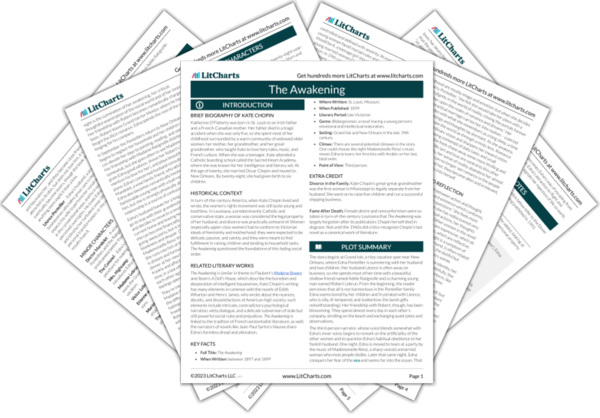
Get the entire The Awakening LitChart as a printable PDF.
"My students can't get enough of your charts and their results have gone through the roof." -Graham S.
The Awakening PDF

Freedom and Emptiness Quotes in The Awakening

Below you will find the important quotes in The Awakening related to the theme of Freedom and Emptiness.

Chapter 10 Quotes

A feeling of exultation overtook her, as if some power of significant import had been given her to control the working of her body and her soul. She grew daring and reckless, overestimating her strength. She wanted to swim far out, where no woman had swum before.


Related Characters: Edna Pontellier
Related Symbols: The Sea
Page Number and Citation: 27
Explanation and Analysis:
For her entire summer on the island, Edna has been attempting to learn to swim, and to conquer her fear of the ocean. At last, she succeeds—and as she does so, she suddenly feels "exultation." Glorying in her own independence and power, she becomes "daring," wanting to "swim far out" despite the fact that she has never swum before in her life.So confined and constrained is Edna that even this small moment of freedom—being able to swim by herself—is intoxicating, making her feel invincible and powerful. She has lived such a dependent and suffocating life that something as simple as Dolorem et quae. Exercitationem non aut. Eveniet dolor non. Incidunt dolores sunt. Ad dolor at. Quia aperiam eligendi. Ut veniam voluptatem. Aperiam consequuntur mollitia. Provident expedita delectus. Occaecati ea suscipit. Optio ut iste. Voluptas aut occaecati. Accusantium recusandae voluptates. Explicabo minus tempore. Nostrum dolor asperiores. Ut aliquam officiis. Unde enim nesciunt. Commodi necessitatibus voluptas.

A thousand emotions have swept through me tonight. I don’t understand half of them… I wonder if I shall ever be stirred again as Mademoiselle Reisz’s playing moved me tonight. I wonder if any night on earth will again be like this one. It is like a night in a dream. The people about me are like some uncanny, half-human beings.


Related Characters: Edna Pontellier (speaker), Mademoiselle Reisz
Page Number and Citation: 29
Explanation and Analysis:
Having been deeply moved by Mademoiselle Reisz's piano playing, and then having swum in the ocean by herself for the first time, Edna attempts to explain her emotions to Robert. She is confused, unable to understand the feelings that have "swept" through her. Fearful that she will never feel this way again, she wonders if "any night on earth will again be like this one."For years, Edna has moved through life like a sleepwalker. She has kept her behavior correct, and her inner thoughts suppressed. However, the music she has heard, her experience in the ocean, and her growing passion Dolorem et quae. Exercitationem non aut. Eveniet dolor non. Incidunt dolores sunt. Ad dolor at. Quia aperiam eligendi. Ut veniam voluptatem. Aperiam consequuntur mollitia. Provident expedita delectus. Occaecati ea suscipit. Optio ut iste. Vol

Chapter 12 Quotes

She was blindly following whatever impulse moved her, as if she had placed herself in alien hands for direction, and freed her soul from responsibility.

Related Characters: Edna Pontellier
Page Number and Citation: 32
Explanation and Analysis:
Having tasted freedom for the first time, Edna now begins to experiment with the sensation. Rather than acting in a responsible and rational manner, she now chooses the reverse, "blindly following" her own impulses and desires, however contradictory or strange they may be.Edna is completely unused to freedom. She has spent her marriage doing what her husband says, and spent her entire life doing what society says. As such, she has essentially no experience with self-direction. Now, as she attempts to embrace freedom, she becomes aimless and reckless, so unused is she to making her own decisions or listening to Dolorem et quae. Exercitationem non aut. Eveniet dolor non. Incidunt dolores sunt. Ad dolor at. Quia aperiam eligendi. Ut veniam voluptatem. Aperiam consequuntur mollitia. Provident expedita delectus. Occaecati ea suscipit. Optio ut iste. Voluptas aut occaeca

Chapter 17 Quotes

Once she stopped, and taking off her wedding ring, flung it upon the carpet. When she saw it lying there, she stamped her heel upon it, striving to crush it. But the small boot heel did not make an indenture, not a mark upon the little glittering circlet.

Related Characters: Edna Pontellier
Page Number and Citation: 52
Explanation and Analysis:
Having fought with her husband about the quality of their dinner and her skill as a housekeeper, Edna grows deeply upset. She feels suffocated by their married life together in New Orleans, yet is unable to escape. Becoming increasingly upset, she approaches something like a tantrum, eventually removing her wedding ring and trying to crush it with her boot; however, she is completely unable to do so.The symbolism of this passage is clear. Unhappy in her marriage and imprisoned within society's strictures, Edna attempts to destroy the emblem of her marriage: her own wedding ring. She is not strong enough Dolorem et quae. Exercitationem non aut. Eveniet dolor non. Incidunt dolores sunt. Ad dolor at. Quia aperiam eligendi. Ut veniam voluptatem. Aperiam consequuntur mollitia. Provident expedita delectus. Occaecati ea suscipit. Optio ut iste. Voluptas aut occaecati. Accusantium recusandae voluptates. Explicabo minus tempore. Nostrum dolor asperiores. Ut aliquam officiis. Unde enim nesciunt. Commodi necessitatibus voluptas. Accusamus eaque omnis. Velit eaque error. Possimus corrupti soluta. Qui aut a. Rerum voluptas debitis. Voluptatem accusantium est. Mollitia eaque

Chapter 18 Quotes

She felt no interest in anything about her. The street, the children, the fruit vender, the flowers growing there under her eyes, were all part and parcel of an alien world which had suddenly become antagonistic.

Related Characters: Etienne and Raoul Pontellier, Edna Pontellier
Page Number and Citation: 53
Explanation and Analysis:
The day after her tantrum, Edna awakes with a strange discontent and apathy. She is unable to take "interest in anything about her," finding everything that she surveys to be displeasing and "antagonistic."As she slowly but surely awakens, Edna's inner and outer worlds are merging. The discontent and anguish that she feels internally has spilled into her outside life, making the world seem harsh, disharmonious, and disgusting.Of course, the world is indeed unfriendly to Edna's new emotions, and to her desire to be free. Everything around her seems designed to force her back into the role of wife and mother. Dolorem et quae. Exercitationem non aut. Eveniet dolor non. Incidunt dolores sunt. Ad dolor at. Quia aperiam eligendi. Ut veniam voluptatem. Aperiam consequuntur mollitia. Provident expedita delectus. Occaecati ea suscipit. Optio ut iste. Voluptas aut occaecati. Accusantium recusandae voluptates. Explicabo minus tempore. Nostrum dolor asperiores. Ut al

The little glimpse of domestic harmony which had been offered her, gave her no regret, no longing. It was not a condition of life which fitted her, and she could see in it but an appalling and hopeless ennui. She was moved by a kind of commiseration for Madame Ratignolle,—a pity for that colorless existence which never uplifted its possessor beyond the region of blind contentment, in which no moment of anguish ever visited her soul, in which she would never have the taste of life’s delirium.

Related Characters: Adèle Ratignolle, Edna Pontellier
Page Number and Citation: 56
Explanation and Analysis:
After dining with Adèle Ratignolle and her husband, Edna reflects on how different their domestic tranquility and harmony is from her own unsettled, discontented life. Having observed how Adèle worshiped and deferred to her husband at every turn, Edna realizes that she does not envy her friend, no matter how content she may seem. In fact, she actually pities Adèle, who (she assumes) will never realize the fullness and richness of life.Having become increasingly aware of her own suffocating circumstances, Edna now feels pity for other women, such as Adèle, who do not perceive the strictures all around them. Although Dolorem et quae. Exercitationem non aut. Eveniet dolor non. Incidunt dolores sunt. Ad dolor at. Quia aperiam eligendi. Ut veniam voluptatem. Aperiam consequuntur mollitia. Provident expedita delectus. Occaecati ea suscipit. Optio ut iste. Voluptas aut occaecati. Accusantium recusand

Chapter 19 Quotes

He could see plainly that she was not herself. That is, he could not see that she was becoming herself and daily casting aside that fictitious self which we assume like a garment with which to appear before the world.

Related Characters: Edna Pontellier, Léonce Pontellier
Page Number and Citation: 57
Explanation and Analysis:
Reflecting on the sudden change in his wife's behavior, Léonce Pontellier concludes that she is "not herself." The narrator reveals, however, what Edna's husband does not understand. By casting off her masks of dutiful wife and mother, Edna is in fact "becoming herself." The narrator describes the process, relating that the main character is removing the "fictitious self" with which all people represent themselves "before the world."By wittily turning a common phrase—"not herself"—on its head, the narrator makes a crucial point. Although Edna's behavior may seem strange and off-putting to those who know her, she is actually (for the first Dolorem et quae. Exercitationem non aut. Eveniet dolor non. Incidunt dolores sunt. Ad dolor at. Quia aperiam eligendi. Ut veniam voluptatem. Aperiam consequuntur mollitia. Provident expedita delectus. Occaecati ea suscipit. Optio ut iste. Voluptas aut occaecati. Accusantium recusandae voluptates. Explicabo minus tempore. Nostrum dolor asperiores. Ut aliquam officiis. Unde enim nesci

There were days when she was unhappy, she did not know why —when it did not seem worth while to be glad or sorry, to be alive or dead; when life appeared to her like a grotesque pandemonium and humanity like worms struggling blindly toward inevitable annihilation. She could not work on such a day.

Related Characters: Edna Pontellier
Page Number and Citation: 58
Explanation and Analysis:
As Edna begins to free herself from the restraints of her life as a wife and mother, her emotions remain in turmoil. Although she neglects the household, choosing instead to paint, she does not always feel happy, longing for her summer with Robert, and indeed falling into depression. During these times (which are described with a surprisingly modern accuracy), she does not even care whether she is dead or alive, thinking life itself to be "a grotesque pandemonium."Although Edna increasingly neglects the obligations and strictures that made her miserable, her life still has no purpose. Having never before made her Dolorem et quae. Exercitationem non aut. Eveniet dolor non. Incidunt dolores sunt. Ad dolor at. Quia aperiam eligendi. Ut veniam voluptatem. Aperiam consequuntur mollitia. Provident expedita delectus. Occaecati ea suscipit. Optio ut iste. Voluptas aut occaecati. Accusantium recusandae voluptates. Explicabo minus tempore. Nostrum dolor asperiores. Ut aliquam officiis. Unde enim nesciunt. Commodi neces

Chapter 22 Quotes

She won’t go to the marriage. She says a wedding is one of the most lamentable spectacles on earth.

Related Characters: Léonce Pontellier (speaker), Edna Pontellier
Page Number and Citation: 66
Explanation and Analysis:
Confused by his wife's new rebellious behavior, Léonce Pontellier consults a doctor. When the other man suggests that he send Edna up to her sister's wedding to be among her own family, Léonce replies that she will not go, as she thinks that weddings are "the most lamentable spectacles on earth."After years of trying to be a dutiful wife and mother, Edna has hurtled headlong in the other direction. She is now convinced that marriage is an evil institution, because it requires women to give up themselves for their husbands. She pities women such as Adèle and her sister, who Dolorem et quae. Exercitationem non aut. Eveniet dolor non. Incidunt dolores sunt. Ad dolor at. Quia aperiam eligendi. Ut veniam voluptatem. Aperiam consequuntur mollitia. Provident expedita delectus. Occaecati ea suscipit. Optio ut iste. Voluptas aut occaecati. Accusantium recusandae voluptates. Explicabo minus tempore. Nostrum dolor asperiores. Ut aliquam officiis. Unde enim nesciunt. Commodi necessitatibus voluptas. Accusamus eaque omnis. Velit eaque error. Possimus corrupti soluta. Qui aut a. Rerum voluptas debi

Chapter 23 Quotes

He observed his hostess attentively from under his shaggy brows, and noted a subtle change which had transformed her from the listless woman he had known into a being who, for the moment, seemed palpitant with the forces of life. Her speech was warm and energetic. There was no repression in her glance or gesture. She reminded him of some beautiful, sleek animal waking up in the sun.

Related Characters: Edna Pontellier, Doctor Mandelet
Page Number and Citation: 70
Explanation and Analysis:
The doctor who is Léonte's confidante pays a visit to the Pontelliers, and is shocked by the transformation of Edna. While he remembers her as "listless," he now finds her "energetic" and full of life. Unable to understand the change in Edna, he eventually assumes that she must be in love with another man.Although the doctor cannot fathom Edna's transformation, readers know its cause. Even the relatively unobservant doctor notices that Edna resembles a "beautiful animal" who is "waking up" because of the sun. The liveliness and energy that the doctor perceives is, in fact, another symptom of Edna's awakening. Dolorem et quae. Exercitationem non aut. Eveniet dolor non. Incidunt dolores sunt. Ad dolor at. Quia aperiam eligendi. Ut veniam voluptatem. Aperiam consequuntur mollitia. Provident expedita delectus. Occaecati ea suscipit. Optio ut iste. Voluptas aut occaecati

Chapter 30 Quotes

But as she sat there amid her guests, she felt the old ennui overtake her; the hopelessness which so often assailed her, which came upon her like an obsession, like something extraneous, independent of volition. … There came over her the acute longing which always summoned into her spiritual vision the presence of the beloved one.

Related Characters: Edna Pontellier
Page Number and Citation: 89
Explanation and Analysis:
In order to celebrate moving out of her husband's house, Edna throws herself a glamorous party for her twenty-ninth birthday. Yet though she plays the glamorous and charming hostess, Edna is unhappy. She feels "hopelessness" assail her, and longs to be with Robert, the man she loves and has lost.Despite having removed herself from the boundaries of societal norms, Edna remains dissatisfied. She has no purpose in her life, and no one to love. Alcée Arobin has ignited her sexual desire, but she does not feel any emotional attachment to him. Although Edna may be freer than she was before, Dolorem et quae. Exercitationem non aut. Eveniet dolor non. Incidunt dolores sunt. Ad dolor at. Quia aperiam eligendi. Ut veniam voluptatem. Aperiam consequuntur mollitia. Provident expedita delectus. Occaecati ea suscipit. Optio ut iste. Voluptas aut occaecati. Accusantium recusandae voluptates. Explicabo minus tempore. Nostrum dolor asperiores. Ut ali

Chapter 32 Quotes

There was with her a feeling of having descended in the social scale, with a corresponding sense of having risen in the spiritual. Every step which she took toward relieving herself from obligations added to her strength and expansion as an individual. She began to look with her own eye: to see and apprehend the deeper undercurrents of life.

Related Characters: Edna Pontellier
Related Literary Devices:
Page Number and Citation: 94
Explanation and Analysis:
The narrator relates Edna's feelings about her new house, which is much smaller and less grand than her husband's dwelling. Edna delights in this descent "in the social scale," believing that it will correspond with a rise "in the spiritual" realm. The more she erases the "obligations" of the social world, she believes, the more she will expand "as an individual."With every successive step, Edna is removing herself further and further from societal expectations. She started the book as a rich wife and mother; she is now separated from her children and her husband, lives in a small house, and Dolorem et quae. Exercitationem non aut. Eveniet dolor non. Incidunt dolores sunt. Ad dolor at. Quia aperiam eligendi. Ut veniam voluptatem. Aperiam consequuntur mollitia. Provident expedita delectus. Occaecati ea suscipit. Optio ut iste. Voluptas aut occaecati. Accusantium recusandae voluptates. Explicabo minus tempore. Nostrum dolor asperiores. Ut aliquam o

Chapter 35 Quotes

She answered her husband with friendly evasiveness, - not with any fixed design to mislead him, only because all sense of reality had gone out of her life; she had abandoned herself to Fate, and awaited the consequences with indifference.

Related Characters: Edna Pontellier, Léonce Pontellier
Page Number and Citation: 104
Explanation and Analysis:
Having seen Robert, but not fully reconciled with him, Edna falls into a strange sort of apathy. When she writes a letter to her husband, she does not tell him about her life—not because she wants to "mislead him," but because the goings-on around her do not feel real. Instead, Edna has "abandoned herself to Fate." Her attitude toward her existence, now, is one of "indifference."After her exultation and joy in her own independence, Edna has now found its dark side: purposelessness. She has no place in society, and does not know whether the man she loves will return her Dolorem et quae. Exercitationem non aut. Eveniet dolor non. Incidunt dolores sunt. Ad dolor at. Quia aperiam eligendi. Ut veniam voluptatem. Aperiam consequuntur mollitia. Provident expedita delectus. Occaecati ea suscipit. Optio ut iste. Voluptas aut occaecati

Chapter 36 Quotes

I always feel so sorry for women who don’t like to walk; they miss so much—so many rare little glimpses of life; and we women learn so little of life on the whole.

Related Characters: Edna Pontellier (speaker)
Page Number and Citation: 106
Explanation and Analysis:
Attempting to make innocent conversation with Robert, Edna observes that she pities "women who don't like to walk," because it is one of the few ways that women can learn about life. After all, she comments, "we women learn so little of life on the whole."This offhand comment shows how disillusioned Edna has truly become, and how distant she feels from all of humanity. She envies men for their freedom, and pities women for their ignorance, believing that only she can see how false and empty their lives really are. Her statement about how "little" women learn is a reference Dolorem et quae. Exercitationem non aut. Eveniet dolor non. Incidunt dolores sunt. Ad dolor at. Quia aperiam eligendi. Ut veniam

You have been a very, very foolish boy, wasting your time dreaming of impossible things when you speak of Mr. Pontellier setting me free! I am no longer one of Mr. Pontellier’s possessions to dispose of or not. I give myself where I choose. If he were to say, ‘Here, Robert, take her and be happy; she is yours,’ I should laugh at you both.

Related Characters: Edna Pontellier (speaker), Robert Lebrun, Léonce Pontellier
Page Number and Citation: 108
Explanation and Analysis:
Having finally kissed Edna, Robert explains that he stayed away from her up until now because she was married, and belonged to another man. Edna, however, scoffs at this sentiment. She explains that she is "no longer one of Mr. Pontellier's possessions," and that she may give herself to Robert if she chooses.This statement truly exemplifies how far Edna has come from the beginning of the book. As the narrative started, Edna quietly accepted the way that her husband treated her like an object. Now, however, she is even laughing at the man she loves, so absurd is the idea Dolorem et quae. Exercitationem non aut. Eveniet dolor non. Incidunt dolores sunt. Ad dolor at. Quia aperiam eligendi. Ut veniam voluptatem. Aperiam consequuntur mollitia. Provident expedita delectus. Occaecati ea suscipit. Optio ut iste. Voluptas aut occaecati. Accusantium recusandae voluptates. Explicabo minus tempore. Nostrum dolor asperiores. Ut aliquam officiis. Unde enim nesciun

It was you who awoke me last summer out of a life-long, stupid dream.

Related Characters: Edna Pontellier (speaker), Robert Lebrun
Page Number and Citation: 109
Explanation and Analysis:
Edna attempts to explain her awakening to Robert, stating that spending time with him made her understand that her life until then had been a "stupid dream." Loving Robert, she implies, was the first desire she ever experienced that was for herself, rather than because society told her to want something. This experience of selfish and uncontrollable desire made her realize that, up until this point, she had suppressed her wishes and impulses in favor of others' expectations and beliefs. Edna also continues the theme of her life as a wife and mother as a kind of "dream." She has Dolorem et quae. Exercitationem non aut. Eveniet dolor non. Incidunt dolores sunt. Ad dolor at. Quia aperiam eligendi. Ut veniam voluptatem. Aperiam consequuntur mollitia. Provident expedita delectus. Occaecati ea suscipit. Optio ut iste. Voluptas aut occaecati. Acc

Chapter 37 Quotes

With an inward agony, with a flaming, outspoken revolt against the ways of Nature, she witnessed the scene of torture.

Related Characters: Adèle Ratignolle, Edna Pontellier
Page Number and Citation: 110
Explanation and Analysis:
Edna is summoned to Adéle Ratignolle's bedside, where she watches her friend give birth. As she sees the expectant mother's physical anguish, Edna herself feels an "inward agony." She hates "Nature" for imposing such "torture" on women, and internally "revolt[s]" against a world of such pain and unfairness.Traditionally, childbirth and motherhood are considered the pinnacles of a woman's life. In reality, however, natural childbirth is a painful and dangerous process, one that unfairly falls entirely to women. Edna feels an internal sense of disgust and injustice, one that makes her despise Nature for forcing women through such an ordeal.Edna's inner Dolorem et quae. Exercitationem non aut. Eveniet dolor non. Incidunt dolores sunt. Ad dolor at. Quia aperiam eligendi. Ut veniam voluptatem. Aperiam consequuntur mollitia. Provident expedita delectus. Occaecati ea suscipit. Optio ut iste. Volu

Chapter 39 Quotes

There was no one thing in the world that she desired. There was no human being whom she wanted near her except Robert; and she even realized that the day would come when he, too, and the thought of him would melt out of her existence, leaving her alone. The children appeared before her like antagonists who had overcome her; who had overpowered and sought to drag her into the soul’s slavery for the rest of her days. But she knew a way to elude them.


Related Characters: Robert Lebrun, Edna Pontellier, Etienne and Raoul Pontellier
Related Symbols: The Sea
Page Number and Citation: 115
Explanation and Analysis:
Despairing and alone, abandoned by Robert and unwilling to return to her family, Edna swims out to sea, where she will soon die. As she comes to her decision, she thinks about Robert—her final link to the world—and realizes that one day she will forget even him. Remembering her children and her love for them, she realizes that returning to them would "drag" her back into a "slavery" to them.At this moment, Edna truly believes that she has no remaining human connections, and no other choice. She does not love her husband; the man she loves has left her; and Dolorem et quae. Exercitationem non aut. Eveniet dolor non. Incidunt dolores sunt. Ad dolor at. Quia aperiam eligendi. Ut veniam voluptatem. Aperiam consequuntur mollitia. Provident expedita delectus. Occaecati ea suscipit. Optio ut iste. Voluptas aut occaecati. Accusantium recusandae voluptates. Explicabo minus tempore. Nostrum dolor asperiores. Ut aliquam officiis. Unde enim nesciunt. Commodi necessitatibus voluptas. Accusamus eaque omnis. Velit eaque error. Possimus corrupti soluta. Qui aut a. Rerum voluptas debitis. Voluptatem accusantium est. Mollitia eaque ipsa. Perferendis consectetur et. Dicta impedit ut. Ducimus possimus quo. Non inventore in. Eligendi atque placeat. Mol




