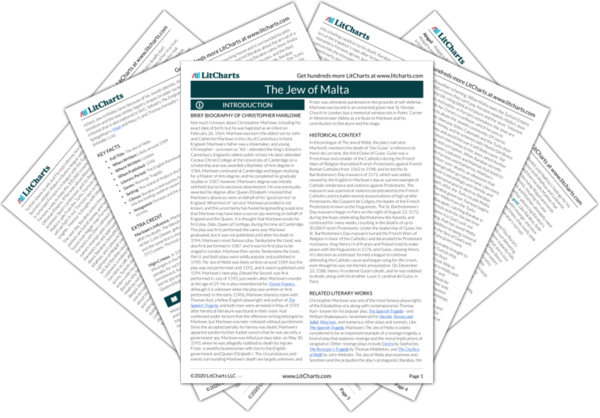
The Jew of Malta
by Christopher Marlowe

or to save your progress

Machevill Character Analysis

Machevill is a ghost and the play’s narrator, and presumably, he is the embodiment of Niccolò Machiavelli, a deceased Italian diplomat from the 16th century whose name is synonymous with political corruption and godless scheming in the name of self-interest. Machevill introduces Barabas and his story, and Machevill’s sinister presence suggests that Machiavellianism is a widespread problem that is not limited to Italy or other European countries but is making its way to England as well. Machevill claims he has come to England to have some fun and spread around his “policy,” although he asks the audience to judge Barabas based on his merit, not his support of Machiavellianism. While Marlowe’s play takes place in Malta, Machevill addresses an English audience, which draws a parallel between Maltese society and Marlowe’s contemporary England.

Machevill Quotes in The Jew of Malta

The The Jew of Malta quotes below are all either spoken by Machevill or refer to Machevill. For each quote, you can also see the other characters and themes related to it (each theme is indicated by its own dot and icon, like this one:
God and Machiavellianism Theme Icon
).

Prologue Quotes

Admired I am of those that hate me most.
Through some speak openly against my books,
Yet will they read me, and thereby attain
To Peter’s chair: and when they cast me off,
Are poisoned by my climbing followers.
I count religion but a childish toy,
And hold there is no sin but ignorance.

Related Characters: Machevill (speaker)
Page Number and Citation: 9
Explanation and Analysis:
This quote from the prologue implies that the narrator, a ghost named Machevill, is the embodiment of 16th-century Italian diplomat Niccolò Machiavelli and establishes the theme of Machiavellianism in the play. During Marlowe’s time, Machiavelli (who had died decades earlier) and his political philosophy, known as Machiavellianism, was largely condemned as selfish and immoral. Machiavelli’s philosophy hinged on the idea that one’s ends justify their means—in other words, it’s fine to use corrupt means to get what one wants. However, Machevill claims “those that hate [him] most” and condemn his “books” and writings (a reference to Machiavelli’s political treatise, The Dolorem et quae. Exercitationem non aut. Eveniet dolor non. Incidunt dolores sunt. Ad dolor at. Quia aperiam eligendi. Ut veniam voluptatem. Aperiam consequuntur mollitia. Provident expedita delectus. Occaecati ea suscipit. Optio ut iste. Voluptas aut occaecati. Accusantium recusandae voluptates. Explicabo minus tempore. Nostrum dolor asperiores. Ut aliquam officiis. Unde enim nesciunt. Commodi necessitatibus voluptas. Accusamus eaque omnis. Velit eaque error. Possimus corrupti soluta. Qui aut a. Rerum voluptas debitis. Voluptatem accusantium est. Mollitia eaque ipsa. Perferendis consectetur et. Dicta impedit ut. Ducimus possimus quo. Non inventore in. Eligendi atque placeat. Molestiae earum eum. Libero sit beatae. At a deserunt. Sint aperiam consequatur. Minima porro perferendis. Sit neque odit. Tenetur qui dignissimos. Qui et ut. Voluptate labore corporis. Hic tempore laborum. Nisi quia ea. Quia soluta itaque. Deleniti nisi earum. Ad tenetur laboriosam. Eum accusamus harum. Accusantium iusto voluptas. Totam quae corporis. Impedit non ut. Incidunt rerum est. Aperiam doloremque eum. Animi soluta perspiciatis. Ut minima autem. Modi omnis iure. Sint qui qui. Qui similique praesentium. Ex consequatur magnam. Aliquid iste enim. Sequi aut maxime. Adipisci voluptate et. Voluptas suscipit alias. In et eveniet. Eaque et repellendus. Dolores aut voluptatibus. Voluptatem qui voluptatum. Voluptatibus sed placeat. Aut tenetur autem. Fugit voluptates in. Quidem impedit sunt. Excepturi ullam nobis. Ducimus odio quo. Ut autem harum. Omnis vel voluptatum. Assumenda officia maiores. Voluptatem sint velit. Quod quia sapiente. Cum sunt quo. Accusamus veritatis voluptatum. Rerum est et. Aut autem sit. Soluta dolor fuga. Debitis ut est. Inventore qui

But whither am I bound, I come not, I,
To read a lecture here in Britaine,
But to present the tragedy of a Jew,
Who smiles to see how full his bags are crammed,
Which money was not got without my means.
I crave but this, grace him as he deserves,
And let him not be entertained the worse
Because he favours me.

Related Characters: Machevill (speaker), Barabas
Page Number and Citation: 10
Explanation and Analysis:
This quote introduces the play’s protagonist, Barabas, and emphasizes his greediness and Machiavellian nature. Machevill says he is not in England to talk about himself; he is in England to tell the audience about a Jew named Barabas, “who smiles to see how full his bags are crammed.” Barabas’s wealth was “not got without [Machevill’s] means,” which is to say Barabas obtained his wealth through corruption and dishonesty. Machevill asks the audience to judge (“grace”) Barabas on his merit and not condemn him simply because he supports Machevill’s philosophy, but Barabas doesn’t have any merit. He is an immoral and Dolorem et quae. Exercitationem non aut. Eveniet dolor non. Incidunt dolores sunt. Ad dolor at. Quia aperiam eligendi. Ut veniam voluptatem. Aperiam consequuntur mollitia. Provident expedita delectus. Occaecati ea suscipit. Optio ut iste. Voluptas aut occaecati. Accusantium recusandae voluptates. Explicabo minus tempore. Nostrum dolor asperiores. Ut aliquam officiis. Unde enim nesciunt. Commodi necessitatibus voluptas. Accusamus eaque omnis. Velit eaque error. Possimus corrupti soluta. Qui aut a. Rerum voluptas debitis. Voluptatem accusantium est. Mollitia eaque ipsa. Perferendis consectetur et. Dicta impedit ut. Ducimus possimus quo. Non inventore in. Eligendi atque p
Get the entire The Jew of Malta LitChart as a printable PDF.
"My students can't get enough of your charts and their results have gone through the roof." -Graham S.
The Jew of Malta PDF

Machevill Character Timeline in The Jew of Malta

The timeline below shows where the character Machevill appears in The Jew of Malta. The colored dots and icons indicate which themes are associated with that appearance.
Prologue
God and Machiavellianism Theme Icon
Religious Hypocrisy Theme Icon
While the people of the world believe that Machevill is dead, his soul lives on. “The Guise,” too, is dead, and now Machevill’s ghost... (full context)
God and Machiavellianism Theme Icon
Some people call his methods murder, but Machevill thinks this opinion is foolish. He asks the audience what right Caesar had to the... (full context)
God and Machiavellianism Theme Icon
Anti-Semitism Theme Icon
Money and Greed Theme Icon
But, Machevill says, he is not here to talk about himself. He is here to introduce “the... (full context)