

The Nightingale
by Kristin Hannah
✓

or to save your progress

Love and War Theme Analysis

Themes and Colors
Morality and Impossible Choices Theme Icon
Antisemitism and Active Resistance  Theme Icon
Gender Roles Theme Icon
Love and War Theme Icon
LitCharts assigns a color and icon to each theme in The Nightingale, which you can use to track the themes throughout the work.
Love and War Theme Icon

Love and war are a timeless pairing, precisely because of the complexity that one engenders in the other. In The Nightingale, both main characters are in love. Isabelle loves her fellow resistance fighter, Gaëtan, and Vianne loves her husband, Antoine. However, the war complicates both romances. For the majority of the novel, Antoine is in a prisoner-of-war camp, meaning that Vianne can only love him from afar. Nonetheless, Vianne loves Antoine and spends much of her free time thinking of him. The fact that he is alive provides Vianne with hope; no matter what the Nazis do, she can look forward to Antoine coming home one day. Meanwhile, Isabelle is in near constant contact with Gaëtan. The two of them regularly partake in romantic rendezvous and spend each night together like it is their last. Because Isabelle and Gaëtan are both resistance fighters, they know that their lives could end at any moment. Yet in the moments they are together, the war is temporarily put on pause, and they effectively use each other and their romance to escape the horrors that war has brought to their everyday lives. Although love is far from a remedy for war in The Nightingale, the novel shows how love can inspire hope and alleviate suffering during war and in other times of hardship.

Related Themes from Other Texts
Compare and contrast themes from other texts to this theme…
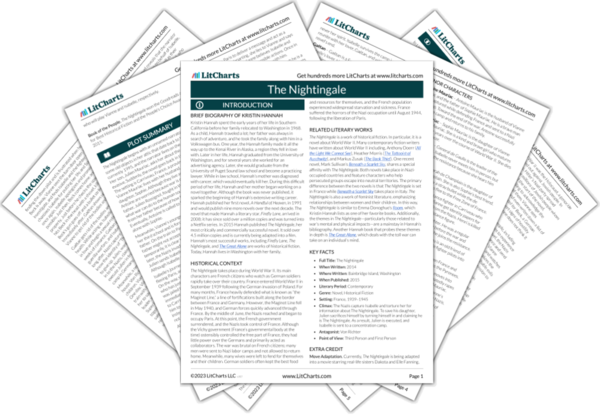
Get the entire The Nightingale LitChart as a printable PDF.
"My students can't get enough of your charts and their results have gone through the roof." -Graham S.
The Nightingale PDF

Love and War Quotes in The Nightingale

Below you will find the important quotes in The Nightingale related to the theme of Love and War.

Chapter 1 Quotes

If I have learned anything in this long life of mine, it is this: In love we find out who we want to be; in war we find out who we are.


Related Characters: Vianne Mauriac (The Narrator) (speaker), Isabelle Rossignol, Julien Mauriac, Ari de Champlain, Gaëtan
Page Number and Citation: 1
Explanation and Analysis:
This quote comes from the beginning of the novel. In 1995, the novel’s present, the unnamed narrator (Vianne Mauriac) juxtaposes love with war. To Vianne, love is an idealistic notion, while war reveals harsh truths. As such, Vianne seems to suggest, love and war are at odds with each other and thus cannot coexist harmoniously. The novel explores this theme throughout its epic story, examining the problems love creates in times of war. Vianne’s sister Isabelle, for instance, falls in love with fellow resistance fighter Gaëtan, but the highly dangerous nature of their missions dooms their relationship from the start. Dolorem et quae. Exercitationem non aut. Eveniet dolor non. Incidunt dolores sunt. Ad dolor at. Quia aperiam eligendi. Ut veniam voluptatem. Aperiam consequuntur mollitia. Provident expedita delectus. Occaecati ea suscipit. Optio ut iste. Voluptas aut occaecati. Accusantium recusandae voluptates. Explicabo minus tempore. Nostrum dolor asperiores. Ut aliquam officiis. Unde enim nesciunt. Commodi necessitatibus voluptas. Accusamus eaque omnis. Velit eaque error. Possimus corrupti soluta. Qui aut a. Rerum voluptas debitis. Voluptatem accusantium est. Mollitia eaque ipsa. Perferendis consectetur et. Dicta impedit ut. Ducimus possimus quo. Non inventore in. Eligendi atque p

Chapter 2 Quotes

“But … but … you’re a postman.”

He held her gaze and suddenly she couldn’t breathe. “I am a soldier now, it seems.”

Related Characters: Vianne Mauriac (The Narrator) (speaker), Antoine Mauriac (speaker)
Page Number and Citation: 14
Explanation and Analysis:
This conversation takes place between Vianne and her husband, Antoine. In this scene, Antoine reveals that the French government drafted him and that he’ll soon leave to fight in World War II. Although Vianne feared this news was coming, it is still a shock to her. The repeated ellipses after “but” suggest that she can barely speak, perhaps because she doesn’t know what to say. As her response indicates, Antoine is merely a postman; he has no business fighting on the frontlines of a war. Nonetheless, that is exactly what he must do. During World War I and World War Dolorem et quae. Exercitationem non aut. Eveniet dolor non. Incidunt dolores sunt. Ad dolor at. Quia aperiam eligendi. Ut veniam voluptatem. Aperiam consequuntur mollitia. Provident expedita delectus. Occaecati ea suscipit. Optio ut iste. Voluptas aut occaecati. Accusantium recusandae voluptates. Explicabo minus tempore. Nostrum dolor asperiores. Ut aliquam officiis. Unde enim nesciunt. Commodi necessitatibus voluptas. Accusamus eaque omnis. Velit eaque error. Possimus corrupti soluta. Qui aut a. Rerum voluptas debitis. Voluptatem accusantium est. Mollitia eaque ipsa

Chapter 4 Quotes

“Ah. Consequences,” Madame said. “Perhaps now you will see that they should be considered.”

Related Characters: Madame Allard (speaker), Isabelle Rossignol
Page Number and Citation: 31
Explanation and Analysis:
Madame Allard has just informed Isabelle that she’s expelling her from her etiquette school and sending her back home to Paris. Isabelle doesn’t want to return to Paris because she doesn’t know if her father will take her in. Here, Madame Allard explains to Isabelle that she should have thought about that before she talked back to teachers—that her actions have consequences. Madame Allard’s advice sheds light on Isabelle’s character at the novel’s start; she does not think before she acts. And once the war begins, her carelessness will lead to far more serious consequences.  Although Isabelle’s actions are immature, Dolorem et quae. Exercitationem non aut. Eveniet dolor non. Incidunt dolores sunt. Ad dolor at. Quia aperiam eligendi. Ut veniam voluptatem. Aperiam consequuntur mollitia. Provident expedita delectus. Occaecati ea suscipit. Optio ut iste. Voluptas aut occaecati. Accusantium recusandae voluptates. Explicabo minus tempore. Nostrum dolor asperiores. Ut aliquam officiis. Unde enim nesciunt. Commodi necessitatibus voluptas. Accusamus eaque omnis. Velit eaque error. Possimus corrupti soluta. Qui aut a. Rerum voluptas debitis. Voluptatem accusantium est. Mollitia eaque ipsa. Perferendis consect

Chapter 6 Quotes

“Something like that. But like I said, a nice girl like you wouldn’t know anything about survival.”

“You’d be surprised the things I know, Gaëtan, There is more than one kind of prison.

Related Characters: Gaëtan (speaker), Isabelle Rossignol (speaker)
Page Number and Citation: 54
Explanation and Analysis:
This quote comes from one of the first conversations between Isabelle and Gaëtan as they travel to Carriveau. Isabelle is eager to head off to war, but Gaëtan is unsure she is ready. Gaëtan has spent time in prison and knows something of the world’s dangers. He takes Isabelle for granted and assumes she is a “nice girl” who does not know about traditionally masculine spaces of war and rebellion. In response, Isabelle is determined to show Gaëtan that she is just as experienced as him, even though their experiences differ because of their respective genders. Gaëtan has been confined Dolorem et quae. Exercitationem non aut. Eveniet dolor non. Incidunt dolores sunt. Ad dolor at. Quia aperiam eligendi. Ut veniam voluptatem. Aperiam consequuntur mollitia. Provident expedita delectus. Occaecati ea suscipit. Optio ut iste. Voluptas aut occaecati. Accusantium recusandae voluptates. Explicabo minus tempore. Nostrum dolor asperiores. Ut aliquam officiis. Unde enim nesciunt. Commodi necessitatibus voluptas. Accusamus eaque omnis. Velit eaque error. Possimus corrupti soluta. Qui aut a. Rerum voluptas debitis. Voluptatem accusantium est. Mollitia eaque ipsa. Perfere

Chapter 9 Quotes

Vianne had been so helpless after Maman’s death. When Papa had sent them away, to live in this small town, beneath the cold, stern eyes of a woman who had shown the girls no love, Vianne had . . . wilted.

In another time, she might have shared with Isabelle what they had in common, how undone she’d been by Maman’s death, how Papa’s rejection had broken her heart.

Related Characters: Julien Rossignol, Vianne Mauriac (The Narrator), Isabelle Rossignol
Related Literary Devices:
Page Number and Citation: 110
Explanation and Analysis:
This quote comes just after Vianne and Isabelle fight over Isabelle’s treatment of Beck. Vianne wishes she had more authority over her sister and realizes that she has none now because she was not there for Isabelle when Isabelle was a child. Here, Vianne describes her younger self as fragile; the word “wilted” suggests that she was delicate like a flower and unable to maintain herself, let alone someone else. Vianne knows that war—in conjunction with her mother’s death—is responsible for making her childhood so loveless and lonely and for making her become so “wilted.” And now that war is Dolorem et quae. Exercitationem non aut. Eveniet dolor non. Incidunt dolores sunt. Ad dolor at. Quia aperiam eligendi. Ut veniam voluptatem. Aperiam consequuntur mollitia. Provident expedita delectus. Occaecati ea suscipit. Optio ut iste. Voluptas aut occaecati. Accusantium recusandae voluptates. Explicabo minus tempore. Nostrum dolor asperiores. Ut aliquam officiis. Unde enim nesciunt. Commodi necessitatibus voluptas. Accusamus eaque omnis. Velit eaque error. Possimus corrupti soluta. Qui aut a. Rerum

Chapter 16 Quotes

“You are a foolish girl. Thank God your maman did not live to see who you have become.”

Isabelle hated how deeply that hurt her. “Or you Papa,” she said. “Or you.”

Related Characters: Julien Rossignol (speaker), Isabelle Rossignol (speaker)
Page Number and Citation: 226
Explanation and Analysis:
This quote occurs at the end of a conversation between Julien and Isabelle, where Isabelle tells Julien she wants to reopen his bookstore. At the end of the conversation, Isabelle makes a crude sexual jab at her father’s expense, which results in this exchange. Here, the novel lays bare the core of Julien and Isabelle’s fractured relationship; they despise each other because neither is over the death of Isabelle’s mother. Julien’s words sting Isabelle because he knows how dear Isabelle’s mother was to both of them. Meanwhile, Isabelle’s jab hurts Julien because Julien believes he has remained loyal to the Dolorem et quae. Exercitationem non aut. Eveniet dolor non. Incidunt dolores sunt. Ad dolor at. Quia aperiam eligendi. Ut veniam voluptatem. Aperiam consequuntur mollitia. Provident expedita delectus. Occaecati ea suscipit. Optio ut iste. Voluptas aut occaecati. Accusantium recusandae voluptates. Explicabo minus tempore. Nostrum dolor asperiores. Ut aliquam officiis. Unde enim nesciunt. Commodi necessitatibus voluptas. Accusamus eaque omnis. Velit eaque error. Possimus corrupti soluta. Qui aut a. Rerum voluptas debitis. Voluptatem accusantium est. Mollitia eaque ipsa. Perferendis consectetur et. Dicta impedit ut. Ducimus possimus quo. Non inventore in. Eligendi atque placeat. Molestiae earum eum. Libero sit beatae. At a deserunt. Sint aperiam consequatur. Minima porro perferendis. Sit neque odit. Tenetur qui dignissimos. Qui et ut. Voluptate labore corporis. Hic tempore laborum. Nisi quia ea

Chapter 28 Quotes

She was wiser than she’d been before. Now she knew how fragile life and love were. Maybe she would love him for only this day, or maybe for only the next week or maybe until she was an old, old woman. Maybe he would be the love of her life . . . or her love for the duration of this war . . . or maybe he would only be her first love. All she really knew was that in this terrible, frightening world, she had stumbled into something unexpected.

Related Characters: Gaëtan, Isabelle Rossignol
Page Number and Citation: 404
Explanation and Analysis:
Isabelle considers her growing feelings for Gaëtan. As he nurses her back to health, they begin to fall in love. For much of the novel, Gaëtan and Isabelle resist the urge to fall for each other. Other characters repeatedly warn them that love is dangerous because of the hurt one feels after they lose their love. However, although love may be dangerous, in this passage, Isabelle suggests that it can also be a good thing, providing excitement and giving lovers an appreciation for the fragility of life. This quotation marks a distinct change from the Isabelle seen at the beginning Dolorem et quae. Exercitationem non aut. Eveniet dolor non. Incidunt dolores sunt. Ad dolor at. Quia aperiam eligendi. Ut veniam voluptatem. Aperiam consequuntur mollitia. Provident expedita delectus. Occaecati ea suscipit. Optio ut iste. Voluptas aut occaecati. Accusantium recusandae voluptates. Explicabo minus tempore. Nostrum dolor asperiores. Ut aliquam officiis. Unde enim nesciunt. Commodi necessitatibus voluptas. Accusamus eaque omnis. Velit eaque error. Possimus corrupti soluta. Qui aut a. Rerum voluptas debitis. Voluptatem accusantium est. Mollitia eaque ipsa. Perferendis consectetur et. Dicta impedit ut. Ducimus possimus quo. Non

Chapter 33 Quotes

Vianne heard the confession that lay beneath. He was telling her his own story in the only way he could, cloaked in Isabelle’s. He was saying that he had worried about his choice to join the army in the Great War, that he had agonized over what his fighting had done to his family. He knew how changed he’d been on his return, and instead of pain drawing him closer to his children and wife, it had separated them.

Related Characters: Julien Rossignol, Vianne Mauriac (The Narrator), Isabelle Rossignol
Page Number and Citation: 472
Explanation and Analysis:
This quote comes from a conversation between Vianne and Julien Rossignol the day before Julien turns himself in to save Isabelle’s life. Julien uses the conversation to say goodbye to Vianne and ensure she will care for Isabelle, explaining that Isabelle’s wartime activities will have traumatized her and that she’ll need Vianne’s help to heal. Though he doesn’t say it, it’s clear to Vianne that Julien is speaking from experience. The conversation is a significant moment for both Vianne and Julien’s characters. For the first time, Julien finds a way to talk about how his service during World War I Dolorem et quae. Exercitationem non aut. Eveniet dolor non. Incidunt dolores sunt. Ad dolor at. Quia aperiam eligendi. Ut veniam voluptatem. Aperiam consequuntur mollitia. Provident expedita delectus. Occaecati ea suscipit. Optio ut iste. Voluptas aut occaecati. Accusantium recusandae voluptates. Explicabo minus tempore. Nostrum dolor asperiores. Ut aliquam officiis. Unde enim nesciunt. Commodi necessitatibus voluptas. Accusamus eaque omnis. Velit eaque error. Possimus corrupti soluta. Qui aut a. Rerum voluptas debitis. Voluptatem accusantium est. Mollitia eaque ipsa. Perferendis consectetur et. Dicta impedit ut. Ducimus possimus quo. Non inventore in. Eligendi atque placeat. Molestiae earum eum.

Chapter 38 Quotes

Don’t forget me, Isabelle thought. She wished she had the strength to say it out loud.

Related Characters: Isabelle Rossignol (speaker), Vianne Mauriac (The Narrator), Julien Rossignol, Gaëtan
Page Number and Citation: 551
Explanation and Analysis:
This passage takes place during the novel’s 1940s timeline, just after the war’s end. Isabelle is in Gaëtan’s arms and surrounded by her family. She knows that she will die soon. For much of her life, Isabelle has felt unloved. Her mother died while she was young, her father wanted nothing to do with her, and Vianne was too busy dealing with her own trauma to handle Isabelle’s as well. However, during the war, Isabelle discovers love in all the places she always wanted it, as well as in a place she did not expect (Gaëtan). Isabelle fought the war Dolorem et quae. Exercitationem non aut. Eveniet dolor non. Incidunt dolores sunt. Ad dolor at. Quia aperiam eligendi. Ut veniam voluptatem. Aperiam consequuntur mollitia. Provident expedita delectus. Occaecati ea suscipit. Optio ut iste. Voluptas aut occaecati. Accusantium recusandae voluptates. Explicabo minus tempore. Nostrum dolor asperiores. Ut aliquam officiis. Unde enim nesciunt. Commodi necessitatibus voluptas. Accusamus eaque omnis. Velit eaque error. Possimus corrupti soluta. Qui aut a. Rerum voluptas debitis. Voluptatem accusantium est. Mollitia eaque ipsa

Chapter 39 Quotes

I smile at them, my two boys who should have broken me, but somehow saved me, each in his own way. Because of them, I know now what matters, and it is not what I have lost. It is my memories. Wounds heal. Love lasts.

We remain.

Related Characters: Vianne Mauriac (The Narrator) (speaker), Julien Mauriac, Von Richter, Rachel de Champlain, Ari de Champlain
Related Literary Devices:
Page Number and Citation: 564
Explanation and Analysis:
This quote concludes the novel. Vianne is still at the passeurs reunion, and she has just reunited with Ari de Champlain after many decades. Vianne considers Ari is the first her “two boys” as she took him in as her son after his mother, Vianne’s best friend Rachel, was sent to a concentration camp during World War II. He “broke[]” her because he was taken away from her at a young age to live in America with his Jewish relatives. However, Ari also saved Vianne because he gave her something to fight for during the war. Meanwhile, Julien broke Vianne Dolorem et quae. Exercitationem non aut. Eveniet dolor non. Incidunt dolores sunt. Ad dolor at. Quia aperiam eligendi. Ut veniam voluptatem. Aperiam consequuntur mollitia. Provident expedita delectus. Occaecati ea suscipit. Optio ut iste. Voluptas aut occaecati. Accusantium recusandae voluptates. Explicabo minus tempore. Nostrum dolor asperiores. Ut aliquam officiis. Unde enim nesciunt. Commodi necessitatibus voluptas. Accusamus eaque omnis. Velit eaque error. Possimus corrupti soluta. Qui aut a. Rerum voluptas debitis. Voluptatem accusantium est. Mollitia eaque ipsa. P





