

Waiting for Godot
by Samuel Beckett
✓

or to save your progress

Themes and Colors
Humor and the Absurd Theme Icon
Waiting, Boredom, and Nihilism Theme Icon
Modernism and Postmodernism Theme Icon
Time Theme Icon
Humanity, Companionship, Suffering, and Dignity Theme Icon
LitCharts assigns a color and icon to each theme in Waiting for Godot, which you can use to track the themes throughout the work.
Humor and the Absurd Theme Icon

Waiting for Godot is a prime example of what has come to be known as the theater of the absurd. The play is filled with nonsensical lines, wordplay, meaningless dialogue, and characters who abruptly shift emotions and forget everything, ranging from their own identities to what happened yesterday. All of this contributes to an absurdist humor throughout the play. However, this humor is often uncomfortably mixed together with tragic or serious content to make a darker kind of comedy. Estragon refers to "billions of others," who have been killed, and describes being beaten by an anonymous "they." Lucky (whose ill-fitting name is itself darkly comic) is treated horribly and physically abused on-stage. And Vladimir and Estragon talk nonchalantly and pleasantly about suicide. All this has a discomforting effect on the audience, who is not sure how to react to this absurd mixture of comedy and tragedy, seriousness and playfulness. In act one, Vladimir says, "one daren't even laugh any more," and his comment could apply well to the audience of Beckett's play, who don't know whether to laugh or to cringe at the events on-stage. The absurdity caused by the seeming mismatch between characters' tones and the content of their speech can be seen as a reaction to a world emptied of meaning and significance. If the world is meaningless, it makes no sense to see it as comic or tragic, good or bad. Beckett thus presents an eerie play that sits uneasily on the border between tragedy and comedy, in territory one can only call the absurd.

Related Themes from Other Texts
Compare and contrast themes from other texts to this theme…

Humor and the Absurd ThemeTracker

The ThemeTracker below shows where, and to what degree, the theme of Humor and the Absurd appears in each act of Waiting for Godot. Click or tap on any chapter to read its Summary & Analysis.
How often theme appears:
act length:
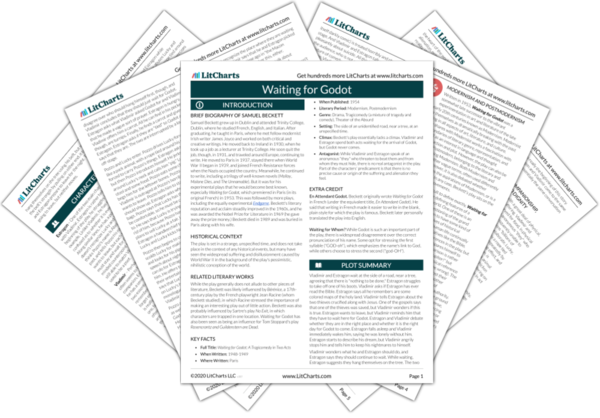
Get the entire Waiting for Godot LitChart as a printable PDF.
"My students can't get enough of your charts and their results have gone through the roof." -Graham S.
Waiting for Godot PDF

Humor and the Absurd Quotes in Waiting for Godot

Below you will find the important quotes in Waiting for Godot related to the theme of Humor and the Absurd.

Act 1 Quotes

One daren't even laugh any more.
Dreadful privation.
Merely smile. (He smiles suddenly from ear to ear, keeps smiling, ceases as suddenly.) It's not the same thing. Nothing to be done.


Related Characters: Vladimir (speaker), Estragon (speaker)
Page Number and Citation: 5
Explanation and Analysis:
These lines follow Vladimir’s laughter at the suggestion that the two repent being born, perhaps as if doing so would allow them to escape their horrible predicament. Vladimir first denies the validity of that laughter, then tries to mimic its feeling with a smile, before rapidly denying the smile’s efficacy. Rejecting the value of humor, even dark humor, helps clarify the depths of nihilism in which the play exists. Though Vladimir has a natural impulse to laugh at the joke, he self-censors—as if something about the environment renders any levity entirely unacceptable. Then he tries to artificially perform a similar Dolorem et quae. Exercitationem non aut. Eveniet dolor non. Incidunt dolores sunt. Ad dolor at. Quia aperiam eligendi. Ut veniam voluptatem. Aperiam consequuntur mollitia. Provident expedita delectus. Occaecati ea suscipit. Optio ut iste. Voluptas aut occaecati. Accusantium recusandae voluptates. Explicabo minus tempore. Nostrum dolor asperiores. Ut aliquam officiis. Unde enim nesciunt. Commodi necessitatibus voluptas. Accusamus eaque omnis. Velit eaque error. Possimus corrupti soluta. Qui aut a. Rerum voluptas debitis. Voluptatem accusantium est. Mollitia eaque ipsa. Perferendis consectetur et. Dicta impedit ut. Ducimus possimus quo. Non inventore in. Eligendi atque placeat. Molestiae earum eum. Libero sit beatae.

What do we do now?
Wait.
Yes, but while waiting.
What about hanging ourselves?
Hmm. It'd give us an erection.


Related Characters: Estragon (speaker), Vladimir (speaker)
Related Literary Devices:
Page Number and Citation: 12
Explanation and Analysis:
This exchange takes place after a brief silence during which Estragon gazes at the tree—one of the only elements of the stage’s set. The two express the desperation induced by the prolonged wait for Godot, and the desolation of the environment surrounding them, as well as the tragic humor lying within that horror. That Estragon and Vladimir cannot propose anything to do except “wait” recalls the opening line about “Nothing to be done.” It is characteristic in this play for any moment of silence to be followed by Estragon’s asking what the two should do next. But Vladimir’s answer is Dolorem et quae. Exercitationem non aut. Eveniet dolor non. Incidunt dolores sunt. Ad dolor at. Quia aperiam eligendi. Ut veniam voluptatem. Aperiam consequuntur mollitia. Provident expedita delectus. Occaecati ea suscipit. Optio ut iste. Voluptas aut occaecati. Accusantium recusandae voluptates. Explicabo minus tempore. Nostrum dolor asperiores. Ut aliquam officiis. Unde enim nesciunt. Commodi necessitatibus voluptas. Accusamus eaque omnis. Velit eaque error. Possimus corrupti soluta. Qui aut a. Rerum voluptas debitis. Voluptatem accusantium est. Mollitia eaque ipsa. Perferendis consectetur et. Dicta impedit ut. Ducimus possimus quo. Non inventore in. Eligendi atque placeat. Molestiae earum eum. Libero sit beatae. At a deserunt. Sint aperiam consequatur. Minima porro perferendis. Sit neque odit. Tenetur qui dignissimos. Qui et ut. Voluptate labore corporis. Hic tempore laborum. Nisi quia ea. Quia soluta itaque. Deleniti nisi earum. Ad te

To Godot? Tied to Godot! What an idea! No question of it. (Pause.) For the moment.

Related Characters: Vladimir (speaker), Godot
Page Number and Citation: 17
Explanation and Analysis:
Vladimir responds, here, to Estragon asking if they are currently tied to Godot. He explains that such an idea would be ridiculous, but then implies that it might be possible and even desirable in the future. One of the beauties of the play is that “Godot” can be taken as a symbol for many different things: God, a bond to civilization, a rescuer, etc. In the broadest sense, he offers some kind of redemptive alternative to the desperate, unmoored characters. Currently the two remain, without question, not “tied to Godot,” for they have not yet made a social connection with Dolorem et quae. Exercitationem non aut. Eveniet dolor non. Incidunt dolores sunt. Ad dolor at. Quia aperiam eligendi. Ut veniam voluptatem. Aperiam consequuntur mollitia. Provident expedita delectus. Occaecati ea suscipit. Optio ut iste. Voluptas aut occaecati. Accusantium recusandae voluptates. Explicabo minus tempore. Nostrum dolor asperiores. Ut aliquam officiis. Unde enim nesciunt. Commodi necessitatibus voluptas. Accusamus eaque omnis. Velit eaque error. Possimus corrupti soluta. Qui au

You are human beings none the less. (He puts on his glasses.) As far as one can see. (He takes off his glasses.) of the same species as myself. (He bursts into an enormous laugh.) Of the same species as Pozzo! Made in God's image!

Related Characters: Pozzo (speaker), Estragon, Vladimir
Page Number and Citation: 19
Explanation and Analysis:
During the first moments of their conversation, Estragon tells Pozzo they they are not from this area. In response, Pozzo makes this odd appeal to their common humanity, stressing how the characters are all fundamentally the same, in particular through their connection to God. Pozzo focuses on visual consistencies. Beckett signals this emphasis through the stage direction of putting on and removing glasses. And he indicates that the assertion that they are “human beings” must be confirmed by visual data. Pozzo then moves first into a scientific register of speech with the repetition of “species” and then swaps in religious Dolorem et quae. Exercitationem non aut. Eveniet dolor non. Incidunt dolores sunt. Ad dolor at. Quia aperiam eligendi. Ut veniam voluptatem. Aperiam consequuntur mollitia. Provident expedita delectus. Occaecati ea suscipit. Optio ut iste. Voluptas aut occaecati. Accusantium recusandae voluptates. Explicabo minus tempore. Nostrum dolor asperiores. Ut aliquam officiis. Unde enim nesciunt. Commodi necessitatibus voluptas. Accusamus eaque omnis. Velit eaque error. Possimus corrupti soluta. Qui aut a. Rerum voluptas debitis. Voluptatem accusantium est. Mollitia eaque ipsa. Perferendis consectetur et. Dicta impedit ut. Ducimus possimus quo. Non inven

Why he doesn't make himself comfortable? Let's try and get this clear. Has he not the right to? Certainly he has. It follows that he doesn't want to. There's reasoning for you.

Related Characters: Pozzo (speaker), Lucky
Page Number and Citation: 30
Explanation and Analysis:
After a series of confused attempts to ask Pozzo why Lucky continues to carry so many bags, Vladimir and Estragon are finally able to communicate their question. In response, Pozzo gives this strange definition of his human autonomy, claiming that Lucky is indeed able to rest. Pozzo elevates the status of his statement with the phrases “Let’s try and get this clear” and “There’s reasoning for you.” He implies that other dialogue was perhaps not so lucid, and that he will be able to offer a more direct and useful understanding of their dynamics. Between these two phrases lies a Dolorem et quae. Exercitationem non aut. Eveniet dolor non. Incidunt dolores sunt. Ad dolor at. Quia aperiam eligendi. Ut veniam voluptatem. Aperiam consequuntur mollitia. Provident expedita delectus. Occaecati ea suscipit. Optio ut iste. Voluptas aut occaecati. Accusantium recusandae voluptates. Explicabo minus tempore. Nostrum dolor asperiores. Ut aliquam officiis. Unde enim nesciunt. Commodi necessitatibus voluptas. Accusamus eaque omnis. Velit eaque error. Possimus corrupti soluta. Qui aut a. Rerum voluptas debitis. Voluptatem accusantium est. Mollitia eaque ipsa. Perferendis consectetur et. Dicta impe

The tears of the world are a constant quantity. For each one who begins to weep, somewhere else another stops. The same is true of the laugh. (He laughs.) Let us not then speak ill of our generation, it is not unhappier than its predecessors. (Pause.) Let us not speak well of it either. (Pause.) Let us not speak of it at all.

Related Characters: Pozzo (speaker), Lucky
Page Number and Citation: 32
Explanation and Analysis:
Pozzo offers this theory of world suffering because Estragon has begun to cry after Lucky kicks him in the shins. Previously Lucky shed tears, and Pozzo thus interprets the tears' transfer from Lucky to Estragon as proof that happiness in the world is constant. To construct this theory, Pozzo begins with the physical detail he has just observed: “quantity” is “constant” because when Lucky stopped crying, Estragon started. Applying the same idea to laughter casts Vladimir’s earlier insistence that he not laugh in an intriguing light: It is as if Vladimir was generously leaving the laughter with others, whereas Pozzo Dolorem et quae. Exercitationem non aut. Eveniet dolor non. Incidunt dolores sunt. Ad dolor at. Quia aperiam eligendi. Ut veniam voluptatem. Aperiam consequuntur mollitia. Provident expedita delectus. Occaecati ea suscipit. Optio ut iste. Voluptas aut occaecati. Accusantium recusandae voluptates. Explicabo minus tempore. Nostrum dolor asperiores. Ut aliquam officiis. Unde enim nesciunt. Commodi necessitatibus voluptas. Accusamus eaque omnis. Velit eaque error. Possimus corrupti soluta. Qui aut a. Rerum voluptas debitis. Voluptatem accusantium est. Mollitia eaque ipsa. Perferendis consectetur et. Dicta impedit ut. Ducimus possimus quo. Non inventore in. Eligendi atque placeat. Molestiae earum eum. Libero sit beatae. At a deserunt. Sint aperiam consequatur. Minima porro perferendis. Sit neque odit. Tenetur qui dignissimos. Qui et ut. Voluptate labore corporis. Hic tempore laborum. Nisi quia ea. Quia soluta itaque. Deleniti nisi earum. Ad tenetur laboriosam. Eum accusamus harum. Accusantium iusto voluptas.

(to Lucky.) How dare you! It's abominable! Such a good master! Crucify him like that! After so many years! Really!

Related Characters: Vladimir (speaker), Lucky, Pozzo
Page Number and Citation: 34
Explanation and Analysis:
Only moments after Vladimir accuses Pozzo of having treated Lucky like a banana, he switches his perspective entirely. At the mere suggestion from Pozzo that he has been indirectly abused by Lucky, Vladimir immediately becomes sympathetic to the slaveholder and chastises Lucky instead. These lines clarify the nature of the flippancy in Vladimir’s character. As we have already noted, Vladimir often makes comments in protest but never follows them with action. Here the reason is not cowardice but rather distraction. Just a single comment from Pozzo immediately makes Vladimir consider Lucky’s actions “abominable” and presents Pozzo as both “master” and Dolorem et quae. Exercitationem non aut. Eveniet dolor non. Incidunt dolores sunt. Ad dolor at. Quia aperiam eligendi. Ut veniam voluptatem. Aperiam consequuntur mollitia. Provident expedita delectus. Occaecati ea suscipit. Optio ut iste. Voluptas aut occaecati. Accusantium recusandae voluptates. Explicabo minus tempore. Nostrum dolor asperiores

He thinks?
Certainly. Aloud. He even used to think very prettily once, I could listen to him for hours. Now... (he shudders).

Related Characters: Vladimir (speaker), Pozzo (speaker)
Page Number and Citation: 41
Explanation and Analysis:
As Pozzo prepares to have Lucky perform for Vladimir and Estragon, he notes that one option is for Lucky to “think.” Vladimir is naturally taken aback, considering that Lucky has not yet produced a single real utterance, and Pozzo asserts he can, but also indicates this behavior is now somewhat horrifying. We see here a crucial revision to Lucky’s character. He is not, as we might think, inherently silent or disabled. Rather he used to be highly capable and has only recently descended into his current maligned state. The lines also clarify why Pozzo may now find him torturous to Dolorem et quae. Exercitationem non aut. Eveniet dolor non. Incidunt dolores sunt. Ad dolor at. Quia aperiam eligendi. Ut veniam voluptatem. Aperiam consequuntur mollitia. Provident expedita delectus. Occaecati ea suscipit. Optio ut iste. Voluptas aut occaecati. Accusantium recusandae voluptates. Explicabo minus tempore. Nostrum dolor asperiores. Ut aliquam officiis. Unde enim nesciunt. Commodi necessitatibus voluptas. Accusamus eaque omnis. Velit eaque error. Possimus corrupti soluta. Qui aut a. Rerum voluptas debitis. Voluptatem accusantium est. Mollitia eaque ipsa. Perferendis consectetur et. Dicta impedit ut. Ducimus possimus quo. Non inve

He used to dance the farandole, the fling, the brawl, the jig, the fandango, and even the hornpipe. He capered. For joy. Now that's the best he can do. Do you know what he calls it?
The Scapegoat's Agony.
The Hard Stool.
The Net. He thinks he's entangled in a net.

Related Characters: Pozzo (speaker), Estragon (speaker), Vladimir (speaker), Lucky
Page Number and Citation: 42
Explanation and Analysis:
After Lucky performs, Pozzo observes sadly that he used to be far better. He lists the previous more artful dances Lucky once knew, and then asks Estragon and Vladimir to guess at the name of the recent one. Most simply, these lines reconfirm that Lucky has degenerated from a previous more talented condition. But the more interesting side of the passages lies in how Estragon, Vladimir, and Pozzo describe the dance. The potential titles from each describe a state of hopelessness: Estragon points at how Lucky is a scapegoat for Pozzo’s hatred; Vladimir puns on stool to mean both an Dolorem et quae. Exercitationem non aut. Eveniet dolor non. Incidunt dolores sunt. Ad dolor at. Quia aperiam eligendi. Ut veniam voluptatem. Aperiam consequuntur mollitia. Provident expedita delectus. Occaecati ea suscipit. Optio ut iste. Voluptas aut occaecati. Accusantium recusandae voluptates. Explicabo minus tempore. Nostrum dolor asperiores. Ut aliquam officiis. Unde enim nesciunt. Commodi necessitatibus voluptas. Accusamus eaque omnis. Velit eaque error. Possimus corrupti soluta. Qui aut a. Rerum voluptas debitis. Voluptatem accusantium est. Mollitia eaque ipsa. Perferendis consectetur et. Dicta impedit ut. Ducimus possimus quo. Non inventore in. Eligendi atque placeat. Molestiae earum eum. Libero sit beatae. At a deserunt. Sint aperiam consequatur. Minima porro perferendis. Sit neque

Then adieu.
Adieu.
Adieu.
Adieu.
Silence. No one moves.
Adieu.
Adieu.
Adieu.
Silence.

Related Characters: Estragon (speaker), Pozzo (speaker), Vladimir (speaker)
Page Number and Citation: 50
Explanation and Analysis:
This tragicomic scene of failed goodbyes comes after Pozzo observes how badly Estrange and Vladimir smell. He says he must leave, but the characters seem somehow unable to part. The exchange reiterates the lack of mobility and agency. But more specifically, it shows how an expressed wish to perform an action does not cause that action to take place. Pozzo conveys a motivation for leaving and goes through the necessary social code to depart, yet even after saying the right words he remains rooted to the ground. Indeed, the group tries twice to complete this simple social gesture, demonstrating that Dolorem et quae. Exercitationem non aut. Eveniet dolor non. Incidunt dolores sunt. Ad dolor at. Quia aperiam eligendi. Ut veniam voluptatem. Aperiam consequuntur mollitia. Provident expedita delectus. Occaecati ea suscipit. Optio ut iste. Voluptas aut occaecati. Accusantium recusandae voluptates. Explicabo minus tempore. Nostrum dolor asperiores. Ut aliquam officiis. Unde enim nesciunt. Commodi necessitatibus voluptas. Accusamus eaque omnis. Velit eaque error. Possimus corrupti soluta. Qui aut a. Rerum voluptas debitis. Voluptatem accusantium est. Mollitia eaque ipsa. Perferendis consectetur et. Dicta impedit ut. Ducimus possimus

Let's go.
We can't.
Why not?
We're waiting for Godot.

Related Characters: Estragon (speaker), Vladimir (speaker), Godot
Page Number and Citation: 51
Explanation and Analysis:
After Pozzo and Lucky depart, Estragon immediately becomes bored once more and recommends that he and Vladimir leave as well. Vladimir reproaches him again, reminding the forgetful Estragon of their reason for staying in the same spot. The lines reiterate the fickleness of Estragon’s memory; his mind immediately resets after every interaction, as if each moment is the beginning to a new play. In this way, he is much like a child who cannot track the progress of time or link earlier events to previous ones. He lives purely and perpetually in the present. Before, we might have believed in Dolorem et quae. Exercitationem non aut. Eveniet dolor non. Incidunt dolores sunt. Ad dolor at. Quia aperiam eligendi. Ut veniam voluptatem. Aperiam consequuntur mollitia. Provident expedita delectus. Occaecati ea suscipit. Optio ut iste. Voluptas aut occaecati. Accusantium recusandae voluptates. Explicabo minus tempore. Nostrum dolor asperiores. Ut aliquam officiis. Unde enim nesciunt. Commodi necessitatibus voluptas. Accusamus eaque omnis. Velit eaque error. Possimus corrupti soluta. Qui aut a. Rerum voluptas debitis. Voluptatem accusantium est. Mollitia eaque ipsa. Perferendis consectetur et. Dicta impedit ut. Ducimus p

Mr. Godot told me to tell you he won't come this evening but surely tomorrow.

Related Characters: Boy (speaker), Godot
Page Number and Citation: 55
Explanation and Analysis:
After the interrogation from Vladimir and Estragon, the Boy finally gives his message. But that memo does not convey much real meaning, and rather serves to revert the characters to their bored state of waiting. This rhetoric of expected arrival further casts Godot as a religious symbol. Though he is presumed to offer some kind of eternal salvation for the characters, his presence is constantly delayed and merely promised by others. At this point in the play, the emptiness of these words is not quite clear, for the Boy has only appeared once. But already Vladimir’s comments on how events Dolorem et quae. Exercitationem non aut. Eveniet dolor non. Incidunt dolores sunt. Ad dolor at. Quia aperiam eligendi. Ut veniam voluptatem. Aperiam consequuntur mollitia. Provident expedita delectus. Occaecati ea suscipit. Optio ut

Tell him... (he hesitates)... tell him you saw us. (Pause.) You did see us, didn't you?

Related Characters: Vladimir (speaker), Godot, Boy
Page Number and Citation: 56
Explanation and Analysis:
As the Boy leaves, Vladimir makes this desperate appeal to human recognition. He first asks the Boy to represent them to Godot, but more simply just asks to have been seen. Recognition is, by now, one of Vladimir’s fixations. He has repeatedly claimed to recall and identify other characters, but they refuse to affirm him in return. And, as a result, Vladimir has begun to doubt his own mental capacities. Thus for the boy to see them and tell Godot about them would signal far more than just conveying simple information. For Vladimir, it would imply that they have been Dolorem et quae. Exercitationem non aut. Eveniet dolor non. Incidunt dolores sunt. Ad dolor at. Quia aperiam eligendi. Ut veniam voluptatem. Aperiam consequuntur mollitia. Provident expedita delectus. Occaecati ea suscipit. Optio ut iste. Voluptas aut occaecati. Accusantium recusandae voluptates. Explicabo minus tempore. Nostrum dolor asperiores. Ut aliquam officiis. Unde enim nesciunt. Commodi nece

Well, shall we go?
Yes, let's go.
They do not move.

Related Characters: Estragon (speaker), Vladimir (speaker)
Related Literary Devices:
Page Number and Citation: 59
Explanation and Analysis:
These final lines of the first act come after Estragon and Vladimir debate separating, decide not to, and then propose to move on together. But instead of actually departing, they just verbally suggest it and remain immobile. Once more, this exchange shows the depth of the stagnancy of the characters. They start with the most radical proposal—to separate—then reduce it to moving together, and yet they cannot even accomplish that. As with the “Adieu” sequence, the two perform the requisite speech acts of “Yes, let’s go,” but they cannot transfer language into action. Indeed, this distinction is one of the Dolorem et quae. Exercitationem non aut. Eveniet dolor non. Incidunt dolores sunt. Ad dolor at. Quia aperiam eligendi. Ut veniam voluptatem. Aperiam consequuntur mollitia. Provident expedita delectus. Occaecati ea suscipit. Optio ut iste. Voluptas aut occaecati. Accusantium recusandae voluptates. Explicabo minus tempore. Nostrum dolor asperiores. Ut aliquam officiis. Unde enim nesciunt. Commodi necessitatibus voluptas. Accusamus eaque omnis. Velit eaque error. Possimus corrupti soluta. Qui aut a. Rerum voluptas debitis. Voluptatem accusantium est. Mollitia eaque ipsa. Perferendis consectetur et. Dicta impedit ut. Ducimus possimus quo. Non inventore in. Eligendi atque placeat. Molestiae earum eum. Libero sit beatae. At a deserunt. Sint aperiam consequatur

Act 2 Quotes

Say, I am happy.
I am happy.
So am I.
So am I.
We are happy.
We are happy. (Silence.) What do we do now, now that we are happy?
Wait for Godot.

Related Characters: Estragon (speaker), Vladimir (speaker)
Page Number and Citation: 66
Explanation and Analysis:
As act two begins, Vladimir and Estragon seem to undergo a radical emotional shift. With no real pretense, both claim to be happy, yet when they wonder what to do with this new good mood, they can come up with no suggestion besides waiting once more for Godot. The way the two profess their happiness merits some skepticism. After all, no events have transpired to change their lives from the previous day. And rather than offer any rational basis for being in a good mood, the two will themselves into the state by verbally exclaiming its existence. Vladimir commands Estragon Dolorem et quae. Exercitationem non aut. Eveniet dolor non. Incidunt dolores sunt. Ad dolor at. Quia aperiam eligendi. Ut veniam voluptatem. Aperiam consequuntur mollitia. Provident expedita delectus. Occaecati ea suscipit. Optio ut iste. Voluptas aut occaecati. Accusantium recusandae voluptates. Explicabo minus tempore. Nostrum dolor asperiores. Ut aliquam officiis. Unde enim nesciunt. Commodi necessitatibus voluptas. Accusamus eaque omnis. Velit eaque error. Possimus corrupti soluta. Qui aut a. Rerum voluptas debitis. Voluptatem accusantium est. Mollitia eaque ipsa. Perferendis consectetur et. Dicta impedit ut. Ducimus possimus quo. Non inventore in. Eligendi atque placeat. Molestiae earum eum. Libero sit beatae. At a deserunt. Sint

The best thing would be to kill me, like the other.
What other? (Pause.) What other?
Like billions of others.

Related Characters: Estragon (speaker), Vladimir (speaker)
Page Number and Citation: 68
Explanation and Analysis:
Estragon makes this allusion to human suffering after suggesting that he and Vladimir part ways. Vladimir points out that Estragon often makes similar grandiose statements without ever following through, which causes Estragon to take the more radical position that he should die. Beneath this seemingly insensible statement lie a serious of complex references to other parts in the play. Estragon’s suggestion that death would be preferable to the dullness of their interaction recalls the earlier suggestion that they hang themselves to relieve boredom. But “the other” more likely refers to Lucky, for Pozzo had suggested killing him in order to Dolorem et quae. Exercitationem non aut. Eveniet dolor non. Incidunt dolores sunt. Ad dolor at. Quia aperiam eligendi. Ut veniam voluptatem. Aperiam consequuntur mollitia. Provident expedita delectus. Occaecati ea suscipit. Optio ut iste. Voluptas aut occaecati. Accusantium recusandae voluptates. Explicabo minus tempore. Nostrum dolor asperiores. Ut aliquam officiis. Unde enim nesciunt. Commodi necessitatibus voluptas. Accusamus eaque omnis. Velit eaque error. Possimus corrupti soluta. Qui aut a. Rerum voluptas debitis. Voluptatem accusantium est. Mollitia eaque ipsa. Perferendis consectetur et. Dicta impedit ut. Ducimus possimus quo. Non inventore in. Eligendi atque placeat. Molestiae earum eum. Libero sit beatae. At a deserunt. Sint aperiam consequatur. Minima porro perferendis. Sit neque odit. Tenetur qui dignissimos. Qui et ut. Voluptate labore corporis. Hic tempore laborum. Nisi quia ea. Quia soluta itaque. Deleniti nisi earum. Ad tenetur laboriosam. Eum accusamus harum. Accusantium iusto voluptas. Totam quae corporis. Impedit non ut. Incidunt reru

Suppose we got up to begin with?
No harm trying.
They get up.
Child's play.
Simple question of will-power.

Related Characters: Estragon (speaker), Vladimir (speaker)
Page Number and Citation: 96
Explanation and Analysis:
Pozzo, Vladimir, and Estragon have all by now fallen on the floor and seem unable to rise. Yet after waiting for a bit and expressing a new wave of boredom, they suddenly stand up, self-congratulate, and render it an act of will.These lines are quite humorous, for their simplicity directly contrasts with the earlier empty discussion about standing up. Whereas before words could not translate into action, here action takes place when there is a void of words. The characters may consider this an act of “will-power,” but it seems far more to be a factor of them having had Dolorem et quae. Exercitationem non aut. Eveniet dolor non. Incidunt dolores sunt. Ad dolor at. Quia aperiam eligendi. Ut veniam voluptatem. Aperiam consequuntur mollitia. Provident expedita delectus. Occaecati ea suscipit. Optio ut iste. Voluptas aut occaecati. Accusantium recusandae voluptates. Explicabo minus tempore. Nostrum dolor asperiores. Ut aliquam officiis. Unde enim nesciunt. Commodi necessitatibus voluptas. Accusamus eaque omnis. Velit eaque error. Possimus corrupti soluta. Qui aut a. Rerum voluptas debitis. Voluptatem accusantium est. Mollitia eaque ipsa. Perferendis consectetur et. Dicta impedit ut. Ducimus possimus

Well? Shall we go?
Yes, let's go.
They do not move.

Related Characters: Estragon (speaker), Vladimir (speaker)
Related Literary Devices:
Page Number and Citation: 109
Explanation and Analysis:
These are the final lines of the play. Vladimir suggests they depart and Estragon affirms the choice, but the two remain just as immobile as ever. By finishing the work here, Beckett returns the action back to two earlier moments in the text: The first is an almost identical set of lines at the end of act one. The second is the opening sequence in which it was immediately established that nothing was to be done. This invites a first reading that the text moves nowhere and serves to argue that the characters will wait in boredom and nihilism forever. Dolorem et quae. Exercitationem non aut. Eveniet dolor non. Incidunt dolores sunt. Ad dolor at. Quia aperiam eligendi. Ut veniam voluptatem. Aperiam consequuntur mollitia. Provident expedita delectus. Occaecati ea suscipit. Optio ut iste. Voluptas aut occaecati. Accusantium recusandae voluptates. Explicabo minus tempore. Nostrum dolor asperiores. Ut aliquam officiis. Unde enim nesciunt. Commodi necessitatibus voluptas. Accusamus eaque omnis. Velit eaque error. Possimus corrupti soluta. Qui aut a. Rerum voluptas debitis. Voluptatem accusantium est. Mollitia eaque ipsa. Perferendis consectetur et. Dicta impedit ut. Ducimus possimus quo. Non inventore in. Eligendi atque placeat. Molestiae earum eum. Libero sit beatae. At a deserunt. Sint aperiam consequatur. Minima porro perferendis. Sit neque odit. Tenetur qui dignissimos. Qui et ut. Voluptate labore corporis. Hic tempore laborum. Nisi quia ea. Quia soluta itaque. Deleniti nisi earum. Ad tenetur laboriosam. Eum accusamus harum. Accusantium iusto voluptas. Totam quae corporis. Impedit non ut. Incidunt rerum est. Aperiam doloremque eum. Animi soluta perspiciatis. Ut minima autem. M



