


|
Have questions?
Contact us
Already a member? Sign in
|
Get every literary device explanation for Oliver TwistPlus so much more...
Sign up for LitCharts A+Get instant access to every literary device explanation, plus so much more...
Foil
Explanation and Analysis—Nancy and Rose:
Nancy and Rose function as foils for one another, emphasizing the drastic difference that a person's surrounding circumstances can make in who they turn out to be. In Chapter 29, the narrator introduces 17-year-old Rose as the picture of perfect femininity:
Cast in so slight and exquisite a mould, so mild and gentle, so pure and beautiful, that earth seemed not her element, nor its rough creatures her fit companions.
Dickens was interested in the popular pseudo-science of physiognomy, which held that people's character was reflected in their looks. Rose's outer beauty matches her inner perfection. She seems to be the embodiment of good nature, to the point that Oliver and Harry Maylie (rightly) have a difficult time believing that she could truly carry a "stain" on her family's reputation.
In Chapter 40, Nancy goes to Rose to tell her that she has learned of a plot to keep Oliver from learning his true identity. Nancy, who is similar in age to Rose, draws a distinction between the type of woman she is and the type of woman Rose is:
"[I]f there was more like you, there would be fewer like me,—there would—there would!"
Nancy has an air of self-loathing in this scene. She thinks poorly of herself in comparison to Rose. And yet, right before Nancy enters the room to speak with Rose, there is also the sense that she may have been more like Rose had her life gone differently:
The girl’s life had been squandered in the streets, [...] but there was something of the woman’s original nature left in her still; and when she heard a light step approaching the door opposite to that by which she had entered, and thought of the wide contrast which the small room would in another moment contain, she felt burdened with the sense of her own deep shame, and shrunk as though she could scarcely bear the presence of her with whom she had sought this interview.
Nancy can hardly stand to enter Rose's presence, not only because of the "wide contrast" between them, but also because the remainder of her "original nature" makes her ashamed of and sorrowful about her failure to be like Rose. This passage makes it clear that Nancy's circumstances are to blame for her "corruption," and for the tragic end she is about to meet. Nancy attached herself to Fagin and Sikes from a young age out of a need for their support to survive a childhood in the streets. Her reliance on them eventually results in her murder. Rose, by contrast, has always been cared for by loving parental figures who have made sure she had the resources she needed to thrive. When the people who took her in as a young child could no longer care for her, they placed her in the care of benevolent Mrs. Maylie. Through Mrs. Maylie, Rose meets the man she will come to love and eventually marry. Nancy and Rose may easily have swapped fates had they swapped circumstances. Through this pairing of women, Dickens emphasizes that moral perfection and happiness are more available to the wealthy than to the poor.
Monthly
Annual (Best Value)

$595USD/mo
Charged $71.40 USD every year



 Teacher
$795USD/mo
Charged $95.40 USD every year




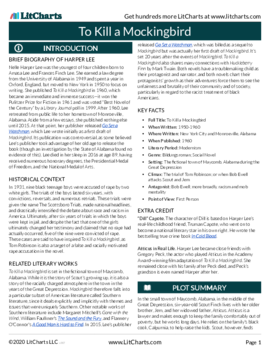
Literature Guide PDFs
LitCharts PDFs for every book you'll read this year.
Instant PDF downloads of all 2238 LitCharts literature guides and of every new one we publish. Try a free sample literature guide.
"Would not have made it through AP Literature without the printable PDFs. They're like having in-class notes for every discussion!"




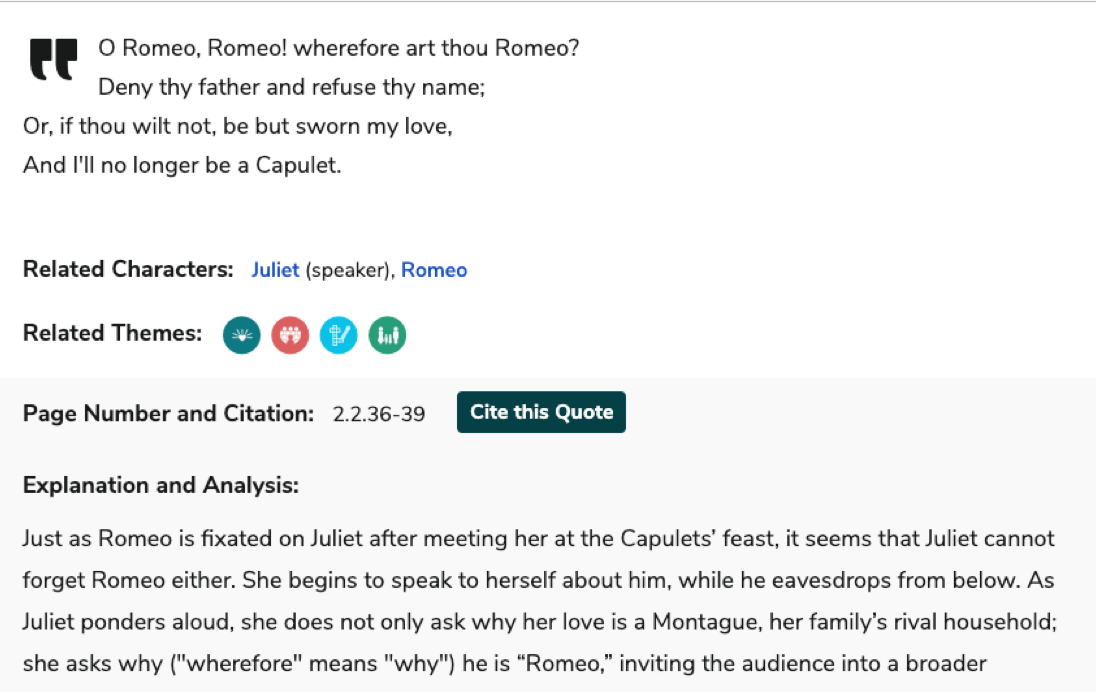
Quotes Explanations
Find the perfect quote. Understand it perfectly. Then rock the citation, too.
For all 49,909 quotes we cover.
For all 49,909 quotes we cover.



Teacher Editions
Close reading made easy for students.
Time saved for teachers.
For every book we cover.
Time saved for teachers.
For every book we cover.


Common Core-aligned


PDFs of modern translations of every one of Shakespeare's 37 plays, 154 sonnets, and 3 longer poems.

Literary Terms and Devices
Definitions and examples for every literary term and device you need to know.
Plus a quick-reference PDF with concise definitions of all 136 terms in one place.
Plus a quick-reference PDF with concise definitions of all 136 terms in one place.


Try a free sample literary term PDF.


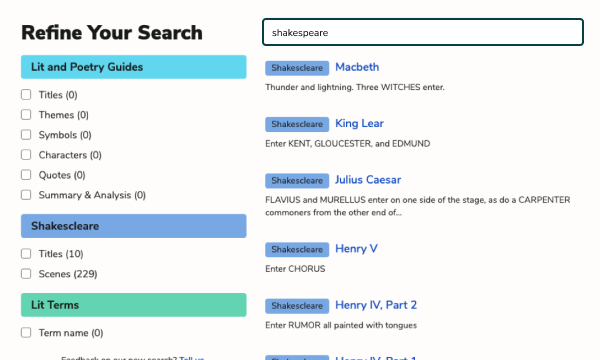
Advanced Search
Refine any search. Find related themes, quotes, symbols, characters, and more.


Related Themes
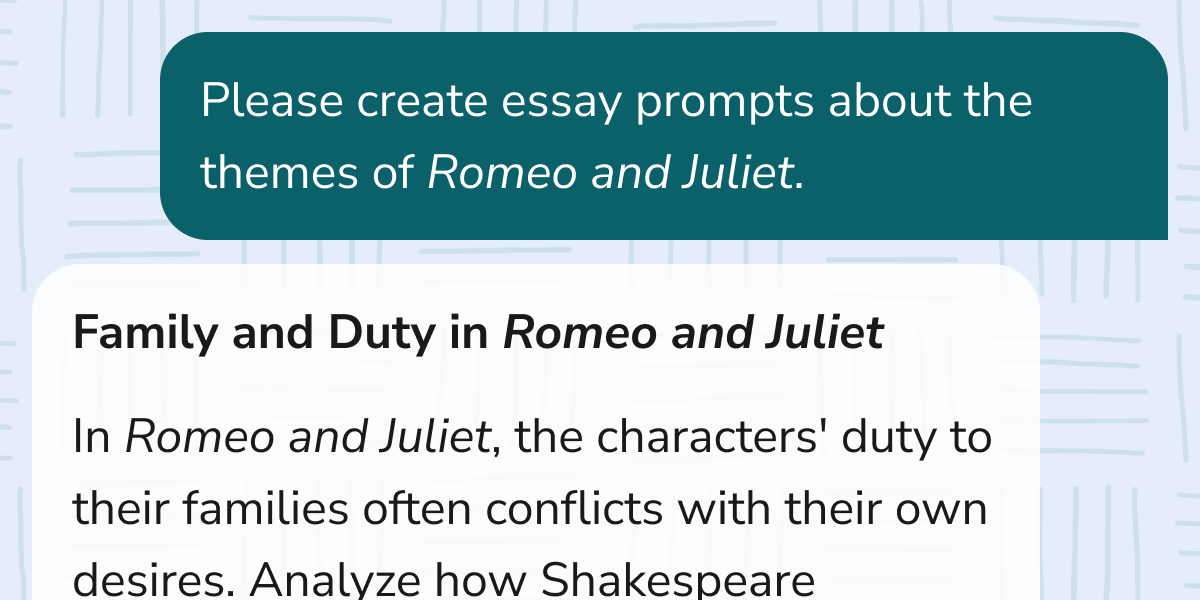
Comparing and contrasting texts? Find where any theme occurs across all of LitCharts in seconds.



Poetry Guides
Line-by-line explanations and analysis of figurative language and poetic devices.
For every lyric poem we cover.
For every lyric poem we cover.
