


|
Have questions?
Contact us
Already a member? Sign in
|
Get every literary device explanation for LolitaPlus so much more...
Sign up for LitCharts A+Get instant access to every literary device explanation, plus so much more...
Metaphor
Explanation and Analysis—Visual Memory:
When describing his mental images of Annabel Leigh and Dolores “Lolita” Haze from his prison cell, Humbert uses two different metaphors for understanding visual memory:
There are two kinds of visual memory: one when you skillfully recreate an image in the laboratory of your mind, with your eyes open (and then I see Annabel in such general terms as: “honey-colored skin,” “thin arms,” “brown bobbed hair,” “long lashes,” “big bright mouth”); and the other when you instantly evoke, with shut eyes, on the dark innerside of your eyelids, the objective, absolutely optical replica of a beloved face, a little ghost in natural colors (and this is how I see Lolita).
Humbert claims that there are “two kinds of visual memory.” The first, he writes, takes place “when you skillfully recreate an image in the laboratory of your mind.” Here, he uses a “laboratory” as a metaphor for memory, imagining himself as a scientist who pieces together an image of a person limb by limb. The second type of visual memory, he argues, occurs when “you instantly invoke [...] the objective, absolutely optical replica of a beloved face, a little ghost in natural colors.” This second type of memory, then, is even stronger than the first, as he claims that he can see an “objective” image of Lolita as a “little ghost” standing before him. The first metaphor draws from the language of science and medicine, and the second, in contrast, invokes ghosts and the supernatural, perhaps communicating Humbert Humbert's irrational, destructive, and even frightening interest in Lolita.
Monthly
Annual (Best Value)

$595USD/mo
Charged $71.40 USD every year



 Teacher
$795USD/mo
Charged $95.40 USD every year




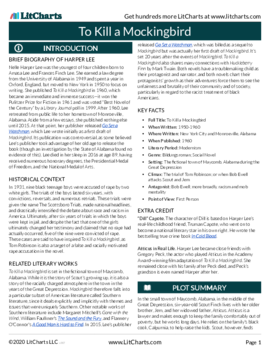
Literature Guide PDFs
LitCharts PDFs for every book you'll read this year.
Instant PDF downloads of all 2238 LitCharts literature guides and of every new one we publish. Try a free sample literature guide.
"Would not have made it through AP Literature without the printable PDFs. They're like having in-class notes for every discussion!"




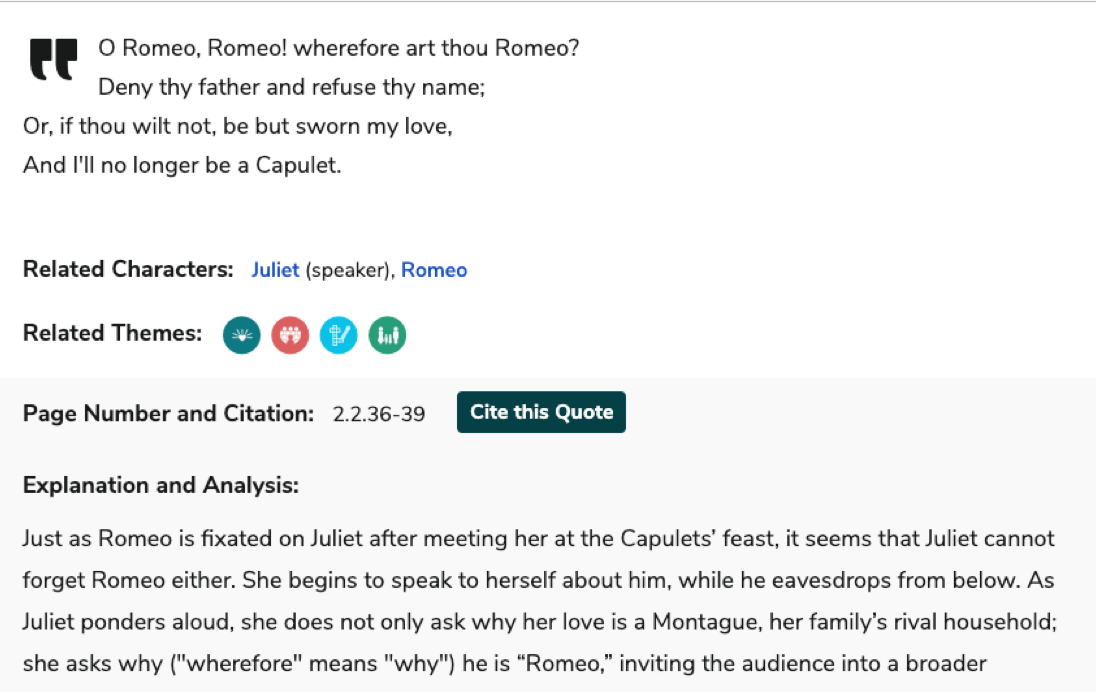
Quotes Explanations
Find the perfect quote. Understand it perfectly. Then rock the citation, too.
For all 49,909 quotes we cover.
For all 49,909 quotes we cover.



Teacher Editions
Close reading made easy for students.
Time saved for teachers.
For every book we cover.
Time saved for teachers.
For every book we cover.


Common Core-aligned


PDFs of modern translations of every one of Shakespeare's 37 plays, 154 sonnets, and 3 longer poems.

Literary Terms and Devices
Definitions and examples for every literary term and device you need to know.
Plus a quick-reference PDF with concise definitions of all 136 terms in one place.
Plus a quick-reference PDF with concise definitions of all 136 terms in one place.


Try a free sample literary term PDF.


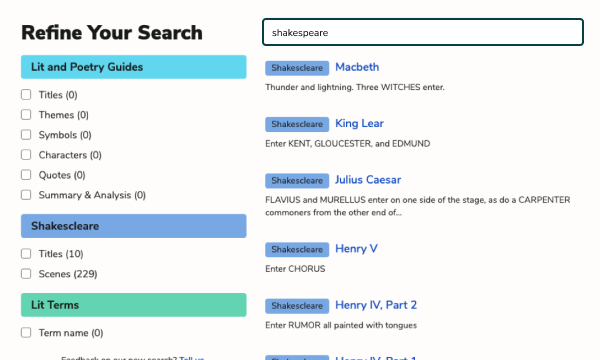
Advanced Search
Refine any search. Find related themes, quotes, symbols, characters, and more.


Related Themes
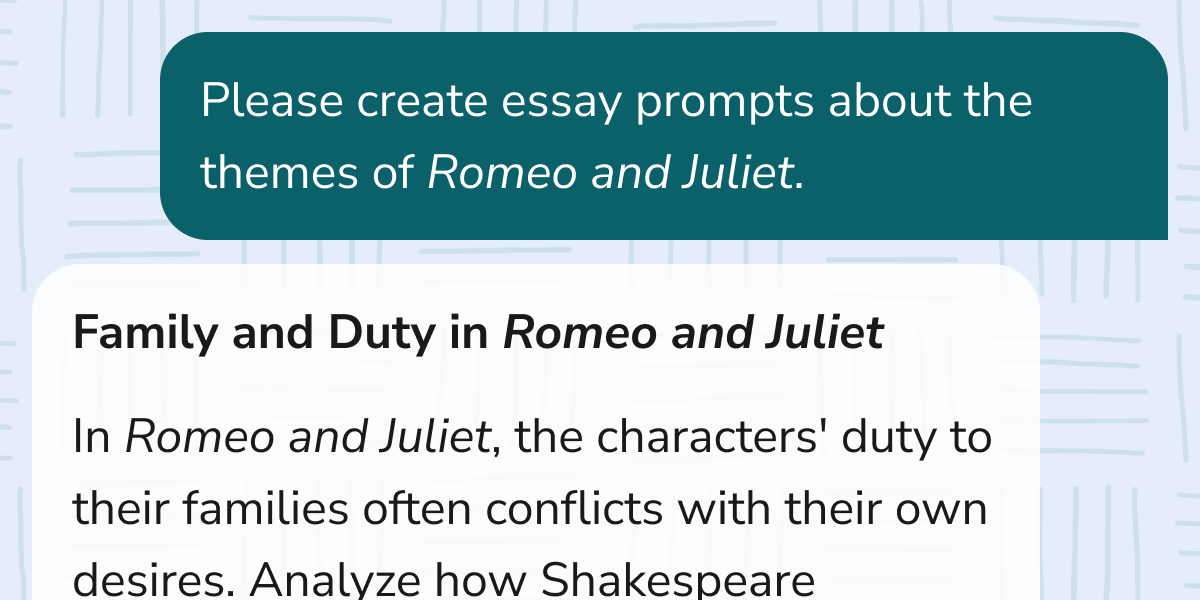
Comparing and contrasting texts? Find where any theme occurs across all of LitCharts in seconds.



Poetry Guides
Line-by-line explanations and analysis of figurative language and poetic devices.
For every lyric poem we cover.
For every lyric poem we cover.
