


|
Have questions?
Contact us
Already a member? Sign in
|
Get every literary device explanation for Le Morte d’ArthurPlus so much more...
Sign up for LitCharts A+Get instant access to every literary device explanation, plus so much more...
Metaphor
Explanation and Analysis—Christian Salvation:
The book uses Christian conversion and salvation narratives as a metaphor for English ethnic identity and belonging. For example, in Volume 1, Book 5, Chapter 10, Priamus injures Gawaine with a magically enhanced weapon, then promises to heal him if only Gawaine will "christen" him:
‘That may I do,’ said the knight, ‘if I will, and so will I if thou wilt succour and aid me, that I may be christened and believe on God, and thereof I require thee of thy manhood, and it shall be great merit for thy soul.’
Priamus is not a baptized Christian when he meets Gawaine. It seems odd that he is so desperate to be baptized ("christened"); this is the one favor he asks of Gawaine when he could ask him for anything. But in the context of Le Morte d'Arthur, seemingly everyone wants to be a baptized Christian. In Volume 2, Book 12, Chapter 14, Tristram tells Palomides that God will forgive "all thine evil" if he surrenders his "Saracen," or Muslim, identity and becomes a Christian:
‘Now take your horse,’ said Sir Tristram, ‘and as ye say so it shall be, and all thine evil will God forgive it you, and I do. And here within this mile is the suffragan of Carlisle that shall give you the sacrament of baptism.’
Then they took their horses and Sir Galleron rode with them. And when they came to the suffragan Sir Tristram told him their desire. Then the suffragan let fill a great vessel with water, and when he had hallowed it he then confessed clean Sir Palomides, and Sir Tristram and Sir Galleron were his godfathers.
In the cases of both Priamus and Palomides, converting to Christianity helps them mend rifts with Arthur's knights and join forces with this brotherhood of knights. This is especially evident in the case of Palomides, who gets two "godfathers" out of the deal. Giving up his Muslim identity and embracing Christianity helps him form religious kinship ties that were previously unavailable to him.
The literal justification in the text for the pressure on non-Christians to convert is that Christianity leads to God's forgiveness and a place in heaven. Like Galahad and Launcelot, Palomides and Priamus are offered the chance to be lifted to heaven by angels. On a metaphorical level, though, Palomides and Priamus's conversions reinforce Christianity as the tie binding together Arthur's knights, and by extension England. In the 15th century, when Malory was writing, England's politics and borders were unstable. The monarchy was still very much mixed up with feudalism, and different families jockeyed for power. Still, there was a longstanding tradition among many of these families of treating non-Christians (Muslims, Jews, and others) as outsiders. As different political factions fought over where and how to consolidate power, English ethnic identity and belonging hinged largely on Christianity and its perceived superiority to other religions. Myths about King Arthur helped prop up the idea that Christianity had deep and sacred roots in England. The book's celebratory narratives about Christian conversion and salvation generally represent the idea that a "real" English person can prove their English-ness with their Christianity, and that all "real" English people are destined to go to heaven.
Monthly
Annual (Best Value)

$595USD/mo
Charged $71.40 USD every year



 Teacher
$795USD/mo
Charged $95.40 USD every year




Literature Guide PDFs
LitCharts PDFs for every book you'll read this year.
Instant PDF downloads of all 2238 LitCharts literature guides and of every new one we publish. Try a free sample literature guide.
"Would not have made it through AP Literature without the printable PDFs. They're like having in-class notes for every discussion!"





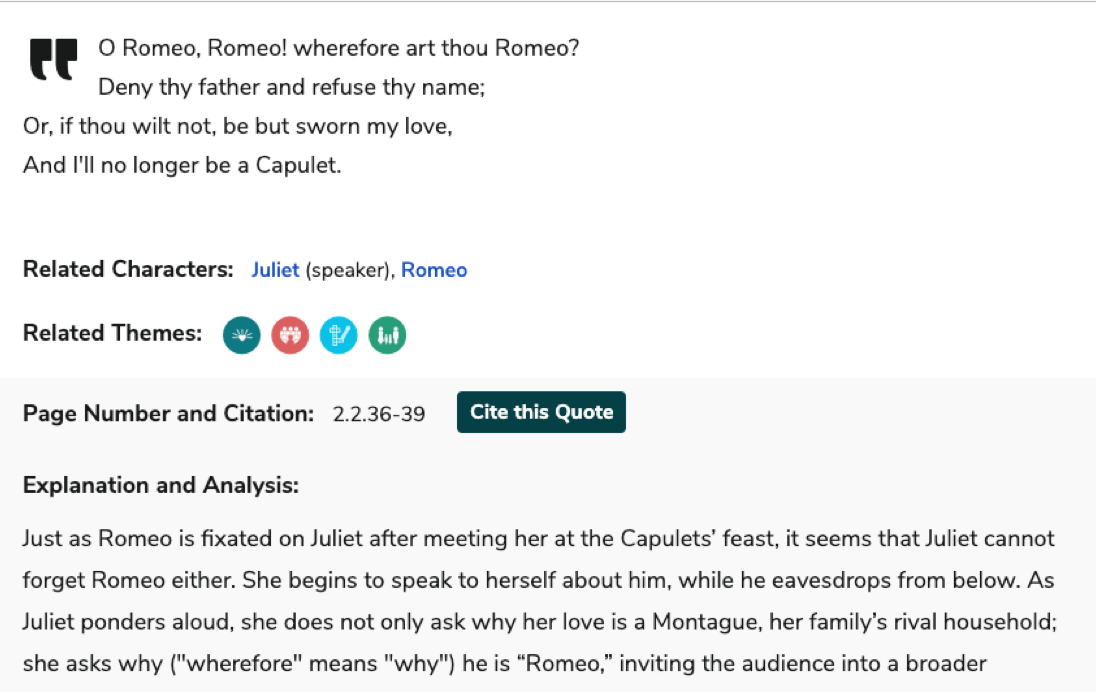
Quotes Explanations
Find the perfect quote. Understand it perfectly. Then rock the citation, too.
For all 49,909 quotes we cover.
For all 49,909 quotes we cover.



Teacher Editions
Close reading made easy for students.
Time saved for teachers.
For every book we cover.
Time saved for teachers.
For every book we cover.


Common Core-aligned


PDFs of modern translations of every one of Shakespeare's 37 plays, 154 sonnets, and 3 longer poems.

Literary Terms and Devices
Definitions and examples for every literary term and device you need to know.
Plus a quick-reference PDF with concise definitions of all 136 terms in one place.
Plus a quick-reference PDF with concise definitions of all 136 terms in one place.


Try a free sample literary term PDF.


Advanced Search
Refine any search. Find related themes, quotes, symbols, characters, and more.


Related Themes
Comparing and contrasting texts? Find where any theme occurs across all of LitCharts in seconds.



Poetry Guides
Line-by-line explanations and analysis of figurative language and poetic devices.
For every lyric poem we cover.
For every lyric poem we cover.
