


|
Have questions?
Contact us
Already a member? Sign in
|
Get every literary device explanation for Le Morte d’ArthurPlus so much more...
Sign up for LitCharts A+Get instant access to every literary device explanation, plus so much more...
Metaphor
Explanation and Analysis—Arthur's Burning Anger:
In Volume 2, Book 20, Chapter 5, Launcelot explains to several of his supporters that he has accidentally killed Agravaine and at least 12 other knights. He uses a metaphor to describe the dire circumstances they are all in:
[...]these knights were sent and ordained by King Arthur to betray me. And therefore the king will in this heat and malice judge the queen to the fire, and that may not I suffer, that she should be burnt for my sake [...]
Launcelot is saying that Arthur is going to burn Guenever at the stake so that he does not have to turn against Launcelot. Launcelot refers to Arthur's anger metaphorically as "heat." The implication in the context of this passage is that Arthur is already burning emotionally just as Guenever is soon to burn physically. Arthur is in such a state of torment that he must choose between exacting revenge on his best knight or on his wife. The fact that Arthur chooses to turn his burning anger on Guenever (literally) demonstrates the deep misogyny of Malory's book. More than this, it emphasizes just how deep the bond between men runs in the social order the book venerates. Under the chivalric code, it is worse for Arthur to murder his best knight than it is for him to murder his wife. Of course, things soon devolve past the point where Arthur and Launcelot's relationship can be saved. But in this moment, it seems that Arthur really thinks his anger will burn out with Guenever's body. She is being thrown on a sacrificial fire so that Arthur can keep loving Launcelot.
Monthly
Annual (Best Value)

$595USD/mo
Charged $71.40 USD every year



 Teacher
$795USD/mo
Charged $95.40 USD every year




Literature Guide PDFs
LitCharts PDFs for every book you'll read this year.
Instant PDF downloads of all 2238 LitCharts literature guides and of every new one we publish. Try a free sample literature guide.
"Would not have made it through AP Literature without the printable PDFs. They're like having in-class notes for every discussion!"





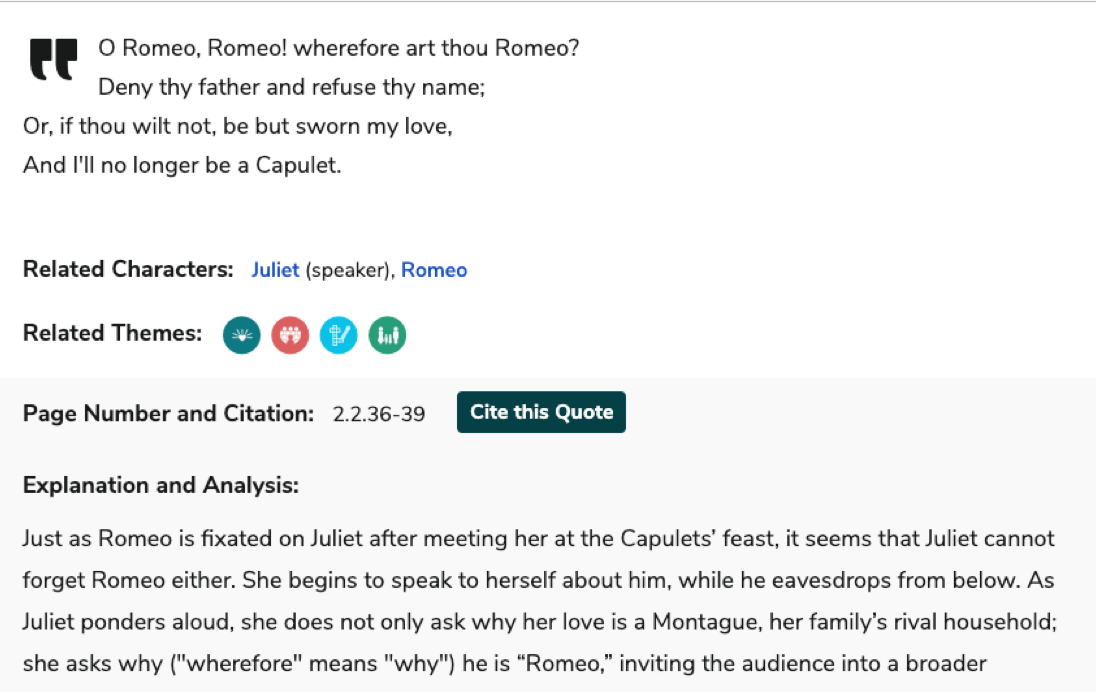
Quotes Explanations
Find the perfect quote. Understand it perfectly. Then rock the citation, too.
For all 49,909 quotes we cover.
For all 49,909 quotes we cover.



Teacher Editions
Close reading made easy for students.
Time saved for teachers.
For every book we cover.
Time saved for teachers.
For every book we cover.


Common Core-aligned


PDFs of modern translations of every one of Shakespeare's 37 plays, 154 sonnets, and 3 longer poems.

Literary Terms and Devices
Definitions and examples for every literary term and device you need to know.
Plus a quick-reference PDF with concise definitions of all 136 terms in one place.
Plus a quick-reference PDF with concise definitions of all 136 terms in one place.


Try a free sample literary term PDF.


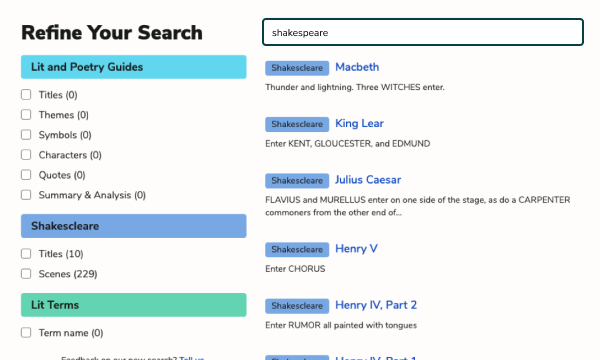
Advanced Search
Refine any search. Find related themes, quotes, symbols, characters, and more.


Related Themes
Comparing and contrasting texts? Find where any theme occurs across all of LitCharts in seconds.



Poetry Guides
Line-by-line explanations and analysis of figurative language and poetic devices.
For every lyric poem we cover.
For every lyric poem we cover.
