The LitCharts.com logo. Have questions? Contact us
Already a member? Sign in
Sign in
Get every literary device explanation for The Jilting of Granny WeatherallPlus so much more...
Sign up for LitCharts A+Get instant access to every literary device explanation, plus so much more...
Simile
Explanation and Analysis—Marching Ghosts:

Porter uses personification and simile to give shape to death’s quiet advance in "The Jilting of Granny Weatherall," allowing the reader to feel its presence as a haunting, natural force. One of the most striking examples appears late in the story, as Granny’s thoughts begin to unravel and her connection to the present fades:

A fog rose over the valley, she saw it marching across the creek swallowing the trees and moving up the hill like an army of ghosts.

This sentence is rich with literary devices. First, the fog is personified: it “marches,” “swallows,” and “moves,” suggesting intent and momentum. Rather than a passive weather phenomenon, the fog takes on an almost conscious presence, silently encroaching on Granny’s world. The use of the simile “like an army of ghosts” transforms it into something even more unsettling: a spectral force that recalls the dead, the past, and the inevitability of what’s coming. The image evokes both the literal approach of nightfall and the more abstract arrival of death.

The quote is especially powerful in context. Just before this moment, Granny is mentally making plans for tomorrow—what chores to do, what letters to burn, what still needs to be said. She’s still clinging to the illusion of continuity and control. But then she forgets what she was thinking, and the narrative shifts to this image of the fog. The juxtaposition creates a stark contrast between Granny’s imagined future and the very real, creeping present. The fog not only symbolize deaths, but it also mirrors her failing mind that is slowly becoming clouded and disoriented.

On a structural level, this moment functions as a turning point. Up until now, Granny has resisted the idea that she is dying. The imagery signals that resistance beginning to dissolve. The natural world becomes a reflection of Granny’s internal state: the hill becomes her consciousness, the fog her forgetfulness and mortality. The personified fog invades both landscape and mind, creating a layered symbolic representation of how death overtakes not only the body but also memory and self-awareness.

This visual also affects the reader’s experience. By describing the fog as something marching “like an army of ghosts,” Porter invites the reader into the scene, not just to witness Granny’s final moments but to feel them. The tension rises not because of dramatic action, but because of the quiet power of the image. The fog doesn’t rush—it creeps, surrounds, and eventually consumes. Its movement is inevitable, just like Granny’s death. Through this poetic use of personification and simile, Porter turns a natural image into something deeply emotional. The fog becomes a metaphor for memory, aging, and death—forces that arrive slowly, silently, and finally.

Monthly
Annual (Best Value)
A+ logo.
$595USD/mo
Charged $71.40 USD every year
  • Ask LitCharts AI
    Arrow Icon

    Ask LitCharts AI

    Instant answers to all your lit questions. Powered by LitCharts content and AI.

    Ask LitCharts AI
  • Quote explanations & citation info
    Arrow Icon

    Find the perfect quote

    Then understand it perfectly. And get the citation, too. For all 35,000+ quotes we cover.

    Quote explanations & citation info
  • PDF downloads for every guide
    Arrow Icon

    Printable PDFs for every guide

    "Would not have made it through without the printable PDFs. They're like having in-class notes for every discussion!"

    – LitCharts A⁺ user

    PDF downloads for every guide
  • Detailed chapter analysis
    Arrow Icon

    Get what happens and what it means

    Targeted analysis next to the summary ensures you’ll understand more than just the plot.

    Detailed chapter analysis
  • Line-by-line poetry analysis
    Arrow Icon

    Get the meaning in every line

    Never feel lost reading a poem again with clear and in-depth analysis of each and every line.

    Line-by-line poetry analysis
  • Literary & poetic device analysis
    Arrow Icon

    Decode the author’s language

    Quickly find and understand the key devices in whatever you’re reading.

    Literary & poetic device analysis
  • Unlimited quizzes
    Arrow Icon

    Unlimited quizzes and feedback

    Boost your learning with quizzes that pinpoint and address knowledge gaps.

    Unlimited quizzes
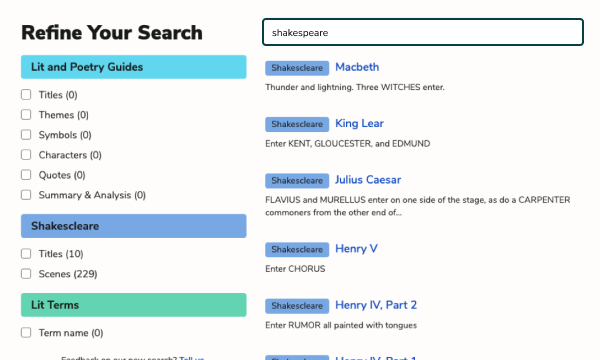
  • Advanced search
    Arrow Icon

    Find exactly what you need

    Refine your search using advanced filters like genre, time period, literary movement, author context, grade level, and more.

    Advanced search
  • Theme comparisons across books
    Arrow Icon

    Compare and contrast

    Identify similar themes across books, making comparisons fast and simple.

    Theme comparisons across books
  • Highlight, take notes, & save guides
    Arrow Icon

    Make LitCharts your own

    Add highlights or notes, save guides for easy access later, and request new titles.

    Highlight, take notes, & save guides
  • A+ logo.Teacher
    $795USD/mo
    Charged $95.40 USD every year
  • Ask LitCharts AI
    Arrow Icon

    Ask LitCharts AI

    Instant answers to all your lit questions. Powered by LitCharts content and AI.

    Ask LitCharts AI
  • Quote explanations & citation info
    Arrow Icon

    Find the perfect quote

    Then understand it perfectly. And get the citation, too. For all 35,000+ quotes we cover.

    Quote explanations & citation info
  • PDF downloads for every guide
    Arrow Icon

    Printable PDFs for every guide

    "Would not have made it through without the printable PDFs. They're like having in-class notes for every discussion!"

    – LitCharts A⁺ user

    PDF downloads for every guide
  • Detailed chapter analysis
    Arrow Icon

    Get what happens and what it means

    Targeted analysis next to the summary ensures you’ll understand more than just the plot.

    Detailed chapter analysis
  • Line-by-line poetry analysis
    Arrow Icon

    Get the meaning in every line

    Never feel lost reading a poem again with clear and in-depth analysis of each and every line.

    Line-by-line poetry analysis
  • Literary & poetic device analysis
    Arrow Icon

    Decode the author’s language

    Quickly find and understand the key devices in whatever you’re reading.

    Literary & poetic device analysis
  • Unlimited quizzes
    Arrow Icon

    Unlimited quizzes and feedback

    Boost your learning with quizzes that pinpoint and address knowledge gaps.

    Unlimited quizzes
  • Advanced search
    Arrow Icon

    Find exactly what you need

    Refine your search using advanced filters like genre, time period, literary movement, author context, grade level, and more.

    Advanced search
  • Theme comparisons across books
    Arrow Icon

    Compare and contrast

    Identify similar themes across books, making comparisons fast and simple.

    Theme comparisons across books
  • Highlight, take notes, & save guides
    Arrow Icon

    Make LitCharts your own

    Add highlights or notes, save guides for easy access later, and request new titles.

    Highlight, take notes, & save guides
  • Teacher editions
    Arrow Icon

    Save time with in-depth organizers

    "THE best teaching resource I have ever used. My students love the handouts."

    – LitCharts A⁺ User

    Teacher editions
  • Shakespeare translation worksheets
    Arrow Icon

    Printable, customizable worksheets

    Help students engage with Shakespeare's language by writing their own modern English translations.

    Shakespeare translation worksheets
  • Discussion question generator
    Arrow Icon

    Discussion question generator

    Instantly create discussion questions that get people talking, through the power of LitCharts analysis and AI.

    Discussion question generator
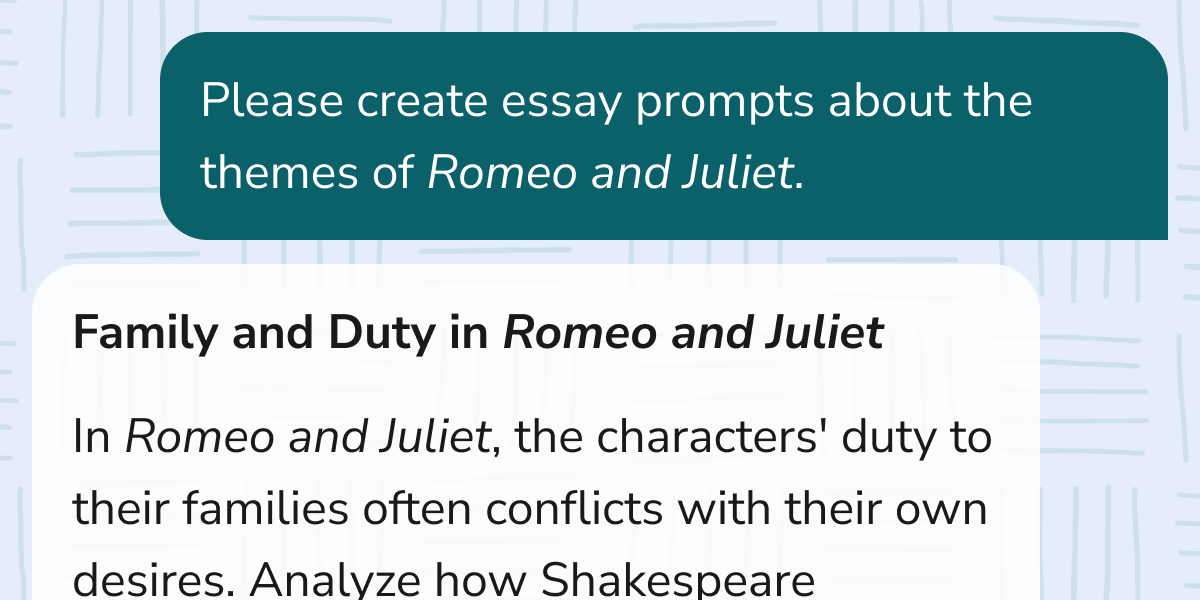
  • Essay prompt generator
    Arrow Icon

    Essay prompt generator

    Quickly create thought-provoking essay prompts that will get your students writing, powered by LitCharts analysis and AI.

    Essay prompt generator
  • Quiz question generator
    Arrow Icon

    Quiz question generator

    Effortlessly generate targeted quiz questions, powered by the world’s best literary analysis and AI.

    Quiz question generator
  • PDFs

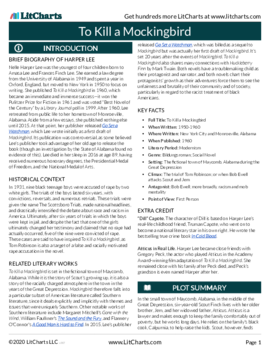
    Literature Guide PDFs

    LitCharts PDFs for every book you'll read this year.

    Instant PDF downloads of all 2238 LitCharts literature guides and of every new one we publish. Try a free sample literature guide.
    "Would not have made it through AP Literature without the printable PDFs. They're like having in-class notes for every discussion!"
    Pride and Prejudice PDF
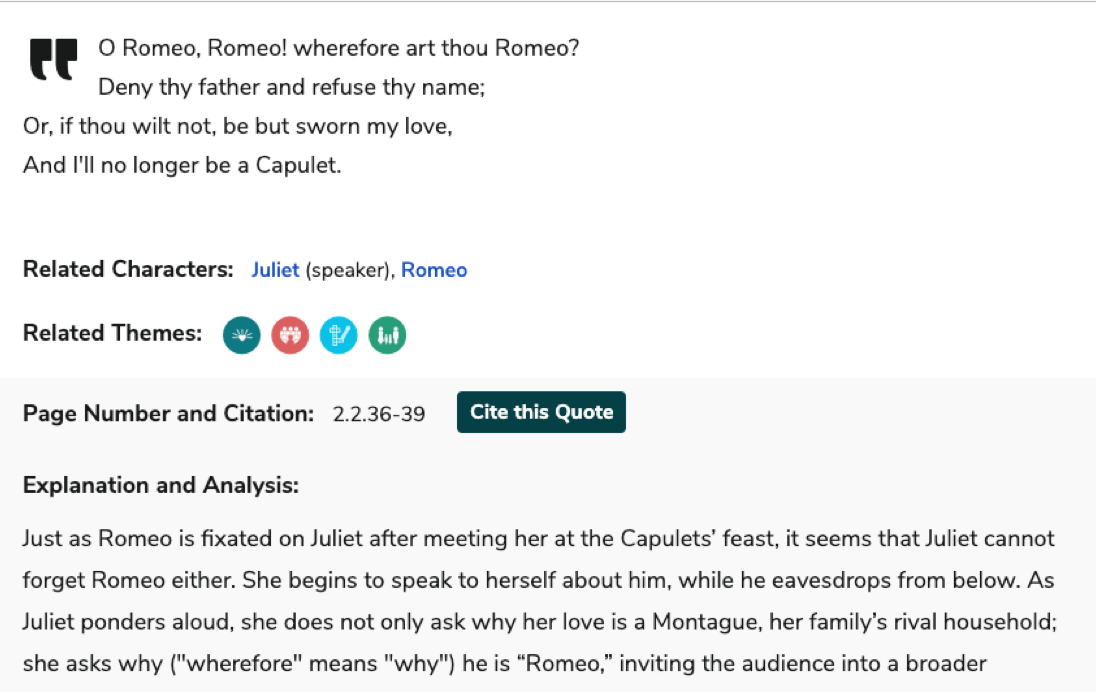
    Quotes

    Quotes Explanations

    Find the perfect quote. Understand it perfectly. Then rock the citation, too.
    For all 49,909 quotes we cover.
    Find. Search every LitChart by chapter, theme, or character to find just the quote you need.
    Understand. Grasp the quote's significance with our detailed Explanation and Analysis.
    Cite. Get the quote's page or line number, or a perfect citation with our Cite this Quote button.
    Teacher editions

    Teacher Editions

    Close reading made easy for students.
    Time saved for teachers.
    For every book we cover.

    Teacher Edition Contents

    Close Reading Organizers
    Character Analysis Organizers
    Symbol Analysis Organizers
    Theme Analysis Organizers
    Quote Analysis Organizers

    Common Core-aligned

    ""
    Try a free and complete sample Teacher Edition.

    PDFs of modern translations of every one of Shakespeare's 37 plays, 154 sonnets, and 3 longer poems.

    Every translation available to download as a PDF. Try a free sample Shakespeare translation.
    "Every teacher of literature should use these translations. They completely demystify Shakespeare. Students love them!"
    Original
    Romeo
    (aside) She speaks.
    O, speak again, bright angel! For thou art
    As glorious to this night, being o’er my head,
    As is a winged messenger of heaven
    Unto the white, upturnèd, wondering eyes
    Of mortals that fall back to gaze on him
    When he bestrides the lazy-puffing clouds
    And sails upon the bosom of the air.
    Juliet
    O Romeo, Romeo! Wherefore art though Romeo?
    Deny they father and refuse they name.
    Or, if thou wilt not, be but sworn my love,
    And I’ll no longer be a Capulet.
    Modern
    Romeo
    (to himself) She speaks. Speak again, bright angel! For tonight you are as glorious, there up above me, as a winged messenger of heaven who makes mortals fall onto their backs to gaze up with awestruck eyes as he strides across the lazy clouds and sails through the air.
    Juliet
    O Romeo, Romeo! Why must you be Romeo? Deny your father and give up your name. Or, if you won’t change your name, just swear your love to me and I’ll give up being a Capulet.
    Lit terms
    Literary Terms and Devices
    Definitions and examples for every literary term and device you need to know.
    Plus a quick-reference PDF with concise definitions of all 136 terms in one place.
    Try a free sample literary term PDF.
    Advanced search
    Advanced Search
    Refine any search. Find related themes, quotes, symbols, characters, and more.
    Advanced search
    Related themes
    Related Themes
    Comparing and contrasting texts? Find where any theme occurs across all of LitCharts in seconds.
    Related themes
    Poetry guides
    Poetry Guides
    Line-by-line explanations and analysis of figurative language and poetic devices.
    For every lyric poem we cover.
    Poetry guides
    Sign up for LitCharts A+
    Company
    About Us Our Story
    Support
    Help Center Contact Us
    Connect
    Facebook Twitter
    Legal
    Terms of Service Privacy Policy Privacy Request
    Home About Contact Help
    LitCharts, a Learneo, Inc. business
    Copyright © 2025 All Rights Reserved
    Terms Privacy Privacy Request