Find the perfect quote
Then understand it perfectly. And get the citation, too. For all 35,000+ quotes we cover.

|
Have questions?
Contact us
Already a member? Sign in
|
Author Kenneth Grahame uses alliteration multiple times throughout the novel. For example, in the beginning of Chapter 1, the narrator uses alliteration to describe Mole's movements as he cleans up his home for spring:
So he scraped and scratched and scrabbled and scrooged, and then he scrooged again and scrabbled and scratched and scraped, working busily with his little paws and muttering to himself, ‘Up we go! Up we go!’ till at last, pop! his snout came out into the sunlight, and he found himself rolling in the warm grass of a great meadow.
The /sc/ sound is repeated eight times in the above passage. The repetition of the /sc/ sound reflects Mole's repeated efforts to ascend from underground while also creating a sense of continuity and persistence. This sense of persistence fittingly mirrors Mole's determination to climb up and emerge into the world above. By incorporating this repetition of sound, Grahame effectively conveys Mole's experience to the reader in a descriptive and evocative manner. Grahame's use of alliteration also adds a layer of vividness to the narrative, allowing the reader to feel more connected to Mole's journey and the challenges he faces along the way.
The narrator also uses alliteration multiple times in Chapter 5 to describe the sight of a bird in its cage:
On the middle perch the fluffy occupant, head tucked well into feathers, seemed so near to them as to be easily stroked, had they tried; even the delicate tips of his plumped-out plumage were pencilled plainly on the illuminated screen.
In the passage above, note how the /p/ sound is repeated in the words "plumped-out," "plumage," "pencilled," and "plainly." This repetitive use of the /p/ sound creates a soft, rhythmic quality in the language. The alliteration of the /p/ sound in the phrase "plumped-out plumage" draws attention to the plumpness and fullness of the bird's feathers, while /p/ sound in the phrase "pencilled plainly" underscores the precision and clarity with which the tips of the bird's feathers are illuminated on the screen.
All in all, the whimsical tone of this alliteration aligns with the novel's genre and mood. By incorporating such linguistic techniques, Grahame adds a touch of playfulness and enchantment to the narrative, which all in all enhances the reader's experience and enjoyment of the novel.


 Teacher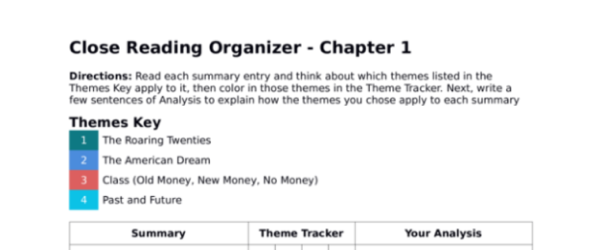












|
Close Reading Organizers |

|
Character Analysis Organizers |

|
Symbol Analysis Organizers |

|
Theme Analysis Organizers |

|
Quote Analysis Organizers |
Common Core-aligned