Find the perfect quote
Then understand it perfectly. And get the citation, too. For all 35,000+ quotes we cover.

|
Have questions?
Contact us
Already a member? Sign in
|
Milo, in Chapter 28, steals from the company's life jackets and leaves a note within them that makes an allusion to 1950s American politics:
The life jackets failed to inflate because Milo had removed the twin carbon dioxide cylinders from the inflating chambers to make the strawberry and crushed-pineapple ice-cream sodas he served in the officer's mess hall and had replaced them with mimeographed notes that read: "What's good for M & M Enterprises is good for the country."
Heller is referencing the well-publicized remark of Charles E. Wilson, former chief executive of General Motors, during his hearings for his appointment to the Secretary of Defense by Dwight Eisenhower, in which Wilson said, "What's good for General Motors is good for the country." (Milo himself would be unaware of this remark, since this hearing took place in 1953, and Milo wrote this note in 1944.)
"What's good for General Motors is good for the country" was the widely publicized, and widely remembered, version of the quote. The real version, though, was slightly different. Wilson was asked whether he would be willing as Secretary to make a decision that would negatively affect GM if it helped the country, and he said that such a decision was not possible, because "What would be good for the country would be good for GM and vice versa." The above version, "What's good for General Motors is good for the country," is much better known, probably because it depicts more simply the character of greedy capitalists, rather than Wilson's truer, more nuanced opinion.
One major purpose of Heller's allusion is to inflect the novel with the feeling of the 50s. This is common throughout the novel (with "loyalty oaths" and IBM computers, among other things). Milo is just the sort of money-pinching capitalist who became part of the American cultural imagination more thoroughly in the 50s, a comparison strengthened by the allusion to Wilson. Heller also seeks to make a comment on the connection of American manufacturing to the war effort, often for the economic self-interest of certain individuals. Milo is meant to satirize greedy defense contractors who sacrifice quality for profit, and the allusion emphasizes this satire. In addition, Heller was likely aware of the real quote and chose to use the inaccurate one on purpose. This is partially because the inaccurate quote simply sounds better. But it is also because Heller, in Catch-22, sought to use the American perception of the 50s in his satire, even if it different from real historical evidence; in other words, he used the quote as it was remembered in culture, not as it really was said. The inaccuracy of the quote, as alluded to in the novel, drives home Heller's intention.



 Teacher












|
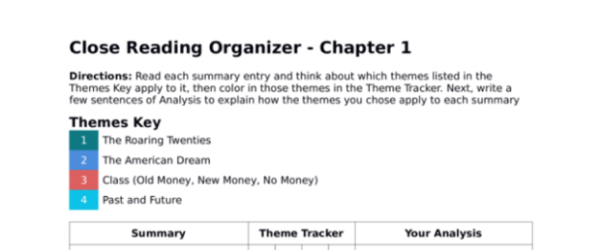
Close Reading Organizers |

|
Character Analysis Organizers |

|
Symbol Analysis Organizers |

|
Theme Analysis Organizers |

|
Quote Analysis Organizers |
Common Core-aligned