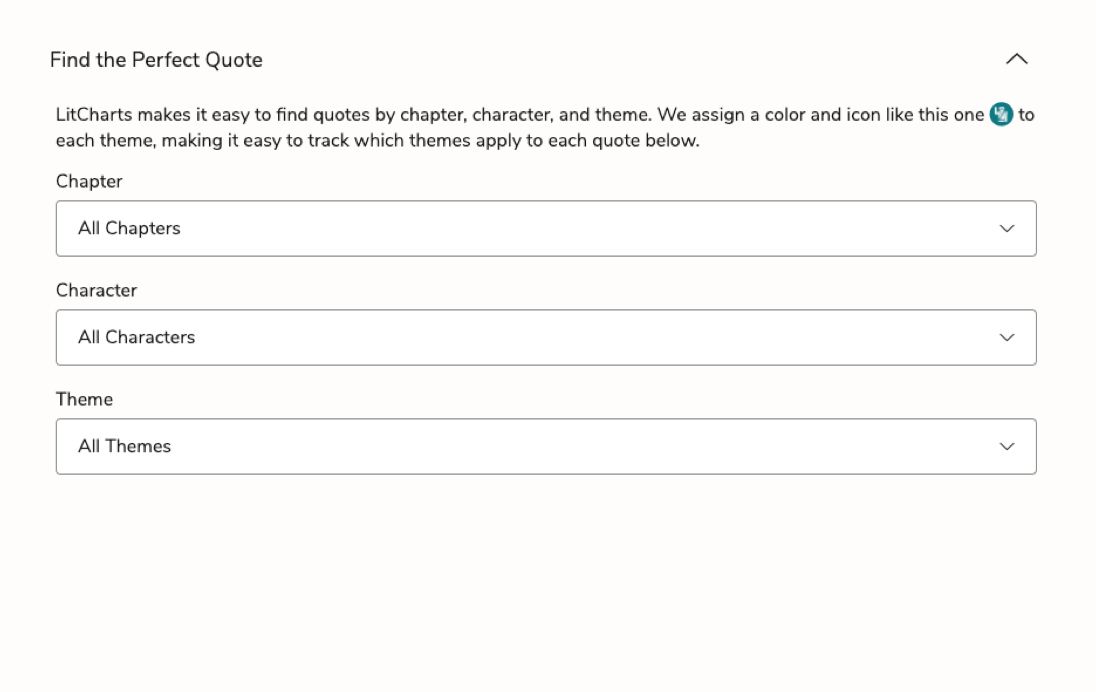
Find the perfect quote
Then understand it perfectly. And get the citation, too. For all 35,000+ quotes we cover.

|
Have questions?
Contact us
Already a member? Sign in
|
In the novel's sixth chapter, a large group from the Pension go on an outing to Fiesole with Mr. Eager. They are divided between two carriages, one of which the narrator claims is driven by Phaethon:
It was Phaethon who drove them to Fiesole that memorable day, a youth all irresponsibility and fire, recklessly urging his master’s horses up the stony hill. Mr Beebe recognized him at once. Neither the Ages of Faith nor the Age of Doubt had touched him; he was Phaethon in Tuscany driving a cab. And it was Persephone whom he asked leave to pick up on the way, saying that she was his sister — Persephone, tall and slender and pale, returning with the spring to her mother’s cottage, and still shading her eyes from the unaccustomed light.
In Greek mythology, Phaethon was the son of Helios, the god of the sun. The boy convinces his father to let him drive the chariot of the sun, but loses control of the horses, which sets the world ablaze and results in his own death. The allusion to Phaethon thereby evokes the catastrophic potential of youthful hubris. By declaring that the Italian cab driver is Phaethon, the narrator both makes fun of him for his juvenile boldness and makes fun of Mr. Eager for his stuffy fear of the driver's youth.
The passage contains another mythical allusion, as the narrator writes that Phaethon picks up Persephone on the way. In Greek myth, Persephone becomes the goddess of the underworld after being abducted by Hades from her mother Demeter. She shields her eyes because she has presumably just come back to the earth's surface. Although Phaethon and Persephone never encounter one another in the world of Greek myth, it is fitting to pair Phaethon with Persephone in this chapter, as she is associated with spring.
Needless to say, Phaethon is not literally driving the cab, and he does not literally pick up Persephone on the way. The role of this extended metaphor is to emphasize the mythical mood of the excursion and to suggest that the British tourists primarily see the Italians they encounter as characters in the stories they tell about their own lives.
Phaethon plays an important role in the rest of the sixth chapter, as it is he who leads Lucy to George when the two kiss; the narrator suggests that this mythical character recognizes the love brewing between the two and brings them together. He also returns in the twentieth chapter, when George and Lucy spend their honeymoon back in Florence. As George looks out at the view, he spots a man who reminds him of their cab driver from a year ago:
The cab-driver, who at once saluted him with the hiss of a serpent, might be that very Phaethon who had set this happiness in motion twelve months ago. A passion of gratitude — all feelings grow to passions in the South — came over the husband, and he blessed the people and the things who had taken so much trouble about a young fool.
This passage again underlines the British tourist's romanticism of Italy and association of its people with mythology. The cab driver "might" be the same, but it ultimately doesn't really matter if he is. George and Lucy prove to be two of the novel's most critically minded characters, yet they still encounter the world as tourists who are more intent on myth than on truly seeing the people around them.


 Teacher









|
Close Reading Organizers |

|
Character Analysis Organizers |

|
Symbol Analysis Organizers |

|
Theme Analysis Organizers |

|
Quote Analysis Organizers |
Common Core-aligned