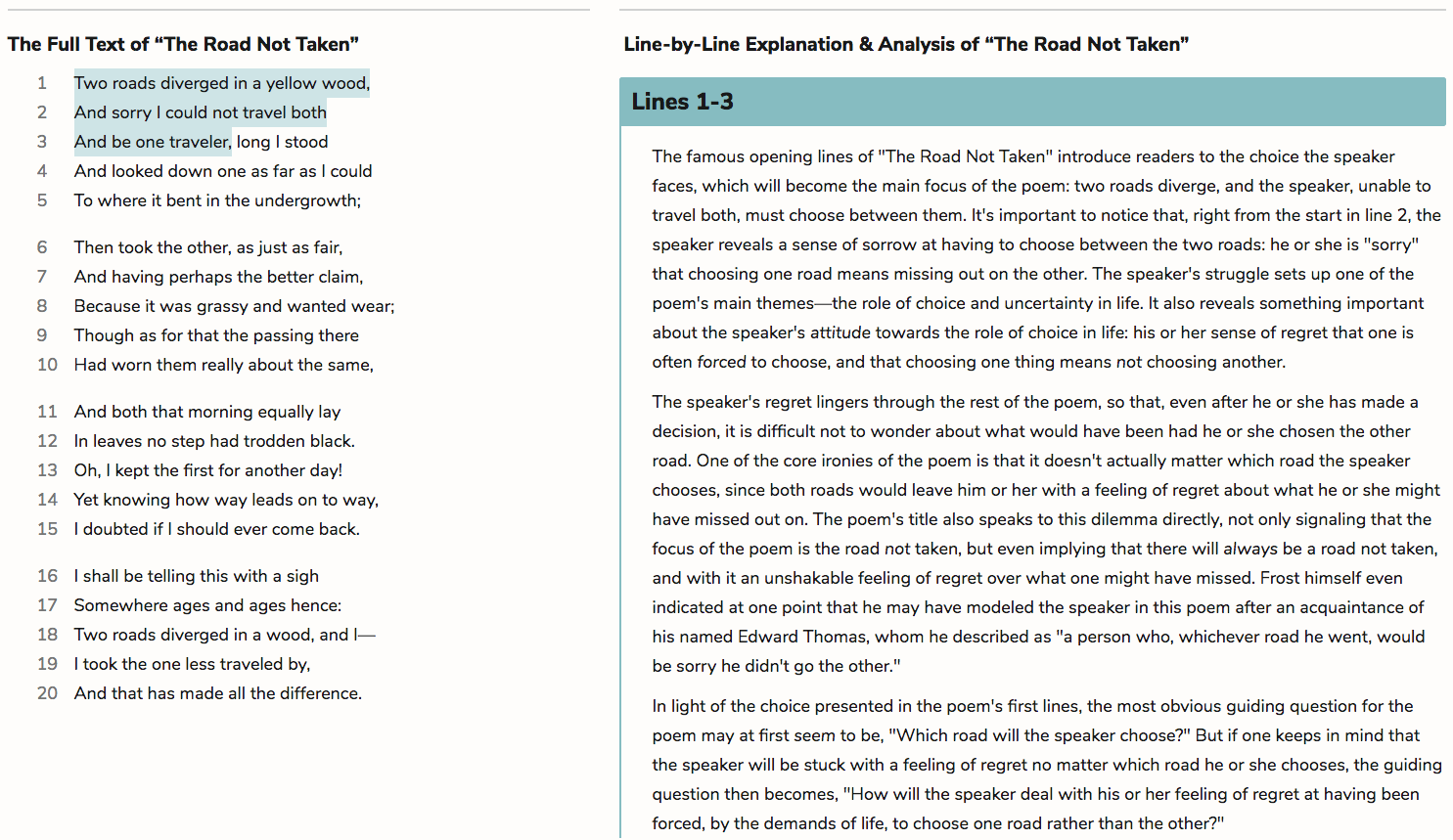
Find the perfect quote
Then understand it perfectly. And get the citation, too. For all 35,000+ quotes we cover.

|
Have questions?
Contact us
Already a member? Sign in
|
Any reader of Shakespeare’s Hamlet will know that Guildenstern and Rosencrantz are destined to die; in Rosencrantz and Guildenstern Are Dead, the characters themselves do not. This lack of knowledge often makes for painful moments of irony. While transporting their charge towards England, Rosencrantz opens the sealed letter and reads aloud Hamlet’s death sentence. When he raises the prospect of sparing their childhood friend, Guildenstern waves it off:
Guil: Well, yes, and then again no. (Airily). Let us keep things in proportion. Assume, if you like, that they’re going to kill him. Well, he is a man, he is mortal, death comes to us all, etcetera, and consequently he would have died anyway, sooner or later. Or to look at it from the social point of view—he’s just one man from among many, the loss would be well within reason and convenience. And then again, what is so terrible about death? As Socrates so philosophically put it, since we don’t know what death is, it is illogical to fear it. It might be…very nice. Certainly it is a release from the burden of life, and, for the godly, a haven and a reward. Or to look at it another way—we are little men, we don’t know the ins and outs of the matter, there are wheels within wheels, etcetera—it would be presumptuous of us to interfere with the designs of fate or even of kings. All in all, I think we’d be well advised to leave well alone. Tie up the letter—there—neatly—like that.—They won’t notice the broken seal, assuming you were in character.
Guildenstern dismisses any need to help Hamlet, appealing to “proportion” and Socrates. He even praises death as a potential “release from the burden of life,” a “haven and a reward.” Above all, his reasoning relies upon the assumption of humankind’s insignificance amid life’s grander designs. As victim, Hamlet is just “one man from among many,” so his death makes little difference. But as bystanders, Guildenstern and Rosencrantz are equally powerless—they are “little men” who “don’t know the ins and outs of the matter,” and whose ignorance conveniently enables their complacency.
Guildenstern’s lengthy digression about fate is rich with irony. For the reader, Guildenstern and Rosencrantz’s execution is all but a certainty. That Guildenstern cites the “design of fate or even of kings” while destined to die himself makes his reasoning doubly devastating. If anything, supporting the same treatment that he is about to suffer merely makes Guildenstern appear all the more pathetic. His belittling lack of agency comes back to bite him when the tables turn on them. When Rosencrantz unseals the swapped letter and finds their execution orders instead, his companion cries out in anguish this time: “but why? Was it all for this? Who are we that so much should converge on our little deaths?”
In his overreliance on human fallibility, Guildenstern’s reaction contains an emphasis on his mortal limitations that also lends itself to a critique of passivity. Stoppard’s protagonists are indeed helpless in the face of an arbitrary and unjustified universe. But their reluctance to “interfere” in anything—compassion and friendship included—also costs them their lives.



 Teacher






|
Close Reading Organizers |

|
Character Analysis Organizers |

|
Symbol Analysis Organizers |

|
Theme Analysis Organizers |

|
Quote Analysis Organizers |
Common Core-aligned