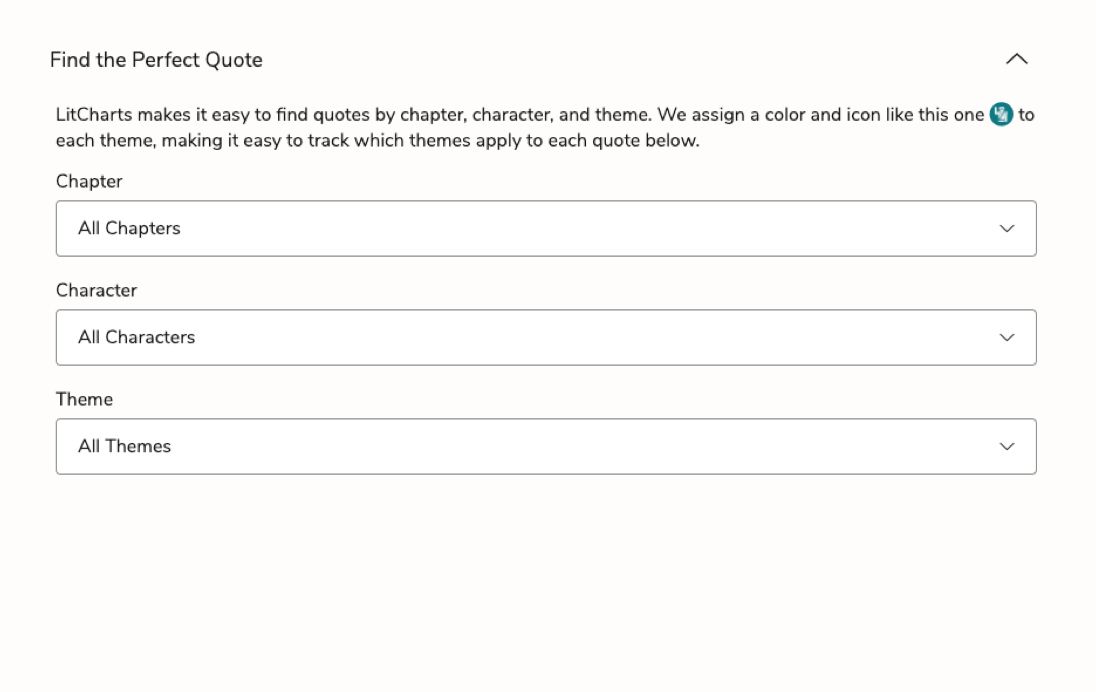
Find the perfect quote
Then understand it perfectly. And get the citation, too. For all 35,000+ quotes we cover.

|
Have questions?
Contact us
Already a member? Sign in
|
When Helen and Arthur are first married, Helen describes Arthur’s affection for her, using different kinds of imagery in the process:
He is very fond of me – almost too fond. I could do with less caressing and more rationality: I should like to be less of a pet and more of a friend, if I might choose – but I won’t complain of that: I am only afraid his affection loses in depth where it gains in ardour. I sometimes liken it to a fire of dry twigs and branches compared with one of solid coal, – very bright and hot, but if it should burn itself out and leave nothing but ashes behind, what shall I do?
In implying that she feels like she is more of Arthur’s “pet” than his “friend,” Helen encourages readers to visualize the difference—as a pet, she receives affection but is in no way her husband’s equal. This is not unique to their relationship, but defines many of the romantic relationships in the novel, signaling how unjust power dynamics are tied to gender in British society generally at this time.
By describing how Arthur’s love for her feels more like “a fire of dry twigs and branches” that burns “very bright and hot” before “burn[ing] itself out,” Helen again uses imagery to help readers understand the unsustainability of their relationship as it is. This is also an example of foreshadowing as Arthur’s love does burn out very quickly, and he becomes the cruel and abusive husband Helen did not want to believe he had the capacity to be.


 Teacher









|
Close Reading Organizers |

|
Character Analysis Organizers |

|
Symbol Analysis Organizers |

|
Theme Analysis Organizers |

|
Quote Analysis Organizers |
Common Core-aligned