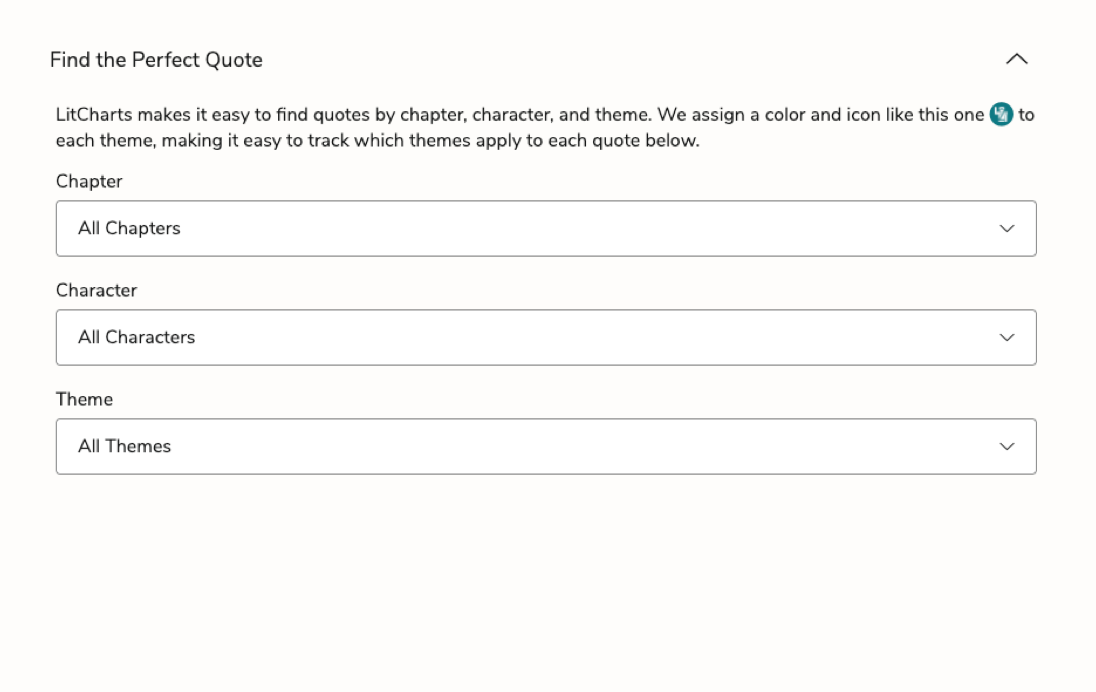
Find the perfect quote
Then understand it perfectly. And get the citation, too. For all 35,000+ quotes we cover.

|
Have questions?
Contact us
Already a member? Sign in
|
In one of Doña Maria's letters to Doña Clara, she writes that she has enclosed a special gold chain as a present for one of her daughter's friends. Doña Maria tells a fantastic (and obviously false) story about how she obtained the necklace, writing that she walked into a painting by Diego Velázquez, a famous Spanish artist, and took the necklace from one of its subjects:
The canvas resisted for a moment, but the painter himself came forward to lift me through the pigment. I told him that the most beautiful girl in Spain wished to present the finest gold chain that could be found to the most gracious king in the world. It was as simple as that...
The image of Doña Maria trying to enter the resistant canvas, and of the painter bringing her "through the pigment," appeal to the reader's imagination because they conjure up a fantastic world that obviously does not exist. The romantic concept of being able to literally penetrate a work of art and interact the subjects it represents elevates the gold chain from a simple object to a powerful talisman.
It's important to remember that in the context of the novel, Doña Maria has imagined this scenario and written these words herself. The beautiful image she casually creates in this letter demonstrates her power as an artist, which is important to the broader arc of the novel: Wilder repeatedly tells the reader that Doña Maria's correspondence will become a celebrated piece of national literature after her death.
At the same time, the image demonstrate Doña Maria's desperation to earn her daughter's love and the narcissism that fuels her constant letter-writing. To elicit Doña Clara's approval, Doña Maria inflates her own actions far beyond what she actually did, describing herself interacting with a great work of art rather than simply buying a gold chain. As Wilder says elsewhere in the novel, Doña Maria's own ego keeps her trapped in this ingratiating mode of address and limits what she can achieve in her art. Only when Doña Maria learns to love her daughter selflessly is she able to achieve peace and tranquility. In her last letter to Doña Clara, written shortly before her death in the bridge collapse, Doña Maria finally transcends with and style to create a truly great work of art.



 Teacher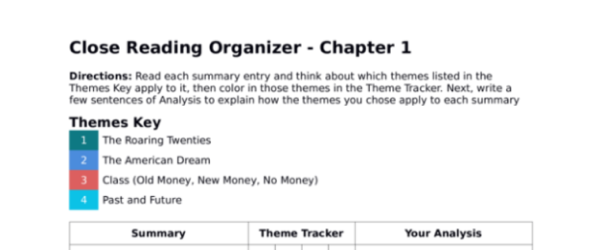












|
Close Reading Organizers |

|
Character Analysis Organizers |

|
Symbol Analysis Organizers |

|
Theme Analysis Organizers |

|
Quote Analysis Organizers |
Common Core-aligned