Find the perfect quote
Then understand it perfectly. And get the citation, too. For all 35,000+ quotes we cover.

|
Have questions?
Contact us
Already a member? Sign in
|
In court, the law seems to be on Shylock's side. But as he is about to cut into Antonio and collect his bond, Portia (disguised as the lawyer Balthazar) tells him,
The words expressly are "a pound of flesh."
Take then thy bond, take thou thy pound of flesh,
But in the cutting it, if thou dost shed
One drop of Christian blood, thy lands and goods
Are by the laws of Venice confiscate / Unto the state of Venice.
Portia uses logos—appealing to an audience's sense of logic—to interpret the law even more literally than Shylock, reasoning that the bond allows Shylock to collect Antonio's flesh, but not his blood; if Shylock sheds any of Antonio's blood, Shylock will be charged with murder. Shylock can neither refute Portia's claim nor collect the flesh without the blood, and Portia thus saves Antonio from certain death.
And Portia doesn't stop there—she continues to use logos to punish Shylock. She states,
If it be proved against an alien
That by direct or indirect attempts
He seek the life of any citizen,
The party ’gainst the which he doth contrive
Shall seize one half his goods; the other half
Comes to the privy coffer of the state,
And the offender’s life lies in the mercy
Of the Duke only, ’gainst all other voice.
[...] Thou hast contrived against the very life
Of the defendant, and thou hast incurred
The danger formerly by me rehearsed.
Portia traps Shylock again, asserting that he—an "alien"—has conspired to kill Antonio, a Venetian "citizen." As punishment, per Venetian law, Shylock's property will be confiscated; Antonio can seize half, while the state will seize the other. Shylock's life, meanwhile, lies at the mercy of the Duke.
Shylock demanded the law, and that is exactly what he received. This moment aptly illustrates how, in Merchant, powerful people can manipulate the law—as well as each other—to achieve the outcomes they desire.


 Teacher









|
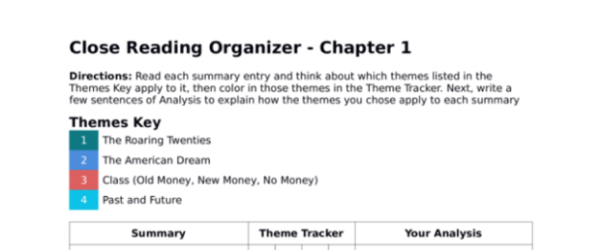
Close Reading Organizers |

|
Character Analysis Organizers |

|
Symbol Analysis Organizers |

|
Theme Analysis Organizers |

|
Quote Analysis Organizers |
Common Core-aligned