Find the perfect quote
Then understand it perfectly. And get the citation, too. For all 35,000+ quotes we cover.

|
Have questions?
Contact us
Already a member? Sign in
|
Over the course of the novel, characters use letters to express difficult feelings and to sustain relationships from afar. Through the motif, McEwan shows that written correspondence can bring anything from disaster to redemption. Moreover, the novel's most consequential letter shows that sending letters requires relinquishing control of one's words.
In the first part, letters are exchanged less for the purpose of bridging geographical distances. Instead, they facilitate the communication of complicated sentiments. In the eighth chapter, Robbie writes Cecilia a letter because he doubts his ability to formulate his feelings in a face-to-face interaction. For him, writing a letter is a way to think aloud and avoid immediate confrontation. Several chapters later, the Quincey twins leave a letter on a chair in the dining room, in which they confess that they have run away. Their inability to communicate with the people around them is why they decide to run away in the first place.
Later in the novel, letter-writing becomes a necessity because of real, geographical distances. In the second part, Robbie and Cecilia send each other letters after his arrest and while he's a soldier. Their letters to and from the prison are subject to close, censorious scrutiny, prompting them to find creative ways to communicate their true sentiments under the radar. While Robbie fights in France, the material existence of Cecilia's letters keeps him from losing hope—merely the thought of the letters in his pocket fills his mind with her words. In the third part, letters are also central to Briony's wartime life. She receives letters from Emily about life at home as well as a letter from her father announcing Lola's marriage to Paul Marshall. Additionally, the long letter Briony receives from the literary magazine is embedded into the narrative. In the epilogue, as she describes the research she did for her book project, she mentions having corresponded with Corporal Nettle.
The novel's main conflict springs out of a letter that Robbie writes in the first part. It seems worth nothing, however, that these far-reaching consequences do not primarily come from what is written in the letter. The main problem is who winds up accessing it. If the letter had passed directly from Robbie to Cecilia, it may not have made much damage. However, because Briony reads the letter and shows it to the police, the potency of the letter snowballs so much that Robbie's written words play a part in his arrest. As soon as he hands off the envelope, Robbie loses control over his words and their reception.
In a scene at the end of the first part, McEwan illustrates the challenges of epistolary privacy. Cecilia is outraged to find that everyone in the drawing is passing around the letter she received from Robbie. She shouts “It belongs to me” and “You have absolutely no right!” as they block her from grabbing the letter. Practically speaking, even if the envelope has her name on it, Cecilia's proprietary right to the letter is flimsy.
On the other hand, letters do not merely bring about chaos and conflict in the novel. McEwan also presents written communication as the basis of atonement and redemption. At the end of the third part, Cecilia and Robbie instruct Briony to write various letters in order to retract her evidence. In the hopeful final sentences of the novel, the mess that started with a letter ends with a letter as well: "She knew what was required of her. Not simply a letter, but a new draft, an atonement, and she was ready to begin."


 Teacher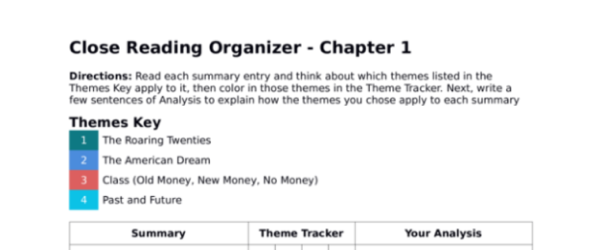









|
Close Reading Organizers |

|
Character Analysis Organizers |

|
Symbol Analysis Organizers |

|
Theme Analysis Organizers |

|
Quote Analysis Organizers |
Common Core-aligned