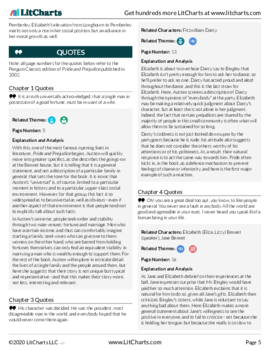
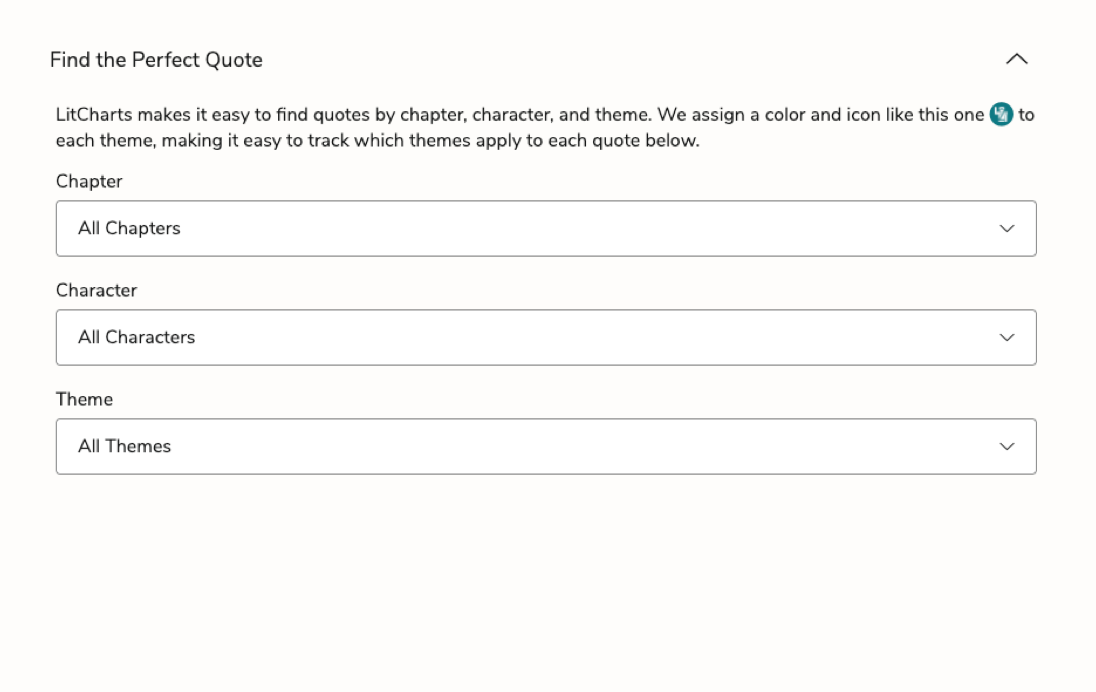
Find the perfect quote
Then understand it perfectly. And get the citation, too. For all 35,000+ quotes we cover.

|
Have questions?
Contact us
Already a member? Sign in
|
Throughout The Blithedale Romance, many characters attempt to conceal their feelings, motives, and identities. One example is the narrator—Miles "Coverdale"—who attempts to "cover" his personal feelings and motives while explaining those of others. His name reveals the defining quality of his character; he not only tries to hide his true thoughts, but also deludes himself into believing that he does not know them. For example, when Zenobia asks him why he keeps bringing up Priscilla's love for Hollingsworth, he claims that “an uncertain sense of some duty to perform, that brings my thoughts, and therefore my words, continually to that one point.” However, his own love for Priscilla—which he conceals until the very last chapter—is the true motive behind continuously talking about her attraction to Hollingsworth. He claims to have an "uncertain sense of duty" toward the subject of Priscilla's romantic relationships when, in reality, his sense of duty derives from his own feelings of love.
A second key example of concealment is that Hollingsworth hides the fact that he uses everybody's labor to further his "philanthropic" vision. At first, Hollingsworth seems like a good man. He appears to be friendly, helpful, and hardworking; he also cares for Coverdale when he falls ill. But later in the story, the narrator reveals that Hollingsworth's obsession with philanthropy leads him to manipulate others in pursuit of his goal. He joined Blithedale in order to build it up, buy its land, and build his own facility. The continual masking of his motives marks another important instance of concealment, and this iteration of the motif supports the theme of the discrepancy between self-interest and collectivism.
A third example is Zenobia's name, which conceals her identity. In Chapter 2, the old man says,
Zenobia, by-the-by, as I suppose you know, is merely her public name; a sort of mask in which she comes before the world, retaining all the privileges of privacy—a contrivance, in short, like the white drapery of the Veiled Lady, only a little more transparent. But it is late! Will you tell me what I can do for you?
Here an old man compares Zenobia to the Veiled Lady, who is perhaps the most obvious example of hiddenness. Zenobia hopes to "retain all the privileges of privacy" by hiding her real name. Rumors of a past marriage, as well as an unspoken connection to the other members of Blithedale, make Zenobia the most mysterious character in the first half of the novel. Her name represents her efforts to protect herself via concealment. Later in the novel, the narrator reveals how he discovered her true identity, her love for Hollingsworth, and her connections to the other characters.
Lastly, it is important to note that concealment works a bit differently for women than it does for men. Zenobia conceals her true name, and the Veiled Lady conceals her physical appearance. Both represent self-protection. But in the case of the men like Coverdale or Hollingsworth, motives must be concealed in order to accomplish goals or protect reputations. Every character has something to hide, and they strive by different means to preserve their privacy of identity, motive, feeling, or past. In the end, though, the reader learns the truth about each and every character.




 Teacher













|
Close Reading Organizers |

|
Character Analysis Organizers |

|
Symbol Analysis Organizers |

|
Theme Analysis Organizers |

|
Quote Analysis Organizers |
Common Core-aligned