Find the perfect quote
Then understand it perfectly. And get the citation, too. For all 35,000+ quotes we cover.

|
Have questions?
Contact us
Already a member? Sign in
|
Hobbes satirizes philosophy as it was taught in the universities of 17th-century England, satirically suggesting that these institutions do not teach philosophy but rather “Aristotelity”:
And since the Authority of Aristotle is onely current there, that study is not properly Philosophy, (the nature whereof dependeth not on Authors,) but Aristotelity. And for Geometry, till of very late times it had no place at all; as being subservient to nothing but rigide Truth. And if any man by the ingenuity of his owne nature, had attained to any degree of perfection therein, hee was commonly thought a Magician, and his Art Diabolicall.
Throughout Leviathan, Hobbes has taken aim at classical philosophy, and in particular, the teachings of Aristotle, who remained immensely influential in Hobbes’s day. Here, he argues that the “Authority of Aristotle” is the only force animating university education, and so the universities cannot truly claim to teach philosophy due to this over-reliance on just one figure.
He further develops this critique of the universities, suggesting that scholars are so overly-reliant upon traditional learning that they cannot appreciate any student who has “ingenuity.” In this passage, Hobbes satirizes the universities for their dogmatic approach to education, and their relative lack of interest in more modern scientific topics such as geometry.




 Teacher








|
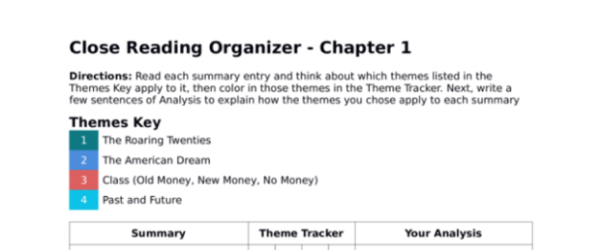
Close Reading Organizers |

|
Character Analysis Organizers |

|
Symbol Analysis Organizers |

|
Theme Analysis Organizers |

|
Quote Analysis Organizers |
Common Core-aligned