Find the perfect quote
Then understand it perfectly. And get the citation, too. For all 35,000+ quotes we cover.

|
Have questions?
Contact us
Already a member? Sign in
|
In Chapter 33, Jack desperately searches for Babette's Dylar pills, which he feels are the only thing that can help his "symptoms." He tears open the trash bags in search of the bottle and sifts through all the various waste. He describes the pile of trash using a simile that compares it to artwork:
The compressed bulk sat there like an ironic modern sculpture, massive, squat, mocking. I jabbed at it with the butt end of a rake and then spread the material over the concrete floor. I picked through it item by item, mass by shapeless mass, wondering why I felt guilty, a violator of privacy, uncovering intimate and perhaps shameful secrets.
The trash, seemingly without any pills, looks like "an ironic modern sculpture, massive, squat, mocking." Perhaps Jack (and DeLillo) refers specifically to Marcel Duchamp, the French modernist artist whose "readymade" sculptures were made of "everyday objects raised to the dignity of a work of art by the artist's act of choice." Similarly, the pile of trash resulting from Jack's fruitless search seems to just be made up of normal consumer items, but in this situation, it becomes a massive sculpture. The trash, through the simile, becomes a work of art, one whose purpose is to mock him for his greedy desire and invasion of privacy.
The comparison to a sculpture also shows the importance of trash in this family. Trash is the fundamental consequence of excessive consumerism. Jack and his family love to buy consumer gadgets and pre-prepared food, both of which create lots of trash. Buying these gadgets and sharing meals are two of the family's essential ways of expressing their love for one another. While searching through the trash, Jack comes to the understanding that he is "a violator of privacy," due to the fact that consumerism is so important to this family. As a result the trash becomes something other than mere "shapeless mass" through Jack's desire to search it; it becomes a representation of the family's basest secrets. In this way, the trash indeed becomes a sculpture, a physical object with deeper meaning, as described in the simile.



 Teacher











|
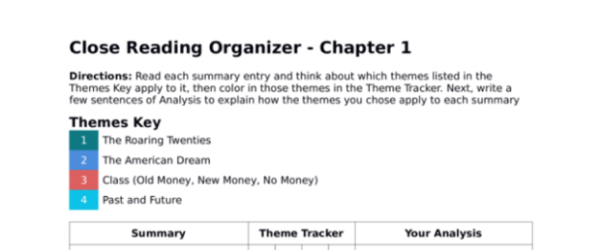
Close Reading Organizers |

|
Character Analysis Organizers |

|
Symbol Analysis Organizers |

|
Theme Analysis Organizers |

|
Quote Analysis Organizers |
Common Core-aligned