Find the perfect quote
Then understand it perfectly. And get the citation, too. For all 35,000+ quotes we cover.

|
Have questions?
Contact us
Already a member? Sign in
|
In the nineteenth chapter, Lucy has a conversation with Mr. Emerson. During this conversation, the old man eventually discovers that his son's love for Lucy is requited, and he makes it clear that he has figured this out. By way of a simile, the narrator compares Lucy's reaction to being hit by waves in the ocean.
Then he burst out excitedly: ‘That’s it; that’s what I mean. You love George!’ And after his long preamble the three words burst against Lucy like waves from the open sea.
Lucy remains, throughout the novel, firmly committed to being "absolutely truthful." It becomes clear to both her and the reader, however, that telling the truth is not always straightforward. Sometimes, Lucy finds the boundary between truth and lies frustratingly blurry. Most of all, it proves difficult for her to tell others the truth when she is unwilling to be honest with herself. At this point in the novel, she has refused to admit to her love to George for several months. When Mr. Emerson realizes that she loves him, and says it out loud, the truth finally hits Lucy like crashing waves.
The forceful effect that Mr. Emerson's words have on Lucy speak to the effort she has put into suppressing her love for George. As she responds to Mr. Emerson, the metaphorical water from the waves remains in the scene:
‘How dare you!’ gasped Lucy, with the roaring of waters in her ears. ‘Oh, how like a man! — I mean, to suppose that a woman is always thinking about a man.’ ‘But you are.’
The roaring of the water continues as Lucy grapples with the truth catching up to her. Her gut reaction is to call Mr. Emerson sexist for claiming that she's always thinking about a man. This is somewhat ironic, given that Mr. Emerson seems to be the least sexist man who exerts influence on Lucy throughout the novel but the only one she calls out. He stands firm, simply telling her that in this situation she is clearly thinking about a man and that she shouldn't forgo the rare possibility of true love. The loudness and intensity contained in the wave simile, as well as in Lucy's response, contrasts sharply with Mr. Emerson's calm conviction. The wave simile underlines the discomfort of being honest with oneself, as well as the irrationality of true love.





 Teacher












|
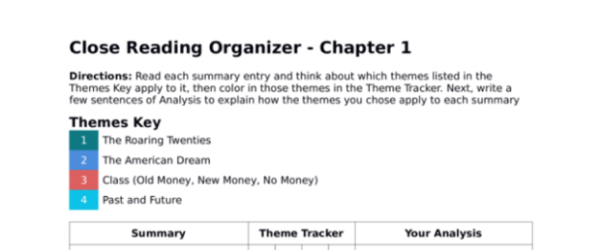
Close Reading Organizers |

|
Character Analysis Organizers |

|
Symbol Analysis Organizers |

|
Theme Analysis Organizers |

|
Quote Analysis Organizers |
Common Core-aligned