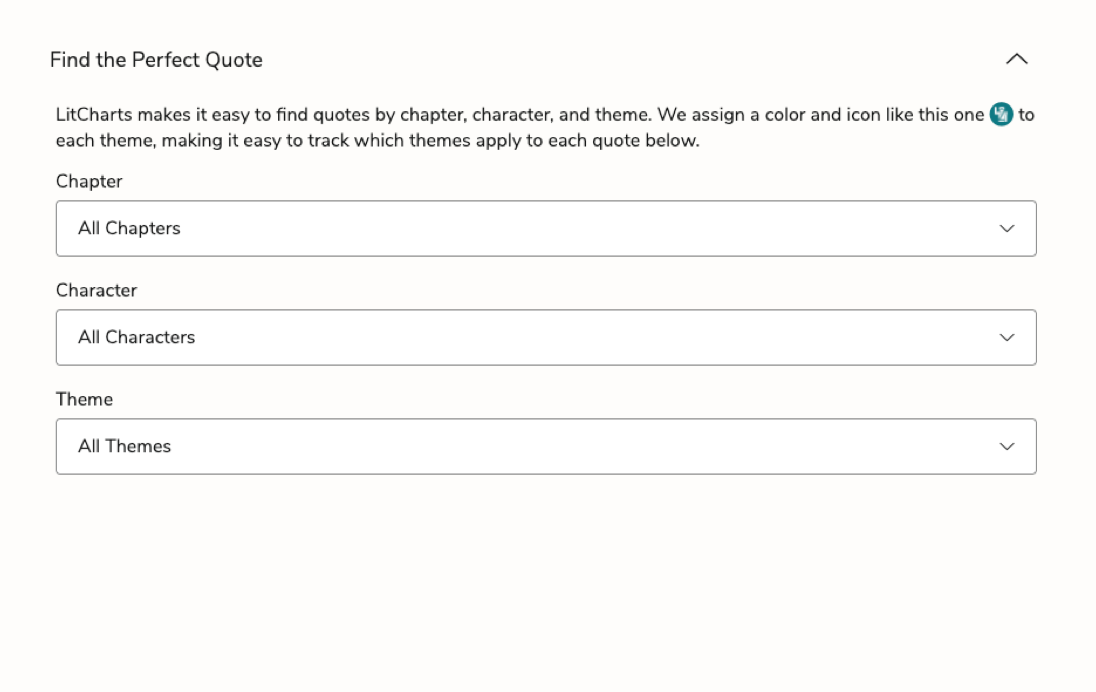
Find the perfect quote
Then understand it perfectly. And get the citation, too. For all 35,000+ quotes we cover.

|
Have questions?
Contact us
Already a member? Sign in
|
The dismissive and easily irritated Hotspur mocks his wife in a speech that satirizes the conventions and morals of the English middle class. Before the upcoming battle, Lady Mortimer sings a song to her husband as he lays his head in her lap. After Hotspur requests to hear his wife sing a song, she primly refuses, saying that she will not do it “in good sooth,” a phrase similar to “darn it” in contemporary English. Hotspur responds by making fun of her refusal to curse:
Not yours, in good sooth! Heart, you swear
like a comfit-maker’s wife! “Not you, in good
sooth,” and “as true as I live,” and “as God shall
mend me,” and “as sure as day”—
And givest such sarcenet surety for thy oaths
As if thou never walk’st further than Finsbury.
Swear me, Kate, like a lady as thou art,
A good mouth-filling oath, and leave “in sooth,”
And such protest of pepper-gingerbread
To velvet-guards and Sunday citizens.
He mocks and imitates her speech patterns, listing various cliched phrases that she uses regularly, including “as true as I live” and “as sure as day.” Using a simile, he notes that she swears like the wife of a candy-maker—a decidedly middle class profession—and insists that she learn to swear properly, “like a lady as thou art.”
His language here emphasizes class differences: nobles, he suggests, curse freely, but the women of the self-conscious middle classes refuse to use vulgarities. He jokingly states that it is as if she “never walk’st further than Finsbury,” referencing an area north of London that was home to many families of the emerging middle-class in England. Hotspur’s satirical comments emphasize both his elitism and his inability to communicate effectively with his wife.




 Teacher














|
Close Reading Organizers |

|
Character Analysis Organizers |

|
Symbol Analysis Organizers |

|
Theme Analysis Organizers |

|
Quote Analysis Organizers |
Common Core-aligned