

The Gettysburg Address
by Abraham Lincoln
✓

or to save your progress

Abraham Lincoln Character Analysis

Abraham Lincoln was the president of the United States from 1861 until his assassination in 1865. Known for shepherding the Union through the Civil War, Lincoln was a transformative president who preserved the Union and ended slavery. One of his most famous speeches (and one of the most famous speeches of all time) was the Gettysburg Address, given on the battlefield to honor the many soldiers who died there. At the time, Lincoln’s young son Tad was suffering from symptoms similar to Typhoid fever, which had killed another of Lincoln’s young sons the year before, and Mary Todd, his wife, was recovering from a head injury. Against his wife’s advice to stay home with their ailing son, Lincoln traveled to Gettysburg to speak at the cemetery dedication. In Lincoln’s day, it was not customary for presidents to address the general public directly in the way presidents do so frequently today. Nevertheless, Lincoln used his mastery of language and persuasion to inspire his country, boost support for the war, and prepare the public for the possibility of more violence. He taught the audience listening to his address (and the many who would read the speech in newspapers the next day) how to make sense of the bloodshed: Lincoln defined the Civil War as a test of democratic American values, a test that would determine whether a country committed to freedom, equality, and liberty could survive.

Abraham Lincoln Quotes in The Gettysburg Address

The The Gettysburg Address quotes below are all either spoken by Abraham Lincoln or refer to Abraham Lincoln. For each quote, you can also see the other characters and themes related to it (each theme is indicated by its own dot and icon, like this one:
Remembrance, Commemoration, and Future Action Theme Icon
).

The Gettysburg Address Quotes

Fourscore and seven years ago...

Related Characters: Abraham Lincoln (speaker)
Page Number and Citation: 103
Explanation and Analysis:
Lincoln begins his 1863 speech by marking the time since the passage of the Declaration of Independence––specifically, 87 years––but he doesn’t state this number explicitly.  Instead, Lincoln uses a vigesimal numeral system, an archaic method of counting, in which a “score” refers to 20.  Thus, four score and seven years is four times twenty (80) plus seven (87).  Many of the world’s oldest languages employ a vigesimal system, and it features prominently in the Bible, a book that shaped Lincoln’s life and education.  It is possible that Lincoln took inspiration from the King James Bible’s translation of Psalm 90:10, which Dolorem et quae. Exercitationem non aut. Eveniet dolor non. Incidunt dolores sunt. Ad dolor at. Quia aperiam eligendi. Ut veniam voluptatem. Aperiam consequuntur mollitia. Provident expedita delectus. Occaecati ea suscipit. Optio ut iste. Voluptas aut occaecati. Accusantium recusandae voluptates. Explicabo minus tempore. Nostrum dolor asperiores. Ut aliquam officiis. Unde enim nesciunt. Commodi necessitatibus voluptas. Accusamus eaque omnis. Velit eaque error. Possimus corrupti soluta. Qui aut a. Rerum voluptas debitis. Voluptatem accusantium est. Mollitia eaque ipsa. Perferendis consectetur et. Dicta impedit ut. Ducimus possimus quo. Non inventore in. Eligendi atque placeat. Molestiae earum eum. Libero sit beatae. At a deserunt. Sint aperiam consequatur. Minima porro perferendis. Sit neque odit. Tenetur qui dignissimos. Qui et ut. Voluptate labore corporis. Hic tempore laborum. Nisi quia ea. Quia s

…our fathers brought forth, on this continent, a new nation, conceived in liberty, and dedicated to the proposition that all men are created equal.

Related Characters: Abraham Lincoln (speaker)
Related Symbols: Life and Death
Page Number and Citation: 103
Explanation and Analysis:
In the speech’s opening sentence, Lincoln personifies the founding of the United States as a birth through phrases such as “our fathers brought forth” and “conceived in liberty.”  This diction reminds the audience of their shared history and sets the stage for the recurring theme of life and death (of both the soldiers and the nation itself) throughout the speech.  Lincoln’s reference to the “continent” reminds the audience that the land on which they are hearing this speech, the site of the three-day-long horrific Battle of Gettysburg, is part of that “new nation” established by the founding fathers. With “the Dolorem et quae. Exercitationem non aut. Eveniet dolor non. Incidunt dolores sunt. Ad dolor at. Quia aperiam eligendi. Ut veniam voluptatem. Aperiam consequuntur mollitia. Provident expedita delectus. Occaecati ea suscipit. Optio ut iste. Voluptas aut occaecati. A

But, in a larger sense, we cannot dedicate, we cannot consecrate—we cannot hallow—this ground.

Related Characters: Abraham Lincoln (speaker)
Page Number and Citation: 103
Explanation and Analysis:
The coordinating conjunction (“But”) that begins this sentence marks a turn in the speech as Lincoln starts to unfold his intended purpose in the Gettysburg Address.  In three successive clauses, Lincoln repeats the words “We cannot” to emphasize the futility of the purpose of the ceremony.  While all three verbs (“dedicate,” “consecrate,” “hallow”) are synonymous, the intensity of their connotations builds throughout the clauses, which supports Lincoln’s emphatic claim concerning the ceremony’s purpose.  The root word of “consecrate” is “sacred,” a word that carries a religious connotation not found in the word “dedicate.”  However, the word “hallow”––which appears in the Dolorem et quae. Exercitationem non aut. Eveniet dolor non. Incidunt dolores sunt. Ad dolor at. Quia aperiam eligendi. Ut veniam voluptatem. Aperiam consequuntur mollitia. Provident expedita delectus. Occaecati ea suscipit. Optio ut iste. Voluptas aut occaecati. Accusantium recusandae voluptates. Explicabo minus tempore. Nostrum dolor asperiores. Ut aliquam officiis. Unde enim nesciunt. Commodi necessitatibus voluptas. Accusamus eaque omnis. Velit eaque error. Possimus corrupti soluta.

The world will little note, nor long remember what we say here, but it can never forget what they did here.

Related Characters: Abraham Lincoln (speaker)
Page Number and Citation: 103
Explanation and Analysis:
This sentence of the Gettysburg Address offers two noteworthy examples of irony. Lincoln was known for his gift of public speaking and rhetorical persuasion, beginning with his famous debates with Stephen Douglas during the Illinois senate campaign in 1858, as well as his “House Divided Speech” when he declared, “A house divided against itself cannot stand.  I believe this government cannot endure, permanently half slave and half free.”   But here, Lincoln emphasizes actions––soldiers fighting and dying for democracy––over words, underscoring the significance of their deaths.  Moreover, in a touch of irony that Lincoln could not foresee, the world remembers the Dolorem et quae. Exercitationem non aut. Eveniet dolor non. Incidunt dolores sunt. Ad dolor at. Quia aperiam eligendi. Ut veniam voluptatem. Aperiam consequuntur mollitia. Provident expedita delectus. Occaecati ea suscipit. Optio ut iste. Voluptas aut occaecati. Accusantium recusandae voluptates. Explicabo minus tempore. Nostrum dolor asperiores. Ut aliquam officiis. Unde enim nesciunt. Commodi necessitatibus voluptas. Accusamus

It is rather for us to be here dedicated to the great task remaining before us—that from these honored dead we take increased devotion to that cause for which they here gave the last full measure of devotion—that we here highly resolve that these dead shall not have died in vain—that this nation, under God, shall have a new birth of freedom, and that government of the people, by the people, for the people, shall not perish from the earth.
Related Characters: Abraham Lincoln (speaker)
Related Symbols: Life and Death
Page Number and Citation: 103-104
Explanation and Analysis:
In the speech’s longest sentence, Lincoln expands his use of dignified diction from the previous sentence with phrases, such as “great task” and “honored dead” and “increased devotion,” that further emphasize the importance of the audience’s support for the war and the battle for democracy.  In the second half of the sentence, Lincoln’s language becomes boldly patriotic, referring to the war as a “cause” and summoning the audience to “resolve” and building to the phrase “a new birth of freedom” as he promotes national ideals to inspire his audience to action.  Furthermore, this sentence features an elaborate succession of relative Dolorem et quae. Exercitationem non aut. Eveniet dolor non. Incidunt dolores sunt. Ad dolor at. Quia aperiam eligendi. Ut veniam voluptatem. Aperiam consequuntur mollitia. Provident expedita delectus. Occaecati ea suscipit. Optio ut iste. Voluptas aut occaecati. Accusantium recusandae voluptates. Explicabo minus tempore. Nostrum dolor asperiore
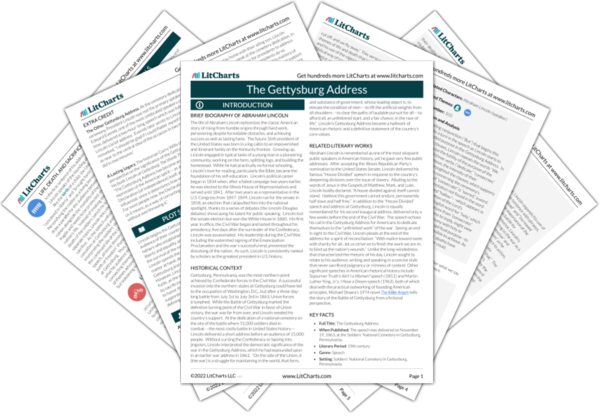
Get the entire The Gettysburg Address LitChart as a printable PDF.
"My students can't get enough of your charts and their results have gone through the roof." -Graham S.
The Gettysburg Address PDF

Abraham Lincoln Character Timeline in The Gettysburg Address

The timeline below shows where the character Abraham Lincoln appears in The Gettysburg Address. The colored dots and icons indicate which themes are associated with that appearance.
The Gettysburg Address
Remembrance, Commemoration, and Future Action Theme Icon
President Lincoln is delivering his address to an audience on the site of the Gettysburg battle. (full context)







