Find the perfect quote
Then understand it perfectly. And get the citation, too. For all 35,000+ quotes we cover.

|
Have questions?
Contact us
Already a member? Sign in
|
In Chapter 58, Dumas invites the reader into a conversation with Noirtier, the old Monsieur de Villefort himself—an apparently ancient man who has lost the power of speech and movement but nonetheless retains his presence of mind. Dumas introduces Noirtier with a slew of literary devices, including hyperbole, metaphor, simile, and the imagery of light and darkness:
Motionless as a corpse, he greeted his children with bright, intelligent eyes .... Sight and hearing were the only two senses which, like two sparks, still lit up this human matter, already three-quarters remoulded for the tomb. Moreover, only one of these two senses could reveal to the outside world the inner life which animated this statue, and the look which disclosed that inner life was like one of those distant lights which shine at night, to tell a traveller in the desert that another being watches in the silence and the darkness.
Though Noirtier cannot move, Dumas conveys his "inner light" in a wash of visual imagery: his "bright" eyes, like "sparks," light Noirtier up from within. Dumas then uses hyperbole to convey just how close to the grave Noirtier appears to be—"three-quarters" on the way, to be exact, his body well en-route to some sort of self-mummification turning him from human being to metaphorical "statue."





 Teacher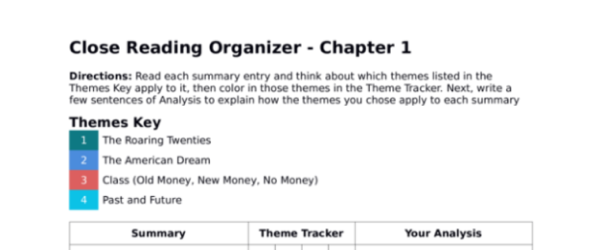















|
Close Reading Organizers |

|
Character Analysis Organizers |

|
Symbol Analysis Organizers |

|
Theme Analysis Organizers |

|
Quote Analysis Organizers |
Common Core-aligned