


|
Have questions?
Contact us
Already a member? Sign in
|
Get every literary device explanation for Death in VenicePlus so much more...
Sign up for LitCharts A+Get instant access to every literary device explanation, plus so much more...
Allusion
Explanation and Analysis—The Boy with a Thorn :
Mann alludes to the famous Boy with a Thorn statue (sometimes also referred to as Spinario or Fedele) in a pivotal scene in which Aschenbach first observes Tadzio and his family at the hotel:
Softness and tenderness obviously presided over his existence. They had refrained from subjecting his beautiful hair to the shears; like that of the Boy with a Thorn, it curled over his forehead and ears and was even longer at the back of his neck. The laces, bows and embroidery on his English sailor suit, with its puffy sleeves that narrowed below and closed tightly around the delicate wrists of his still childlike but slim hands, gave his delicate figure a rich and pampered appearance. He sat in semiprofile opposite his observer, one foot, shod in black patent leather, placed in front of the other [...]
While Tadzio's sisters wear severe and modest outfits that Aschenbach thinks of as nun-like, Tadzio is allowed to dress in a more free and comfortable fashion, and his hair has been left quite long. As he stares at the boy, whom he feels has been raised in an environment of "softness and tenderness," Aschenbach thinks of the "Boy with a Thorn," a Greco-Roman (or Hellenistic) bronze sculpture that has been copied many times since antiquity. The statue, depicting a nude male youth with shoulder-length curling hair who attempts to remove a thorn from his foot, reflects classical beauty ideals and was also celebrated by neoclassical art historians and artists in the 18th and 19th centuries.
Mann's allusion to the sculpture highlights Aschenbach's tendency to view the world, and Tadzio in particular, through the lens of art. Throughout the novel, Aschenbach continues to compare Tadzio to various works of art and mythological figures associated with Ancient Greece, reflecting his inability to confront life directly.
Monthly
Annual (Best Value)

$595USD/mo
Charged $71.40 USD every year



 Teacher
$795USD/mo
Charged $95.40 USD every year




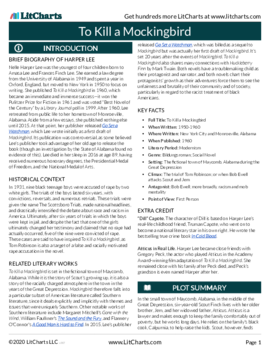
Literature Guide PDFs
LitCharts PDFs for every book you'll read this year.
Instant PDF downloads of all 2238 LitCharts literature guides and of every new one we publish. Try a free sample literature guide.
"Would not have made it through AP Literature without the printable PDFs. They're like having in-class notes for every discussion!"




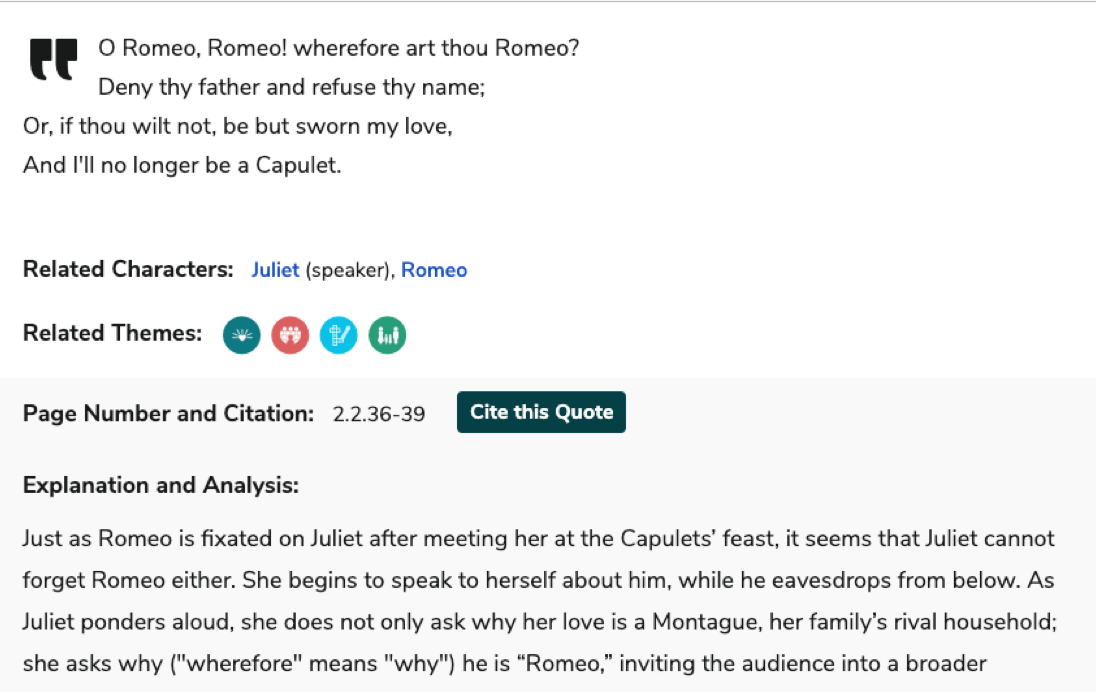
Quotes Explanations
Find the perfect quote. Understand it perfectly. Then rock the citation, too.
For all 49,909 quotes we cover.
For all 49,909 quotes we cover.



Teacher Editions
Close reading made easy for students.
Time saved for teachers.
For every book we cover.
Time saved for teachers.
For every book we cover.


Common Core-aligned


PDFs of modern translations of every one of Shakespeare's 37 plays, 154 sonnets, and 3 longer poems.

Literary Terms and Devices
Definitions and examples for every literary term and device you need to know.
Plus a quick-reference PDF with concise definitions of all 136 terms in one place.
Plus a quick-reference PDF with concise definitions of all 136 terms in one place.


Try a free sample literary term PDF.


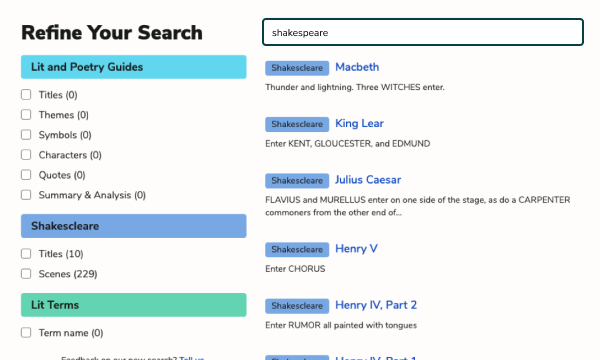
Advanced Search
Refine any search. Find related themes, quotes, symbols, characters, and more.


Related Themes
Comparing and contrasting texts? Find where any theme occurs across all of LitCharts in seconds.



Poetry Guides
Line-by-line explanations and analysis of figurative language and poetic devices.
For every lyric poem we cover.
For every lyric poem we cover.
