


|
Have questions?
Contact us
Already a member? Sign in
|
Get every literary device explanation for Death in VenicePlus so much more...
Sign up for LitCharts A+Get instant access to every literary device explanation, plus so much more...
Allusion
Explanation and Analysis—Saint Sebastian :
Mann alludes to Saint Sebastian, a third-century Christian martyr often depicted in art, in a passage that describes Aschenbach's literary career and his dedication to his art:
At an early stage in the author’s career, a clever analyst had written [...] that it was the concept “of an intellectual and youthful masculinity that grits its teeth in proud modesty and stands by calmly while its body is pierced by swords and spears.” That was elegant, witty and correct [...] because composure beneath blows of fate, graciousness in the midst of torment, does not signify mere endurance; it is an active achievement, a positive triumph, and the figure of Saint Sebastian is the most beautiful symbol, if not in all of art, then at least in the type of art we are discussing [...]
The narrator describes a "clever analyst" who suggested that the protagonists of Aschenbach's novels are typically young men who suffer through pain, illness, and injury with an attitude of noble resignation. This analyst was correct, the narrator suggests, as the ability to maintain "composure beneath blows of fate" is important to Aschenbach, who wakes up early every morning in order to write his books in a steady and consistent manner. Summarizing Aschenbach's attitudes, the narrator describes Saint Sebastian as "the most beautiful symbol [...] in the type of art we are discussing." Saint Sebastian was a common subject for painters in the medieval and Renaissance periods, who painted and sculpted the young saint as his exposed body is pierced by arrows. Through this allusion, then, Mann suggests that Aschenbach believes that there is something noble in pursuing a goal despite profound suffering.
Monthly
Annual (Best Value)

$595USD/mo
Charged $71.40 USD every year



 Teacher
$795USD/mo
Charged $95.40 USD every year




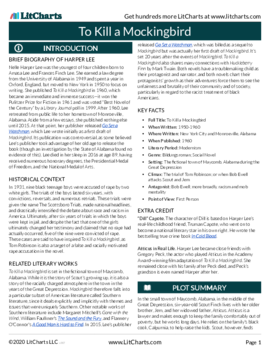
Literature Guide PDFs
LitCharts PDFs for every book you'll read this year.
Instant PDF downloads of all 2238 LitCharts literature guides and of every new one we publish. Try a free sample literature guide.
"Would not have made it through AP Literature without the printable PDFs. They're like having in-class notes for every discussion!"




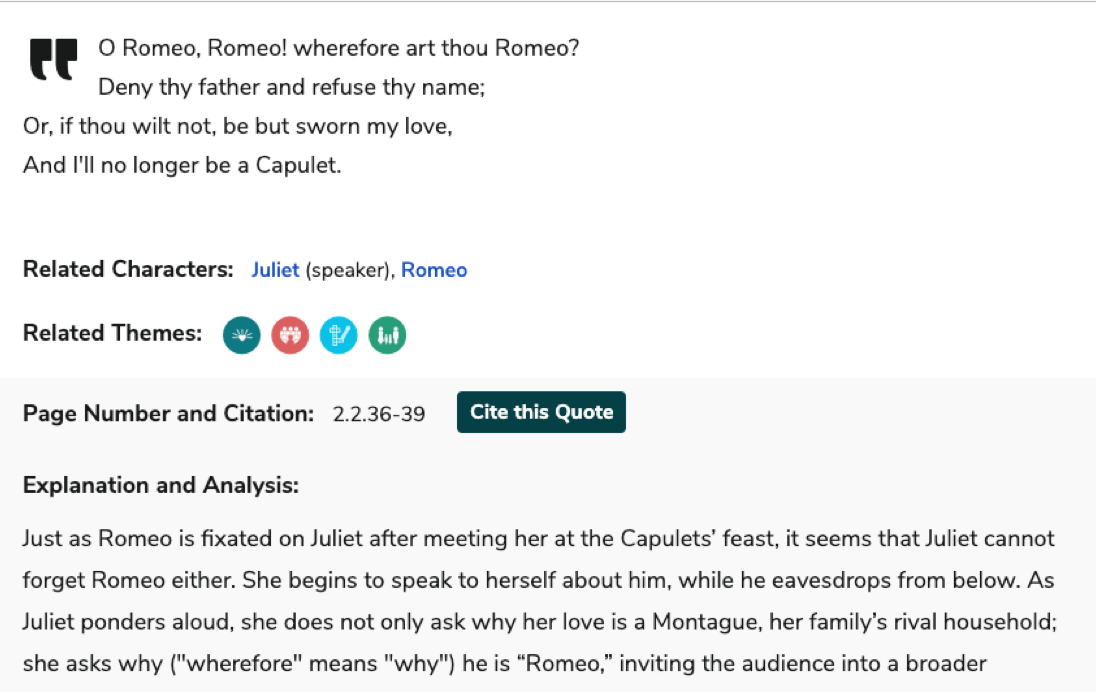
Quotes Explanations
Find the perfect quote. Understand it perfectly. Then rock the citation, too.
For all 49,909 quotes we cover.
For all 49,909 quotes we cover.



Teacher Editions
Close reading made easy for students.
Time saved for teachers.
For every book we cover.
Time saved for teachers.
For every book we cover.


Common Core-aligned


PDFs of modern translations of every one of Shakespeare's 37 plays, 154 sonnets, and 3 longer poems.

Literary Terms and Devices
Definitions and examples for every literary term and device you need to know.
Plus a quick-reference PDF with concise definitions of all 136 terms in one place.
Plus a quick-reference PDF with concise definitions of all 136 terms in one place.


Try a free sample literary term PDF.


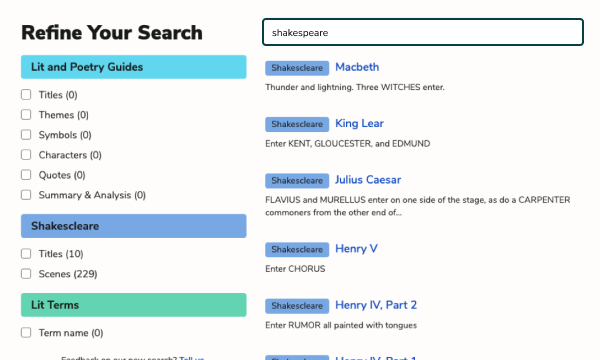
Advanced Search
Refine any search. Find related themes, quotes, symbols, characters, and more.


Related Themes
Comparing and contrasting texts? Find where any theme occurs across all of LitCharts in seconds.



Poetry Guides
Line-by-line explanations and analysis of figurative language and poetic devices.
For every lyric poem we cover.
For every lyric poem we cover.
