


|
Have questions?
Contact us
Already a member? Sign in
|
Get every literary device explanation for Death in VenicePlus so much more...
Sign up for LitCharts A+Get instant access to every literary device explanation, plus so much more...
Simile
Explanation and Analysis—Entering Venice :
In a passage suffused with vivid imagery, the narrator uses a simile that compares entering Venice by train to "entering a palace through the back door." As the ship grows closer to Venice and the view of the city becomes clearer to Aschenbach, the narrator states:
And so he saw it again, that most amazing landing place, that dazzling composition of fantastic architecture which the Republic presented to the reverent gaze of approaching seafarers: the weightless splendor of the Palace, the Bridge of Sighs, the columns with lion and saint on the bank, the ostentatiously projecting side of the fairy-tale temple, the view through to the gateway and the giant clock; and, as he gazed, he reflected that to arrive by land, at the Venice railroad station, was like entering a palace through a back door [...]
Here, Mann employs vivid imagery, noting the "dazzling composition of fantastic architecture" characteristic of Venice, including "the weightless splendor of the [Doge's] Palace, the Bridge of Sighs" and the "columns with lion and saint in the back," found in the famed Piazza San Marco. Gazing at the city with the enthusiasm of a tourist, Aschenbach sees "the ostentatiously projecting side of the fairy-tale temple, the view through to the gateway and the giant clock" and he feels that "to arrive by land, at the Venice railroad station, was like entering a palace through the back door." This simile suggests that, for Aschenbach, Venice is best viewed from the sea, rather than by land. The imagery and simile employed in this passage underscore Aschenbach's growing excitement as the ship approaches the city that he regards as an exotic escape from his life in Munich.
Monthly
Annual (Best Value)

$595USD/mo
Charged $71.40 USD every year



 Teacher
$795USD/mo
Charged $95.40 USD every year




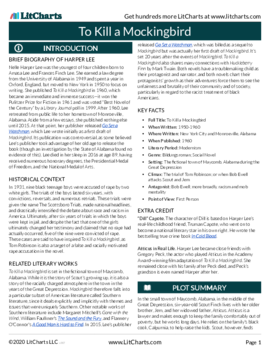
Literature Guide PDFs
LitCharts PDFs for every book you'll read this year.
Instant PDF downloads of all 2238 LitCharts literature guides and of every new one we publish. Try a free sample literature guide.
"Would not have made it through AP Literature without the printable PDFs. They're like having in-class notes for every discussion!"




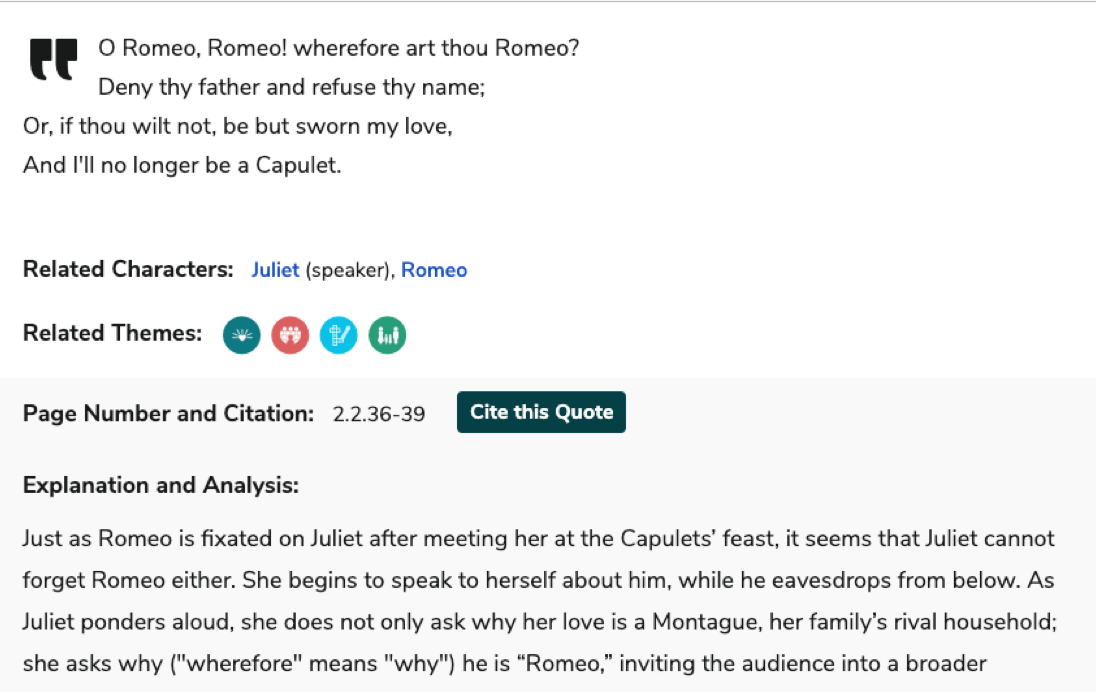
Quotes Explanations
Find the perfect quote. Understand it perfectly. Then rock the citation, too.
For all 49,909 quotes we cover.
For all 49,909 quotes we cover.



Teacher Editions
Close reading made easy for students.
Time saved for teachers.
For every book we cover.
Time saved for teachers.
For every book we cover.


Common Core-aligned


PDFs of modern translations of every one of Shakespeare's 37 plays, 154 sonnets, and 3 longer poems.

Literary Terms and Devices
Definitions and examples for every literary term and device you need to know.
Plus a quick-reference PDF with concise definitions of all 136 terms in one place.
Plus a quick-reference PDF with concise definitions of all 136 terms in one place.


Try a free sample literary term PDF.


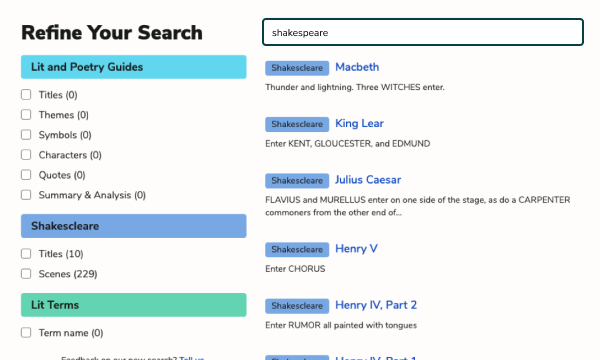
Advanced Search
Refine any search. Find related themes, quotes, symbols, characters, and more.

Related Themes
Comparing and contrasting texts? Find where any theme occurs across all of LitCharts in seconds.


Poetry Guides
Line-by-line explanations and analysis of figurative language and poetic devices.
For every lyric poem we cover.
For every lyric poem we cover.
