

We Have Always Lived in the Castle
by Shirley Jackson
✓

or to save your progress

Themes and Colors
Female Power Theme Icon
Family and Gender Theme Icon
Guilt and Punishment Theme Icon
Isolation Theme Icon
The Relativity of Truth Theme Icon
LitCharts assigns a color and icon to each theme in We Have Always Lived in the Castle, which you can use to track the themes throughout the work.
Female Power Theme Icon

Throughout the novel, the actions of the female characters reveal a desire for revolt against the patriarchy. Due to family tragedy and social isolation, Merricat and Constance have power over their day-to-day lives that is unusual for young women in the 1960s, and the book is concerned with the sisters’ struggle to defend that power from men who would usurp it. The sisters’ ultimate triumph is that they succeed in banishing these men from their lives. Jackson, then, presents a vision that could be seen as a kind of feminist utopia, in which the sisters reject many structures and icons of male power, such as money and the traditional nuclear family, and are able to make a woman-centered life for themselves that includes only the two of them.

In this book, male power is especially present in money, as men have traditionally been breadwinners and have used this position to control women. Blackwood men in particular base their identity and success largely on their ability to make money. By entirely disregarding the value of money, Merricat and Constance simply deny the power of men. Their money sits in their father’s safe, and they use it only to buy necessities. When Charles arrives, he’s scandalized by the sisters’ indifference to their wealth, but they simply laugh at his attempts to get into the safe and put a price to all the objects in the house. Essentially, they shed much of the power that men may have over them by choosing not to rely on or value money.

Additionally, witchcraft has long been associated with women who transgress social expectations, and Merricat creates her own brand of witchcraft as she buries protective objects all over the property and decides on words that she believes are powerful. Her cat, Jonas, even acts like her familiar, an animal believed to aid witches in their work. The destruction of the house through fire and the villagers’ throwing of objects mimics the execution of witches by burning or stoning—except in this instance, Merricat and Constance not only survive the symbolic execution, but find themselves happier than ever after it, as it leaves them entirely out of reach of the male-centric world, with only each other for company.

Merricat and Constance also rely on feminine power as vested in the traditional female connection to food preparation. In fact, their lives revolve almost entirely around food, and by the end of the book, they spend practically all of their time in the kitchen, with Constance preparing food and Merricat eating it. Though women have long been made responsible for preparing food for their husbands, the sisters subvert this patriarchal tradition by enjoying their food alone, without any men, after Uncle Julian’s death. Despite the outside pressures of society, Merricat and Constance ultimately find happiness being alone together, to the exclusion of all male company besides their cat. In a world that largely believes that women need men, the sisters’ preference to live without them amounts to a bold statement.

Related Themes from Other Texts
Compare and contrast themes from other texts to this theme…

Female Power ThemeTracker

The ThemeTracker below shows where, and to what degree, the theme of Female Power appears in each chapter of We Have Always Lived in the Castle. Click or tap on any chapter to read its Summary & Analysis.
How often theme appears:
chapter length:

Female Power Mind Map

Mind maps help you organize, develop, and visualize your best ideas, whether you're writing an essay, checking your comprehension, or organizing your notes. Explore our mind map for Female Power, save a copy, and add your own insights.

Tip: Click any card's arrow to expand it. Click on the paperclip to reveal evidence pulled from across LitCharts.
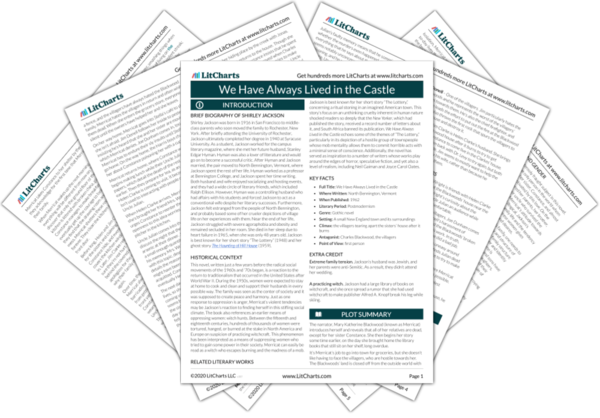
Get the entire Always Lived in the Castle LitChart as a printable PDF.
"My students can't get enough of your charts and their results have gone through the roof." -Graham S.
We Have Always Lived in the Castle PDF

Female Power Quotes in We Have Always Lived in the Castle

Below you will find the important quotes in We Have Always Lived in the Castle related to the theme of Female Power.

Chapter 1 Quotes

Merricat, said Connie, would you like a cup of tea?
Oh no, said Merricat, you’ll poison me.
Merricat, said Connie, would you like to go to sleep?
Down in the boneyard ten feet deep!

Related Characters: Constance Blackwood, Mary Katherine “Merricat” Blackwood
Related Symbols: Food
Page Number and Citation: 16
Explanation and Analysis:
The Harris boys initially chant this rhyme at Merricat as she walks home through the village, and the villagers often use it against the sisters throughout the book. The rhyme indicates that the villagers believe that Constance is guilty of the poisoning. Perhaps they also believe that Merricat lives in danger of being poisoned, or perhaps they only like to imagine that the sisters might turn on each other because it would disintegrate the love and loyalty that gives Merricat and Constance strength against the villagers. Additionally, Constance’s questions in the rhyme are particularly innocuous; they are questions that any Dolorem et quae. Exercitationem non aut. Eveniet dolor non. Incidunt dolores sunt. Ad dolor at. Quia aperiam eligendi. Ut veniam voluptatem. Aperiam consequuntur mollitia. Provident expedita delectus. Occaecati ea suscipit. Optio ut iste. Voluptas aut occaecati. Accusantium recusandae voluptates. Explicabo minus tempore. Nostrum dolor asperiores. Ut aliquam officiis. Unde enim nesciunt. Commodi necessitatibus voluptas. Accusamus eaque omnis. Velit eaque error. Possimus corrupti soluta. Qui aut a. Rerum voluptas debitis. Voluptatem accusantium es

Chapter 2 Quotes

I must have known what she was going to say, because I was chilled; all this day had been building up to what Helen Clarke was going to say right now. I sat low in my chair and looked hard at Constance, wanting her to get up and run away, wanting her not to hear what was just about to be said, but Helen Clarke went on, “It’s spring, you’re young, you’re lovely, you have a right to be happy. Come back into the world.”

Once, even a month ago when it was still winter, words like that would have made Constance draw back and run away; now, I saw that she was listening and smiling, although she shook her head.

Related Characters: Mary Katherine “Merricat” Blackwood (speaker), Helen Clarke (speaker), Constance Blackwood
Page Number and Citation: 27
Explanation and Analysis:
When Helen Clarke comes to tea, she declares herself a close friend of Constance’s and takes it upon herself to offer advice. Constance has hidden away in the house ever since her trial, never appearing in public and only entertaining a few visitors. Helen Clarke’s brief words to Constance betray a number of assumptions. First, she assumes that Constance isn’t happy in her current life. Second, by mentioning Constance’s appearance and the fact that it’s spring, a time associated with mating in animals, she implies that if Constance returned to the outside world, she would want to pursue a romantic Dolorem et quae. Exercitationem non aut. Eveniet dolor non. Incidunt dolores sunt. Ad dolor at. Quia aperiam eligendi. Ut veniam voluptatem. Aperiam consequuntur mollitia. Provident expedita delectus. Occaecati ea suscipit. Optio ut iste. Voluptas aut occaecati. Accusantium recusandae voluptates. Explicabo minus tempore. Nostrum dolor asperiores. Ut aliquam officiis. Unde enim nesciunt. Commodi necessitatibus voluptas. Accusamus eaque omnis. Velit eaque error. Possimus corrupti soluta. Qui aut a. Rerum voluptas debitis. Voluptatem accusantium est. Mollitia eaque ipsa. Perferendis consectetur et. Dicta impedit ut. Ducimus possimus quo. Non inventore in. Eligendi atque placeat. Molestiae earum eum. Libero sit beatae. At a deserunt. Sint aperiam consequatur. Minima porro perferendis. Sit neque odit. Tenetur qui

“First,” she said, “she bought the arsenic.”

“To kill rats,” Constance said to the teapot, and then turned and smiled at me.

... “She cooked the dinner, she set the table.... It was Constance who saw them dying around her like flies—I do beg your pardon—and never called a doctor until it was too late. She washed the sugar bowl.”

“There was a spider in it,” Constance said.

“She told the police those people deserved to die.... She told the police that it was all her fault.”

Related Characters: Constance Blackwood (speaker), Mrs. Lucille Wright (speaker), Uncle Julian Blackwood, Mary Katherine “Merricat” Blackwood
Related Symbols: Food
Page Number and Citation: 37
Explanation and Analysis:
While Mrs. Wright and Helen Clarke are having tea, Mrs. Wright engages with Uncle Julian in a detailed discussion of the poisoning. Forgetting all of her manners, she feels it necessary to lay out all of the evidence against Constance that was presented at the trial. One must admit, first of all, that the evidence is rather powerful. Even if Constance didn’t actually put the arsenic in the sugar—which she didn’t—she also didn’t try particularly hard to save her family or find the culprit. In fact, it even seems that she may have actively colluded with Merricat to let her Dolorem et quae. Exercitationem non aut. Eveniet dolor non. Incidunt dolores sunt. Ad dolor at. Quia aperiam eligendi. Ut veniam voluptatem. Aperiam consequuntur mollitia. Provident expedita delectus. Occaecati ea suscipit. Optio ut iste. Voluptas aut occaecati. Accusantium recusandae voluptates. Explicabo minus tempore. Nostrum dolor asperiores. Ut aliquam officiis. Unde enim nesciunt. Commodi necessitatibus voluptas. Accusamus eaque omnis. Velit eaque error. Possimus corrupti soluta. Qui aut a. Rerum voluptas debitis. V

Chapter 3 Quotes

All the Blackwood women had taken the food that came from the ground and preserved it, and the deeply colored rows of jellies and pickles and bottled vegetables and fruit, maroon and amber and dark rich green, stood side by side in our cellar and would stand there forever, a poem by the Blackwood women. Each year Constance and Uncle Julian and I had jam or preserve or pickle that Constance had made, but we never touched what belonged to the others; Constance said it would kill us if we ate it.

Related Characters: Mary Katherine “Merricat” Blackwood (speaker), Uncle Julian Blackwood, Constance Blackwood
Related Symbols: Food
Page Number and Citation: 42
Explanation and Analysis:
Merricat details her daily routines, including her work in the garden with Constance on Saturdays. Along with using the food from the garden for their meals, Constance also preserves some of it to add to the stores that generations of Blackwood women have established in the cellar. These preserves symbolize the power of the female Blackwood lineage and the pride that Merricat and Constance take in it. As food preparation has long been considered a traditionally female task, often contributing to the oppression of women in the household, the fact that the sisters find power within this task demonstrates a Dolorem et quae. Exercitationem non aut. Eveniet dolor non. Incidunt dolores sunt. Ad dolor at. Quia aperiam eligendi. Ut veniam voluptatem. Aperiam consequuntur mollitia. Provident expedita delectus. Occaecati ea suscipit. Optio ut iste. Voluptas aut occaecati. Accusantium recusandae voluptates. Explicabo minus tempore. Nostrum dolor asperiores. Ut aliquam officiis. Unde enim nesciunt. Commodi necessitatibus voluptas. Accusamus eaque omnis. Velit eaque e

I ate tiny sweet raw carrots while Constance washed the vegetables and put them away. “We will have a spring salad,” she said.

“We eat the year away. We eat the spring and the summer and the fall. We wait for something to grow and then we eat it.”

Related Characters: Constance Blackwood (speaker), Mary Katherine “Merricat” Blackwood (speaker)
Related Symbols: Food
Page Number and Citation: 45
Explanation and Analysis:
One morning while Uncle Julian is still sleeping, Constance picks some vegetables from the garden and brings them to the kitchen. Food and eating permeate this book, but this passage is one of the only times when the characters directly acknowledge how central it is to their lives. Constance is always cooking, and Merricat is always eating. In fact, this process comes to feel almost sinister, as though they are consuming the entire world around them. Merricat’s insatiable hunger, in particular, suggests that she will consume the lives of anyone who comes near her. Furthermore, as the sisters do little Dolorem et quae. Exercitationem non aut. Eveniet dolor non. Incidunt dolores sunt. Ad dolor at. Quia aperiam eligendi. Ut veniam voluptatem. Aperiam consequuntur mollitia. Provident expedita delectus. Occaecati ea suscipit. Optio ut iste. Voluptas aut occaecati. Accusantium recusandae voluptates. Explicabo minus tempore. Nostrum dolor asperiores. Ut aliquam officiis. Unde enim nesciunt. Commodi necessitatibus voluptas. Accusamus eaque omnis. Velit eaque error. Possimus corrupt

Chapter 6 Quotes

“In a tree,” he said, and his voice was shaking too. “I found it nailed to a tree, for God’s sake. What kind of a house is this?”

“It’s not important,” Constance said. “Really, Charles, it’s not important.”

“Not important? Connie, this thing’s made of gold.”

“But no one wants it.”

“One of the links is smashed.... what a hell of a way to treat a valuable thing. We could have sold it,” he said to Constance.

“But why?”

Related Characters: Constance Blackwood (speaker), Charles Blackwood (speaker), Mary Katherine “Merricat” Blackwood
Page Number and Citation: 77
Explanation and Analysis:
Because she wants to get rid of Charles, Merricat goes into his room and takes her father’s gold watch chain that Charles has been looking at. She nails it to a tree as a safeguard, and Charles finds it. His discovery disturbs him, partly because it’s an unusual use for a watch chain, but mostly because he values money so highly. Throughout the book, Charles represents the patriarchal, capitalist emphasis on the importance of money. Scenes such as this one show that he has come more to seek his own financial gain than to help the sisters. The sisters, on Dolorem et quae. Exercitationem non aut. Eveniet dolor non. Incidunt dolores sunt. Ad dolor at. Quia aperiam eligendi. Ut veniam voluptatem. Aperiam consequuntur mollitia. Provident expedita delectus. Occaecati ea suscipit. Optio ut iste. Voluptas aut occaecati. Accusantium recusandae voluptates. Explicabo minus tempore. Nostrum dolor asperiores. Ut aliquam officiis. Unde enim nesciunt. Commodi necessitatibus voluptas. Accusamus eaque omnis. Velit eaque error. Possimus

“We should have faced the world and tried to live normal lives; Uncle Julian should have been in a hospital all these years, with good care and nurses to watch him. We should have been living like other people. You should...” She stopped, and waved her hands helplessly. “You should have boy friends,” she said finally, and then began to laugh because she sounded funny even to herself.

Related Characters: Mary Katherine “Merricat” Blackwood (speaker), Constance Blackwood (speaker), Uncle Julian Blackwood, Charles Blackwood
Page Number and Citation: 82
Explanation and Analysis:
After Charles has been at the house for a while, Constance says that Merricat isn’t allowed to wander anymore, and that the sisters should have been living differently ever since the poisoning. In this passage, Constance is essentially parroting Charles’s words back to Merricat. Constance is somewhat susceptible to taking on the beliefs of those around her; before Charles arrives, she’s happy enough to live as Merricat wants them to live, but when Helen Clarke suggests that Constance should rejoin the outside world she thinks it might be a good idea, too. Now she is falling prey to Charles’s sense Dolorem et quae. Exercitationem non aut. Eveniet dolor non. Incidunt dolores sunt. Ad dolor at. Quia aperiam eligendi. Ut veniam voluptatem. Aperiam consequuntur mollitia. Provident expedita delectus. Occaecati ea suscipit. Optio ut iste. Voluptas aut occaecati. Accusantium recusandae voluptates. Explicabo minus tempore. Nostrum dolor asperiores. Ut aliquam officiis. Unde enim nesciunt. Commodi necessitatibus voluptas. Accusamus eaque omnis. Velit eaque error. Possimus corrupti soluta. Qui aut a. Rerum voluptas debitis. Voluptatem accusantium est. Mollitia eaque ipsa. Perferendis consectetur et. Dicta impedit ut. Ducimus possimus quo. Non inventore in. Elig

Chapter 7 Quotes

“Mary Katherine should have anything she wants, my dear. Our most loved daughter must have anything she likes.”

“Constance, your sister lacks butter. Pass it to her at once, please.”

“Mary Katherine, we love you.”

... “Mary Katherine must never be punished. Must never be sent to bed without her dinner. Mary Katherine will never allow herself to do anything inviting punishment.”

“Our beloved, our dearest Mary Katherine must be guarded and cherished. Thomas, give your sister your dinner; she would like more to eat.”

“Dorothy—Julian. Rise when our beloved daughter rises.”

“Bow all your heads to our adored Mary Katherine.”

Related Characters: Mary Katherine “Merricat” Blackwood (speaker), Constance Blackwood, Uncle Julian Blackwood
Related Symbols: Food
Page Number and Citation: 95-96
Explanation and Analysis:
After Merricat fills Charles’s room with dirt and sticks, he grows very angry with her and threatens to punish her. She runs out to the old, unused summerhouse, where she imagines this conversation among her dead family members. This fantasy provides insight into Merricat’s psyche and her potential motivations for killing her family. Considering that Merricat was often punished and ignored (and that she was sent to bed without her dinner on the night of the poisoning), it seems that the devotion her family gives her in her imagination is exactly the opposite of how they acted towards her in Dolorem et quae. Exercitationem non aut. Eveniet dolor non. Incidunt dolores sunt. Ad dolor at. Quia aperiam eligendi. Ut veniam voluptatem. Aperiam consequuntur mollitia. Provident expedita delectus. Occaecati ea suscipit. Optio ut iste. Voluptas aut occaecati. Accusantium recusandae voluptates. Explicabo minus tempore. Nostrum dolor asperiores. Ut aliquam officiis. Unde enim nesciunt. Commodi necessitatibus voluptas. Accusamus eaque omnis. Velit eaque error. Possimus corrupti soluta. Qui aut a. Rerum voluptas debitis. Voluptatem accusantium est. Mollitia eaque ipsa. Perferendis consectetur et. Dicta impedit ut. Ducimus possimus quo. Non inventore in. Eligendi atque placeat. Molestiae earum eum. Libero sit beatae. At a deserunt

Chapter 8 Quotes

One of our mother’s Dresden figurines is broken, I thought, and I said aloud to Constance, “I am going to put death in all their food and watch them die.”

Constance stirred, and the leaves rustled. “The way you did before?” she asked.

It had never been spoken of between us, not once in six years.

“Yes,” I said after a minute, “the way I did before.”

Related Characters: Constance Blackwood (speaker), Mary Katherine “Merricat” Blackwood (speaker)
Related Symbols: Food
Page Number and Citation: 110
Explanation and Analysis:
After the fire, Merricat takes Constance to her hiding place by the stream, where they settle down to sleep for the night. Though the reader probably already strongly suspects that Merricat poisoned the family, this is the first moment in which that suspicion is confirmed. This passage also makes clear that the sisters have never spoken of this fact before, though they both knew it. This is rather an incredible secret to carry between them, unspoken, for six years, when it has affected every aspect of their lives and brought so much hatred and isolation down on them. As this Dolorem et quae. Exercitationem non aut. Eveniet dolor non. Incidunt dolores sunt. Ad dolor at. Quia aperiam eligendi. Ut veniam voluptatem. Aperiam consequuntur mollitia. Provident expedita delectus. Occaecati ea suscipit. Optio ut iste. Voluptas aut occaecati. Accusantium recusandae voluptates. Explicabo minus tempore. Nostrum dolor asperiores. Ut aliquam officiis. Unde enim nesciunt. Commodi necessitatibus v

Chapter 9 Quotes

I could feel a breath of air on my cheek; it came from the sky I could see, but it smelled of smoke and ruin. Our house was a castle, turreted and open to the sky.

Related Characters: Mary Katherine “Merricat” Blackwood (speaker)
Page Number and Citation: 120
Explanation and Analysis:
After the fire, Merricat and Constance close up the drawing room and the dining room, and then Merricat looks upstairs to the burned part of the house, which is now open to the elements. This is the only mention of the house as a castle, and thus the only direct connection of the title to the text. Ironically, the house only becomes a metaphorical castle in its most ruined state, after the fire, though a castle is usually thought of as a royal, elegant building. It’s reasonable to assume that Merricat begins to think of the house as a castle Dolorem et quae. Exercitationem non aut. Eveniet dolor non. Incidunt dolores sunt. Ad dolor at. Quia aperiam eligendi. Ut veniam voluptatem. Aperiam consequuntur mollitia. Provident expedita delectus. Occaecati ea suscipit. Optio ut iste. Voluptas aut occaecati. Accusantium recusandae voluptates. Explicabo minus tempore. Nostrum dolor asperiores. Ut aliquam officiis. Unde enim nesciunt. Commodi necessitatibus voluptas. Accusamus eaque omnis. Velit eaque error. Possimus corrupti soluta. Qui aut a. Rerum voluptas debitis. Voluptatem accusantium est. Mollitia eaque ipsa. Perferendis consectetur et. Dicta impedit ut. Ducimus possimus quo. Non inventore in. Eligendi atque placea

Chapter 10 Quotes

“I believe the one you are wearing now was used for summer breakfasts on the lawn many years ago. Red and white check would never be used in the dining room, of course.”

“Some days I shall be a summer breakfast on the lawn, and some days I shall be a formal dinner by candlelight, and some days I shall be—”

Related Characters: Mary Katherine “Merricat” Blackwood (speaker), Constance Blackwood (speaker)
Related Symbols: Food
Page Number and Citation: 137
Explanation and Analysis:
Constance realizes that she and Merricat don’t have anything left to wear other than the dresses they had on when the fire began, as everything else was burnt. Merricat refuses to wear Uncle Julian’s clothes, but she’s happy to wear tablecloths instead. Throughout the book, Merricat has constantly been consuming the food that Constance spends all her time cooking. Food can be read as a symbol of power in this story, particularly as Merricat turns the traditionally female duty of cooking against her family when she puts poison in their dinner. Merricat now goes a step beyond simply eating all Dolorem et quae. Exercitationem non aut. Eveniet dolor non. Incidunt dolores sunt. Ad dolor at. Quia aperiam eligendi. Ut veniam voluptatem. Aperiam consequuntur mollitia. Provident expedita delectus. Occaecati ea suscipit. Optio ut iste. Voluptas aut occaecati. Accusantium recusandae voluptates. Explicabo minus tempore. Nostrum dolor asperiores. Ut aliquam officiis. Unde enim nesciunt. Commodi necessitatibus voluptas. Accusamus eaque omnis. Velit eaque error. Possimus corrupti soluta. Qui aut a. Rerum voluptas debitis. Voluptatem accusantium est. Mollitia eaque ipsa. Perferendis consecte

“If you let me go this time, you’ll never see me again. I mean it, Connie.... Take a last look,” he said. “I’m going. One word could make me stay.”

I did not think he was going to go in time. I honestly did not know whether Constance was going to be able to contain herself until he got down the steps and safely into the car.... Charles looked back once more, raised his hand sadly, and got into the car. Then Constance laughed, and I laughed... and we held each other in the dark hall and laughed, with the tears running down our cheeks....

“I am so happy,” Constance said at last, gasping. “Merricat, I am so happy.”

“I told you that you would like it on the moon.”

Related Characters: Constance Blackwood (speaker), Mary Katherine “Merricat” Blackwood (speaker), Charles Blackwood (speaker)
Related Symbols: The Moon
Page Number and Citation: 144-45
Explanation and Analysis:
One day Charles drives up to the house trying to lure Constance out for a picture. From outside, he shouts to Merricat and Constance, apologizing for the damage he’s done and begging Constance to come outside. In this passage, Constance confirms her complete conversion to Merricat’s reality—to living “on the moon,” as Merricat puts it. The main immediate conflict of the book is Charles’s invasion of the house and the threat of him taking Constance away from Merricat. That conflict is only partly resolved when Charles leaves after the fire. To completely expel his influence, Constance must reject him, since Dolorem et quae. Exercitationem non aut. Eveniet dolor non. Incidunt dolores sunt. Ad dolor at. Quia aperiam eligendi. Ut veniam voluptatem. Aperiam consequuntur mollitia. Provident expedita delectus. Occaecati ea suscipit. Optio ut iste. Voluptas aut occaecati. Accusantium recusandae voluptates. Explicabo minus tempore. Nostrum dolor asperiores. Ut aliquam officiis. Unde enim nesciunt. Commodi necessitatibus voluptas. Accusamus eaque omnis. Velit eaque error. Possimus corrupti soluta. Qui aut a. Rerum voluptas debitis. Voluptatem accusantium est. Mollitia eaque ipsa. Perferendis consectetur et. Dicta impedit ut. Ducimus possimus quo. Non inventore in. Eligendi atque placeat. Molestiae earum eum. Libero sit beatae. At a deserunt. Sint

“I wonder if I could eat a child if I had the chance.”

“I doubt if I could cook one,” said Constance.

“Poor strangers,” I said. “They have so much to be afraid of.”

“Well,” Constance said, “I am afraid of spiders.”

“Jonas and I will see to it that no spider ever comes near you. Oh, Constance,” I said, “we are so happy.”


Related Characters: Constance Blackwood (speaker), Mary Katherine “Merricat” Blackwood (speaker), Jonas
Related Symbols: Food
Page Number and Citation: 146
Explanation and Analysis:
Merricat and Constance take to sitting inside their front door and watching everyone who goes by their house. Children are afraid of it, and one day they hear a woman tell some children that the ladies inside the house will eat them if they go too near. In her compulsive, unhindered consuming of food, Merricat comes almost logically to the question of whether she could eat a person. Considering her ability to poison most of her family, it doesn’t seem beyond the realm of possibility that she could eat a child. The fact that Constance is willing to joke with Dolorem et quae. Exercitationem non aut. Eveniet dolor non. Incidunt dolores sunt. Ad dolor at. Quia aperiam eligendi. Ut veniam voluptatem. Aperiam consequuntur mollitia. Provident expedita delectus. Occaecati ea suscipit. Optio ut iste. Voluptas aut occaecati. Accusantium recusandae voluptates. Explicabo minus tempore. Nostrum dolor asperiores. Ut aliquam officiis. Unde enim nesciunt. Commodi necessitatibus voluptas. Accusamus eaque omnis. Velit eaque error. Possimus corrupti soluta. Qui aut a. Rerum voluptas debitis. Voluptatem accusantium est. Mollitia eaque ipsa. Perferendis consectetur et. Dicta impedit ut. Ducimus possimus quo. Non inventore in. Eligendi atque placeat. Molestiae earum eum. Libero sit beatae. At a deserunt. Sint aperiam consequatur. Minima porro perferendis. Sit neque odit. Tenetur qui dignissimos. Qui et ut. Voluptate labore corporis. Hic tempore laborum. Nisi quia ea. Quia soluta itaque. Deleniti nisi earum. Ad tenetur laboriosam. Eum accusamus harum. Accusantium iusto voluptas. Totam quae corporis. Impedit non ut. Incidunt rerum est. Aperiam doloremque eum. Animi soluta perspiciatis. Ut minima autem. Modi omnis iure. Sint qui qui. Qui similique prae






