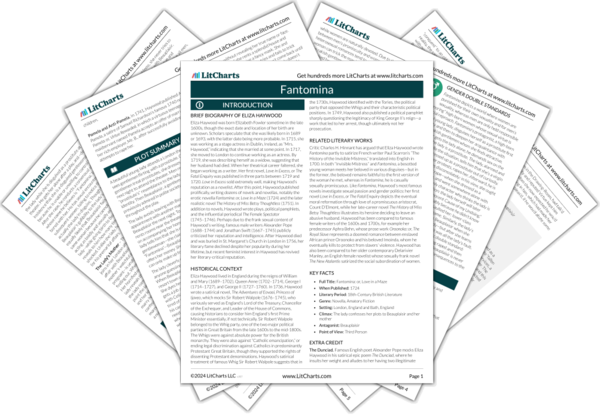
Brief Biography of Eliza Haywood
Eliza Haywood was born Elizabeth Fowler sometime in the late 1600s, though the exact date and location of her birth are unknown. Scholars speculate that she was likely born in 1689 or 1693, with the latter date being more probable. In 1715, she was working as a stage actress in Dublin, Ireland, as “Mrs. Haywood,” indicating that she married at some point. In 1717, she moved to London to continue working as an actress. By 1719, she was describing herself as a widow, suggesting that her husband had died. When her theatrical career faltered, she began working as a writer. Her first novel, Love in Excess, or The Fatal Enquiry was published in three parts between 1719 and 1720. Love in Excess sold extremely well, making Haywood’s reputation as a novelist. After this point, Haywood published prolifically, writing dozens of novels and novellas, notably the erotic novella Fantomina: or, Love in a Maze (1724) and the later realistic novel The History of Miss Betsy Thoughtless (1751). In addition to novels, Haywood wrote plays, political pamphlets, and the influential periodical The Female Spectator (1745–1746). Perhaps due to the frank sexual content of Haywood’s writing, famous male writers Alexander Pope (1688–1744) and Jonathan Swift (1667–1745) publicly criticized her reputation and intelligence. After Haywood died and was buried in St. Margaret’s Church in London in 1756, her literary fame declined despite her popularity during her lifetime, but recent feminist interest in Haywood has revived her literary-critical reputation.
Historical Context of Fantomina
Eliza Haywood lived in England during the reigns of William and Mary (1689–1702), Queen Anne (1702–1714), George I (1714–1727), and George II (1727–1760). In 1736, Haywood wrote a satirical novel, The Adventures of Eovaai, Princess of Ijaveo, which mocks Sir Robert Walpole (1676–1745), who variously served as England’s Lord of the Treasury, Chancellor of the Exchequer, and Leader of the House of Commons, causing historians to consider him England’s first Prime Minister essentially, if not technically. Sir Robert Walpole belonged to the Whig party, one of the two major political parties in Great Britain from the late 1600s to the mid-1800s. The Whigs were against absolute power for the British monarchy. They were also against “Catholic emancipation,” or ending legal discrimination against Catholics in predominantly Protestant Great Britain, though they supported the rights of dissenting Protestant denominations. Haywood’s satirical treatment of famous Whig Sir Robert Walpole suggests that in the 1730s, Haywood identified with the Tories, the political party that opposed the Whigs and their characteristic political positions. In 1749, Haywood also published a political pamphlet sharply questioning the legitimacy of King George II’s reign—a work that led to her arrest, though ultimately not her prosecution.
Other Books Related to Fantomina
Critic Charles H. Hinnant has argued that Eliza Haywood wrote Fantomina partly to satirize French writer Paul Scarron’s “The History of the Invisible Mistress,” translated into English in 1700. In both “Invisible Mistress” and Fantomina, a besotted young woman meets her beloved in various disguises—but in the former, the beloved remains faithful to the first version of the woman he met, whereas in Fantomina, he is casually sexually promiscuous. Like Fantomina, Haywood’s most famous novels investigate sexual passion and gender politics: her first novel Love in Excess, or The Fatal Enquiry depicts the eventual moral reformation through love of a promiscuous aristocrat, Count D’Elmont, while her late-career novel The History of Miss Betsy Thoughtless illustrates its heroine deciding to leave an abusive husband. Haywood has been compared to famous female writers of the 1600s and 1700s, for example her predecessor Aphra Behn, whose prose work Oroonoko: or, The Royal Slave represents a doomed romance between enslaved African prince Oroonoko and his beloved Imoinda, whom he eventually kills to protect from slavers’ violence. Haywood has also been compared to her older contemporary Delarivier Manley, an English female novelist whose sexually frank novel The New Atalantis satirized the social subordination of women.
Key Facts about Fantomina
-
Full Title: Fantomina: or, Love in a Maze
-
When Published: 1724
-
Literary Period: 18th-Century British Literature
-
Genre: Novella, Amatory Fiction
-
Setting: London, England and Bath, England
-
Climax: The lady confesses her plots to Beauplaisir and her mother
-
Antagonist: Beauplaisir
-
Point of View: Third Person
Extra Credit for Fantomina




 Quote explanations,
with page numbers, for over 50,591 quotes.
Quote explanations,
with page numbers, for over 50,591 quotes.
 PDF downloads
of all 2,267 LitCharts guides.
PDF downloads
of all 2,267 LitCharts guides.
 Expert analysis
to take your reading to the next level.
Expert analysis
to take your reading to the next level.
 Advanced search
to help you find exactly what you're looking for.
Advanced search
to help you find exactly what you're looking for.
