

Previous
Is Julius Caesar a tragedy?
|
Previous
Is Julius Caesar a tragedy?
|
How is Brutus a tragic hero?
New! Understand every line of Julius Caesar.
Read our
modern English translation.
|
Next
Literary Devices
|
Brutus is a tragic hero in Julius Caesar because he is noble and principled, yet those same virtues lead him into a disastrous act that destroys Caesar, Rome’s peace, and finally himself.
Brutus's inner conflict begins as honorable. He loves Caesar personally, but he fears that Caesar’s rise toward kingship will threaten Rome. Alone in his orchard, he reasons that he has “no personal cause” against Caesar and imagines Caesar as a “serpent’s egg” that must be killed before it hatches. This makes Brutus tragic because his crime grows out of public duty as he understands it, rather than envy or greed.
His tragic flaw is his rigid trust in reason, honor, and his own moral judgment. Cassius manipulates him with talk of Rome’s shame and with fake letters urging him to act, and Brutus convinces himself that assassination can be a clean sacrifice for liberty. That same moral strictness makes him reject Cassius’s suggestion to kill Antony, because Brutus wants the conspirators to be “sacrificers, but not butchers.” After Caesar’s death, Brutus again trusts logic too much: he lets Antony speak at the funeral, believing his own explanation will satisfy the people. But Antony’s emotional speech turns the crowd against the conspirators and drives Brutus and Cassius from Rome.
Brutus’s fall continues at Philippi, where his choices help lead to military defeat, Cassius’s suicide, and his own despair. Caesar’s ghost appears to him, and Brutus comes to see his death as a kind of justice for killing Caesar. When he finally kills himself with his own sword, he says, “Caesar, now rest. I killed you half as willingly as I kill myself.”
The tragedy is sharpened by Antony’s final judgment: “This was the noblest Roman of them all.” Brutus remains honorable in intention, yet his honor cannot survive the violent politics he enters, and Rome suffers from the gap between moral ideals and political consequences.



 Quote explanations,
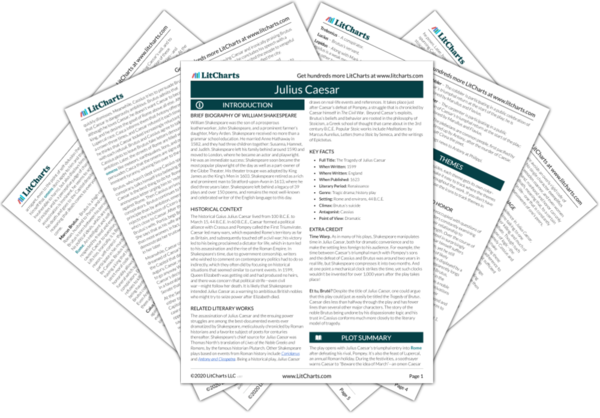
with page numbers, for over 50,642 quotes.
 PDF downloads
of all 2,269 LitCharts guides.
 Expert analysis
to take your reading to the next level.
 Advanced search
to help you find exactly what you're looking for.
Expert analysis
to take your reading to the next level.
Advanced search
to help you find exactly what you're looking for.
