

The Inheritance of Loss
by Kiran Desai
✓

or to save your progress

Gorkha National Liberation Front (GNLF) Term Analysis

A violent movement created in the 1980s by Subhash Ghisingh, on which much of the political conflict in Desai’s novel is centered, and which Gyan briefly joins. The GNLF called for a separate state called “Gorkhaland” for the Nepalis in India, and turned particularly violent in 1985-1986. Various strikes and protests led to the deaths of over 1,200 people. An especially bloody conflict on July 27, 1986, serves as one of the book’s climactic scenes.

Gorkha National Liberation Front (GNLF) Quotes in The Inheritance of Loss

The The Inheritance of Loss quotes below are all either spoken by Gorkha National Liberation Front (GNLF) or refer to Gorkha National Liberation Front (GNLF). For each quote, you can also see the other terms and themes related to it (each theme is indicated by its own dot and icon, like this one:
Colonialism and Globalization Theme Icon
).

Chapter 1 Quotes

His lines had been honed over centuries, passed down through generations, for poor people needed certain lines; the script was always the same, and they had no option but to beg for mercy. The cook knew instinctively how to cry.

Related Characters: The Cook
Page Number and Citation: 6
Explanation and Analysis:
When the boys from the GNLF arrive at the judge’s home to steal his guns, they point a rifle at him and threaten his life, dragging him out from his hiding place underneath the dining table. This passage keys into some of the more expansive themes of the novel. First, the boys use humiliation as a tactic to assert their power over the cook, even though he is far older than they are, and they are of relatively similar social standing. Humiliation is particularly effective here because the cook’s lack of wealth makes him especially defenseless, so the boys exhibit Dolorem et quae. Exercitationem non aut. Eveniet dolor non. Incidunt dolores sunt. Ad dolor at. Quia aperiam eligendi. Ut veniam voluptatem. Aperiam consequuntur mollitia. Provident expedita delectus. Occaecati ea suscipit. Optio ut iste. Voluptas aut occaecati. Accusantium recusandae voluptates. Explicabo minus tempore. Nostrum dolor asperiores. Ut aliquam officiis.

Chapter 2 Quotes

They surveyed the downfall of wealth with satisfaction, and one of the policemen kicked a shaky apparatus of pipes leading from the jhora stream, bandaged here and there with sopping rags.


Related Characters: Sai, The Judge / Jemubhai
Page Number and Citation: 13
Explanation and Analysis:
After the boys from the GNLF steal the judge’s guns and various goods in the house, the police arrive to investigate the robbery. They walk about the house, supposedly looking for evidence, but actually taking pleasure in seeing the estate falling apart, which causes Sai to be ashamed of her living situation. Though it is a small gesture, kicking the pipes is an expression of aggression and an assertion of power over the home, especially with the knowledge that at any minute the house could crumble because it is being hollowed out by termites. This is therefore a small bit Dolorem et quae. Exercitationem non aut. Eveniet dolor non. Incidunt dolores sunt. Ad dolor at. Quia aperiam eligendi. Ut veniam voluptatem. Aperiam consequuntur mollitia. Provident expedita delectus. Occaecati ea suscipit. Optio ut iste. Voluptas aut occaecati. Accusantium recusandae voluptates. Explicabo minus tempore. Nostrum dolor asperiores. Ut aliquam officiis. Unde enim nesciunt. Commodi necessitatibus voluptas. Accusamus eaque omnis. Velit eaque error. Possimus corrupti soluta. Qui aut a. Rerum voluptas debitis. Voluptatem accusantium

Chapter 21 Quotes

Noni: “Very unskilled at drawing borders, those bloody Brits.”

Mrs. Sen, diving right into the conversation: “No practice, na, water all around them, ha ha.”

Related Characters: Sai, Noni, Mrs. Sen, Lola
Page Number and Citation: 143
Explanation and Analysis:
After one of Sai’s lessons, Lola, Noni, and Mrs. Sen all talk about the growing trouble being caused by the GNLF. Although the protests are for the creation of a state in India, the troubles date back to Indian independence, when the British created the nation of India and the nation of Pakistan, but the way in which they drew the borders left many Nepalis stranded in India. Here, Noni and Mrs. Sen joke about the inability of the British to draw borders correctly. While this may be true, the fact that the women can joke about the topic also Dolorem et quae. Exercitationem non aut. Eveniet dolor non. Incidunt dolores sunt. Ad dolor at. Quia aperiam eligendi. Ut veniam voluptatem. Aperiam consequuntur mollitia. Provident expedita delectus. Occaecati ea suscipit. Optio ut iste. Voluptas aut occaecati. Accusantium recusandae voluptates. Explicabo minus tempore. Nostrum dolor asperiores. Ut aliquam officiis. Unde enim nesciunt. Commodi necessitatibus voluptas. Accusamus eaque omnis. Velit eaque error. Possimus corrupti soluta. Qui aut a. Rerum voluptas debitis. Voluptatem accusantium est. Mollitia eaque ipsa. Perferendis consectetur et. Dicta impedit ut. Ducimus possimus quo. Non inventore in. Eligendi atque placeat. Molestiae earum eum. Libero sit beatae. At a

Chapter 26 Quotes

It was a masculine atmosphere and Gyan felt a moment of shame remembering his tea parties with Sai on the veranda, the cheese toast, queen cakes from the baker, and even worse, the small warm space they inhabited together, the nursery talk—

It suddenly seemed against the requirements of his adulthood.

Related Characters: Sai, Gyan
Page Number and Citation: 177
Explanation and Analysis:
After Gyan is swept up in the GNLF procession, he goes to the local canteen with friends to drink and discuss the movement. He begins to become ashamed of his prior political inactivity, thinking back on his earlier time with Sai. This quote represents a turning point in Gyan’s character arc as he finds himself involved in the movement, but his reasons for becoming involved are many. One of the things that The Inheritance of Loss does so well is to demonstrate that no person is motivated or affected by one thing. Thus, Gyan is certainly spurred by the desire Dolorem et quae. Exercitationem non aut. Eveniet dolor non. Incidunt dolores sunt. Ad dolor at. Quia aperiam eligendi. Ut veniam voluptatem. Aperiam consequuntur mollitia. Provident expedita delectus. Occaecati ea suscipit. Optio ut iste. Voluptas aut occaecati. Accusantium recusandae voluptates. Explicabo minus tempore. Nostrum dolor asperiores. Ut aliquam officiis. Unde enim nesciunt. Commodi necessitatibus voluptas. Accusamus eaque omnis. Velit eaque error

Chapter 37 Quotes

They rushed out: “This is our land!”

“It is not your land. It is free land,” they countered, putting down the sentence, flatly, rudely.

“It is our land.”

“It is unoccupied land.”

Related Characters: Noni (speaker), Lola (speaker)
Page Number and Citation: 264
Explanation and Analysis:
As the political troubles escalates in Kalimpong, the boys from the GNLF come to raid Lola and Noni’s house. A few days later, Lola and Noni see a hut sprout up on their property below. They rush outside and have this exchange with the Nepalis living in the hut. What is most remarkable about the exchange is its repetition of colonialist arguments—that land can simply be taken. Thus, Desai’s parallel shows the connections between the original instances of colonialism in India and what is happening now. The results of that colonialism benefitted Lola and Noni while the Nepalis were left Dolorem et quae. Exercitationem non aut. Eveniet dolor non. Incidunt dolores sunt. Ad dolor at. Quia aperiam eligendi. Ut veniam voluptatem. Aperiam consequuntur molliti

Chapter 38 Quotes

The wealth that seemed to protect them like a blanket was the very thing that left them exposed.
Related Characters: Lola, Noni
Page Number and Citation: 266
Explanation and Analysis:
Nepalis begin to raid the homes of the wealthy and sleep in their houses, knowing they will not be searched by the police, and Lola and Noni finally realize how much privilege their wealth has afforded them. In a way, they are even more recognizable as individuals than those of the lower classes when they see how the poor know their names, while they can barely distinguish people’s faces. But now, in the face of political upheaval, they are exposed as targets—for robbery, for squatting, and for humiliation, which they will continue to experience through the rest of the novel. Dolorem et quae. Exercitationem non aut. Eveniet dolor non. Incidunt dolores sunt. Ad dolor at. Quia aperiam eligendi. Ut veniam voluptatem. Aperiam consequuntur mollitia. Provident expedita delectus. Occaecati ea suscipit. Optio ut iste. Voluptas aut occaecati. Accusantium recusandae voluptates. Explicabo minus tempore. Nostrum dolor asperiores. Ut aliquam
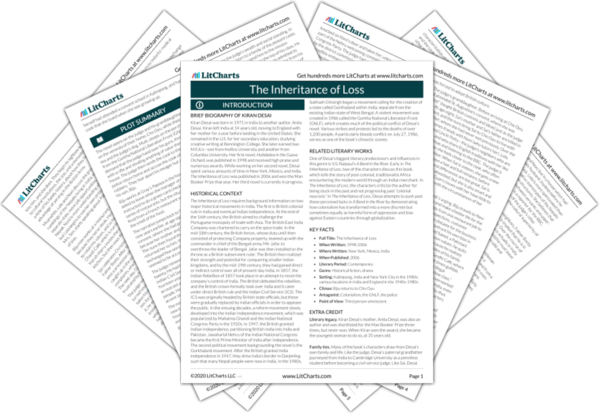
Get the entire The Inheritance of Loss LitChart as a printable PDF.
"My students can't get enough of your charts and their results have gone through the roof." -Graham S.
The Inheritance of Loss PDF






