

The Call of the Wild
by Jack London
✓

or to save your progress

The Man-Dog relationship Theme Analysis

Themes and Colors
The Man-Dog relationship Theme Icon
The Pursuit of Mastery Theme Icon
Wild Law and Order Theme Icon
Domestication to Devolution Theme Icon
LitCharts assigns a color and icon to each theme in The Call of the Wild, which you can use to track the themes throughout the work.
The Man-Dog relationship Theme Icon

In the harsh Klondike, man and sled dog develop intense bonds, coming to depend on each other in symbiotic ways in order to survive. For instance, sled dogs, like Buck provide transportation and labor to couriers like François and Perrault, who in turn care for their animals with food and protection. London portrays such bonds by demonstrating how Buck's owners shape his character and educate him in the ways of mastery.

At Judge Miller's insular estate Buck is a prized and pampered pet, allowed to have the run of the place as a glorified guard dog, who ceremoniously lies by the Judge's feet and accompanies his grandchildren on little hunting trips. Under François and Perrault's just and wise care, Buck becomes an exemplary working dog and fierce leader. Through John Thornton's love and respect, Buck transforms into a loyal companion.

That Buck changes so thoroughly under these human owners highlights not only the diversity of man-dog relationships, but also its evolutionary nature. For London, the kinship between man and dog is ever-changing, but also primeval, stretching back to the ancient times when caveman first hunted with wild wolves. It is also a relationship fraught by a deep-seated struggle "to master, or be mastered.” While men seek to domesticate Buck by shaping his identity, Buck struggles to reconcile his inner instincts with his devotion for his "ideal master,” John Thornton. This struggle for dominance is, for London, the crux of the man-dog relationship. It is a kinship that can be "ideal” through mutual love, respect, and justness, but because it has evolved into various symbiotic partnerships, it can hardly ever live up to its primeval legacy in which man and beast walk as co-dependent, but also autonomous equals.

Related Themes from Other Texts
Compare and contrast themes from other texts to this theme…

The Man-Dog relationship ThemeTracker

The ThemeTracker below shows where, and to what degree, the theme of The Man-Dog relationship appears in each chapter of The Call of the Wild. Click or tap on any chapter to read its Summary & Analysis.
How often theme appears:
chapter length:
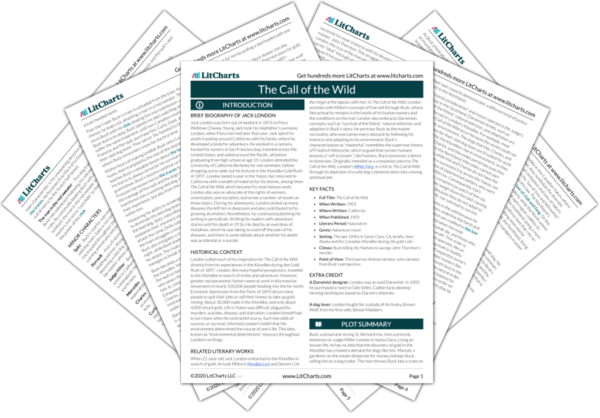
Get the entire The Call of the Wild LitChart as a printable PDF.
"My students can't get enough of your charts and their results have gone through the roof." -Graham S.
The Call of the Wild PDF

The Man-Dog relationship Quotes in The Call of the Wild

Below you will find the important quotes in The Call of the Wild related to the theme of The Man-Dog relationship.

Chapter 1 Quotes

He was beaten (he knew that); but he was not broken. He saw once for all, that he stood no chance against a man with a club. He learned the lesson, and in all his after life he never forgot it. That club was a revelation. It was his introduction to the reign of primitive law. Again and again, as he looked at each brutal performance, the lesson was driven home to Buck: a man with a club was a lawgiver, a master to be obeyed, though not necessarily conciliated.

Related Characters: The man in the red sweater, Buck
Related Symbols: The Law of Club and Fang
Page Number and Citation: 6
Explanation and Analysis:
Buck has been kidnapped unexpectedly, and his new owners beat him with a heavy club, causing Buck great pain. Buck, who's been treated well for his entire life, isn't the least bit used to such acts of violence--he's literally never experienced them before.The passage is important because it establishes the supremacy of violence and survival in the novel. The simple fact is that life (particularly in the Northland) is hard and full of pain--the only question, at least for Buck, is whether or not Buck will be able to overcome the pain and survive. London paints a harsh, Darwinian picture Dolorem et quae. Exercitationem non aut. Eveniet dolor non. Incidunt dolores sunt. Ad dolor at. Quia aperiam eligendi. Ut veniam voluptatem. Aperiam consequuntur mollitia. Provident expedita delectus. O
"Well, Buck, my boy," he went on in a genial voice, "we've had our little ruction, and the best thing we can do is to let it go at that. You've learned your place, and I know mine. Be a good dog and all 'll go well and the goose hang high. Be a bad dog, and I'll whale the stuffin' outa you. Understand?
Related Characters: The man in the red sweater (speaker), Buck
Related Symbols: The Law of Club and Fang
Page Number and Citation: 6
Explanation and Analysis:
In this passage, the man who beats Buck expresses the basic law of survival that London has just shown us. The man has beaten Buck with a heavy club because Buck was being disobedient--Buck had just been kidnapped from his old home, and wasn't used to his new, harsh owners.In essence, Buck has been living in a soft, dreamy world--a world in which there's infinite food and plentiful company. The real world, which Buck is just about to discover, is wild, dangerous, and full of violence. Buck has just discovered the basic law of the real world: know your place, Dolorem et quae. Exercitationem non aut. Eveniet dolor non. Incidunt dolores sunt. Ad dolor at. Quia aperiam eligendi. Ut veniam voluptatem. Aperiam consequuntur mollitia. Provident expedita delectus. Occaecati ea suscipit. Optio ut iste. Voluptas aut occaecati. Accusantium recusandae voluptates. Explicabo minus tempore. Nostrum dolor asperiores. Ut aliquam officiis. Unde enim nesciunt. Commodi necessitatibus voluptas. Accusamus eaque omnis. Velit eaque error. Possimus corrupti soluta. Qui aut a. Rerum volupta

Chapter 5 Quotes

In excess of their own misery, [Hal, Charles, and Mercedes] were callous to the suffering of their animals. Hal's theory, which he practiced on others, was that one must get hardened. He had started out preaching it to his sister and brother-in-law. Failing there, he hammered it into the dogs with a club.

Related Characters: Hal, Charles, Mercedes
Page Number and Citation: 38
Explanation and Analysis:
In this chapter, Buck has been passed to another set of owners, Hal, Charles, and Mercedes. These owners are foolish and incompetent—instead of treating their animals well, they burden them with horribly heavy loads that exhaust the dogs and break their bodies rapidly.The new owners have a philosophy for how to control their animals: they believe that it’s best to be cruel and harsh to the dogs, in order to separate the strong from the weak and make them all get "hardened." Such a theory is a bastardization of Darwin’s survival of the fittest—much like Social Darwinism, the doctrine that Dolorem et quae. Exercitationem non aut. Eveniet dolor non. Incidunt dolores sunt. Ad dolor at. Quia aperiam eligendi. Ut veniam voluptatem. Aperiam consequuntur mollitia. Provident expedita delectus. Occaecati ea suscipit. Optio ut iste. Voluptas aut occaecati. Accusantium recusandae voluptates. Explicabo minus tempore. Nostrum dolor asperiores. Ut aliquam officiis. Unde enim nesciunt. Commodi
“They're lazy, I tell you, and you've got to whip them to get anything out of them. That's their way. You ask any one. Ask one of those men.”
Related Characters: Hal (speaker), The Insides, Buck
Page Number and Citation: 33
Explanation and Analysis:
In this passage, Hal complains that his dogs are lazy for refusing to cross the frozen lake bearing their masters’ cargo. In order to make an example out of the dogs, Hal chooses to whip Buck.Hal’s speech shows how out of touch he is with his own dogs, not to mention the realities of the world. Buck knows far better than Hal what’s going on: he’s not refusing to pull the cargo because he’s lazy, but because he knows that the cargo will break through the frozen river and kill him. Even here, Buck is a fundamentally self-interested animal; he Dolorem et quae. Exercitationem non aut. Eveniet dolor non. Incidunt dolores sunt. Ad dolor at. Quia aperiam eligendi. Ut veniam voluptatem. Aperiam consequuntur mollitia. Provident expedita delectus. Occaecati ea suscipit. Optio ut iste. Voluptas aut occaecati. Accusantium recusandae voluptates. Explicabo minus tempore. Nostrum do
"If you strike that dog again, I'll kill you," he at last managed to say in a choking voice.
Related Characters: John Thornton (speaker), Buck, Hal
Page Number and Citation: 41
Explanation and Analysis:
In this scene, Hal is beating Buck for refusing to cross the frozen river. As Hal beats Buck, a worker, John Thornton, intervenes and threatens to kill Hal if he hurts Buck again. The emotion of the scene is palpable: John seems to be choking as he speaks, suggesting that he’s crying because of Hal’s cruelty.How should we understand this scene—which, unlike everything else in the book, seems to put forth a morality based on compassion and sympathy? Perhaps the reason that London shows John behaving compassionately is that he wants to contrasts John’s behavior with that of the violent, Dolorem et quae. Exercitationem non aut. Eveniet dolor non. Incidunt dolores sunt. Ad dolor at. Quia aperiam eligendi. Ut veniam voluptatem. Aperiam consequuntur mollitia. Provident expedita delectus. Occaecati ea suscipit. Optio ut iste. Voluptas aut occaecati. Accusantium recusandae voluptates. Explicabo minus tempore. Nostrum dolor asperiores. Ut aliquam officiis. Unde enim nesciunt. Commodi necessitatibus voluptas. Accusamus eaque omnis. Velit eaque error. Possimus corrupti soluta. Qui aut a. R

Chapter 6 Quotes

Love, genuine passionate love, was his for the first time. This he had never experienced at Judge Miller'sÉ.With the Judge's sons, hunting and tramping, it had been a working partnership; with the Judge's grandsons, aÉpompous guardianshipÉ.with the Judge himself, a stately dignified friendship. But love that was feverish and burning, that was adoration, that was madness, it had taken John Thornton to arouse.

Related Characters: Judge Miller, John Thornton, Buck
Page Number and Citation: 42
Explanation and Analysis:
In Chapter Six, the novel changes directions abruptly. Buck has had many masters before, but only now does he have an ideal master—someone who genuinely loves him. London distinguishes sharply between the love Buck received in his old, luxurious lifestyle—such love, we’re told, wasn’t really based in respect or mutual appreciation. Here, however, Buck and his new owner, John, genuinely respect each other: they recognize that they’re both talented, intelligent beings, capable of surviving, and beyond that they truly enjoy each other's company.In this passage, London outlines a kind of “ideal society.” London, a politically active thinker throughout his life, Dolorem et quae. Exercitationem non aut. Eveniet dolor non. Incidunt dolores sunt. Ad dolor at. Quia aperiam eligendi. Ut veniam voluptatem. Aperiam consequuntur mollitia. Provident expedita delectus. Occaecati ea suscipit. Optio ut iste. Voluptas aut occaecati. Accus
“As you love me, Buck. As you love me.”
Related Characters: John Thornton (speaker), Buck
Page Number and Citation: 50
Explanation and Analysis:
In this passage, Buck prepares for a wager that will make his master, John, rich. Buck has been sent to move a thousand-pound sled—if he succeeds, John will win a lot of money. As John prepares Buck for the wager, he tells Buck to succeed if Buck loves him.The passage is interesting because it shows the strengths and weaknesses of John and Buck’s relationship. Buck sincerely loves and even worships John, protecting him from danger and making him lots of money. The relationship is strong because John and Buck seem to genuinely respect each other—like the citizens of an ideal Dolorem et quae. Exercitationem non aut. Eveniet dolor non. Incidunt dolores sunt. Ad dolor at. Quia aperiam eligendi. Ut veniam voluptatem. Aperiam consequuntur mollitia. Provident expedita delectus. Occaecati ea suscipit. Optio ut iste. Voluptas aut occaecati. Accu

Chapter 7 Quotes

He had killed man, the noblest game of all, and he had killed in the face of the law of club and fang.

Related Characters: The Yeehats, Buck
Related Symbols: The Law of Club and Fang
Page Number and Citation: 60
Explanation and Analysis:
In this chapter, Buck finally steps out of line and breaks the natural order, the "law of club and fang." He suspects that a group of Yeehats has killed his previous master, John. Buck, who loved John intensely, is overcome with hatred, and he attacks the Yeehats, killing some of them. Buck has never before killed a human being—he’s always been trained to obey humans at all costs, and to accept their mastery. Paradoxically, it was Buck’s love for another human being that led him to kill these humans.Buck seems to be overcoming his natural subservience to humanity. He’s appreciated Dolorem et quae. Exercitationem non aut. Eveniet dolor non. Incidunt dolores sunt. Ad dolor at. Quia aperiam eligendi. Ut veniam voluptatem. Aperiam consequuntur mollitia. Provident expedita delectus. Occaecati ea suscipit. Optio ut iste. Voluptas aut occaecati. Accusantium recusandae voluptates. Explicabo minus tempore

It was the call, the many-noted call, sounding more luringly and compellingly than ever before. And as never before he was ready to obey. John Thornton was dead. The last tie was broken. Man and the claims of man no longer bound him.


Related Characters: John Thornton, Buck
Related Symbols: The Call
Page Number and Citation: 61
Explanation and Analysis:
At the end of the novel, London is at his most romantic and his most political. Over the course of the novel, Buck has had many different masters: metaphorical tyrants, oligarchs, democrats, etc.—some Buck has hated, others he’s loved. And yet every leader Buck ever had stole his own labor from him: Buck’s leaders imprisoned him, forcing him to work for little to no reward.Now that Buck has no human master, he’s free to live in a utopian society of wolves. After years of having his labors stolen from him, he finally controls what he does and where he goes. Dolorem et quae. Exercitationem non aut. Eveniet dolor non. Incidunt dolores sunt. Ad dolor at. Quia aperiam eligendi. Ut veniam voluptatem. Aperiam consequuntur mollitia. Provident expedita delectus. Occaecati ea suscipit. Optio ut iste. Voluptas aut occaecati. Accusantium recusandae voluptates. Explicabo minus tempore. Nostrum dolor asperiores. Ut aliquam officiis. Unde enim nesciunt. Commodi necessitatibus voluptas. Accusamus eaque







