

Tuesdays with Morrie
by Mitch Albom
✓

or to save your progress

Teaching and Learning Theme Analysis

Themes and Colors
Teaching and Learning Theme Icon
Death Theme Icon
Culture and Religion Theme Icon
Movement and Change Theme Icon
Love, Family, and Community Theme Icon
LitCharts assigns a color and icon to each theme in Tuesdays with Morrie, which you can use to track the themes throughout the work.
Teaching and Learning Theme Icon

At various times throughout the book, Mitch describes the book he's written as a "long paper" or a final thesis, written for the final “class” – a class containing only Mitch – that his dying college professor, Morrie, will teach. The entirety of the text, then, is centered around the idea of teaching and learning. The book takes its structure from Morrie's "class" syllabus – each week/chapter is a lecture in Morrie’s class on death – and focuses not just on what is taught but on the teacher/student relationship developing between the two men. As the book progresses and depicts how Mitch and Morrie's relationship grows, we're asked to consider where the student/teacher relationship exists, what the relationship consists of, and to what extent a teacher can affect change on his or her students' lives.

Each of the Tuesday meetings is preceded, and sometimes also followed, by one of Mitch's memories from when he was in college. These memories are primarily focused on his interactions with Morrie. This narrative tool serves two functions – first, to provide an opener or intro to the present day Tuesday meeting, and then to chart the development of trust – from their interaction in college to their relationship as Morrie is dying – between teacher and student. By doing this, the book makes it clear that while teaching and learning can be considered just a transfer of knowledge from one person to another, deeper learning and understanding depends on, and is in fact only possible through, a caring relationship between teacher and student. This relationship begins for Mitch and Morrie in Mitch's first class, when Morrie asks him if he'd prefer to be called Mitch or Mitchell. Mitch had never had a teacher before who cared what he wanted to be called.

The reason that Morrie is able to form such lasting and positive teacher/student relationships can be attributed, at least in part, to the fact that he's a professor of sociology, or the study of how humans relate to each other. In effect, his job is to study relationships, which he does both within and without the university setting. Many of the college memories Mitch mentions, as well as what he teaches Mitch during their Tuesday visits, focus on the critical importance of relationships, and the importance of “relationship skills” such as love, compassion, and forgiveness. In college, Mitch dismissed many of these ideas as "touchy-feely stuff." However, over time, the relationship between him and Morrie grows from being purely student/teacher into something more familial. As their relationship evolves, Mitch becomes more receptive to Morrie's lessons and begins to apply them to his own life. Thei relationship becomes not just a way to learn, but a model for how to have powerful relationships with others.

As Morrie's death creeps closer, his sense of urgency about the need to teach what he knows and what he is learning about death grows more powerful. He begins by writing simple aphorisms on scrap paper, which develops into a newspaper article about him and then being asked to do Nightline interviews with Ted Koppel. The Nightline interviews become an opportunity to teach as many people as watch the show, and the attributes that make Morrie a fantastic teacher in the classroom – a desire to understand and connect with people – are evident on television as wel, and he even manages to teach Koppel something about friendship and compassion.

Finally, Morrie's lessons live on in this book, and in Mitch's other books, not just because they are wise and worthwhile lessons, but because Mitch’s relationship with Morrie is so profound that it compelled him to share the lessons with an even wider audience. Through the publication of the book, the reader becomes the student, and both Mitch and Morrie become teachers of these lessons.

Related Themes from Other Texts
Compare and contrast themes from other texts to this theme…
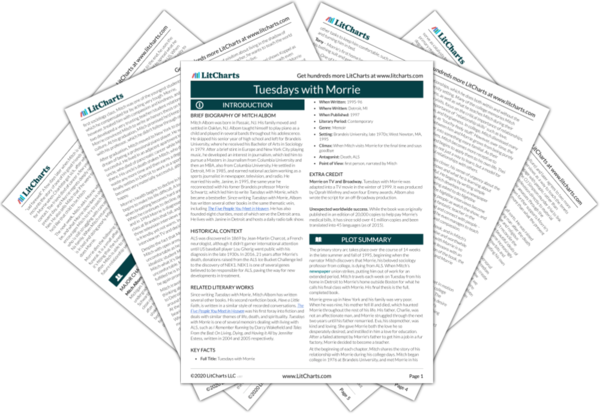
Get the entire Tuesdays with Morrie LitChart as a printable PDF.
"My students can't get enough of your charts and their results have gone through the roof." -Graham S.
Tuesdays with Morrie PDF

Teaching and Learning Quotes in Tuesdays with Morrie

Below you will find the important quotes in Tuesdays with Morrie related to the theme of Teaching and Learning.

The Curriculum Quotes

"Mitch, you are one of the good ones," he says, admiring the briefcase. Then he hugs me. I feel his thin arms around my back. I am taller than he is, and when he holds me, I feel awkward, older, as if I were the parent and he were the child.

Related Characters: Mitch Albom (speaker), Morrie Schwartz
Page Number and Citation: 4
Explanation and Analysis:
Mitch is at his college graduation ceremony and is saying goodbye to Morrie. Morrie's statement that Mitch is "one of the good ones" marks Mitch from the beginning as a kindhearted individual, which creates a counterpoint for the hardened and more materialistic person Mitch will later become after graduation. At this early stage, Mitch is willing and able to provide physical affection to Morrie, and while he admits feeling awkward during the hug, he's at least capable of showing emotion. This further develops young Mitch as an opposite type of character to the Mitch we'll come to know later in Dolorem et quae. Exercitationem non aut. Eveniet dolor non. Incidunt dolores sunt. Ad dolor at. Quia aperiam eligendi. Ut veniam voluptatem. Aperiam consequuntur mollitia. Provident expedita del

The Syllabus Quotes

Instead, he would make death his final project, the center point of his days. Since everyone was going to die, he could be of great value, right? He could be research. A human textbook. Study me in my slow and patient demise. Watch what happens to me. Learn with me.


Related Characters: Mitch Albom (speaker), Morrie Schwartz
Page Number and Citation: 10
Explanation and Analysis:
Morrie has just received his diagnosis of ALS from his doctor and experiences this thought and decision in the following days. Several important ideas coalesce here—first, we get a glimpse of Morrie's unwavering optimism. He makes the conscious decision to not just wither and be miserable with his fate; he decides instead to embrace it and fully experience what's going to happen. Then, we see that Morrie frames his life through teaching and learning, and this encompasses his greater community as well. By vowing to use himself as research and as a means to teach others about death, this central Dolorem et quae. Exercitationem non aut. Eveniet dolor non. Incidunt dolores sunt. Ad dolor at. Quia aperiam eligendi. Ut veniam voluptatem. Aperiam consequuntur mollitia. Provident expedita delectus. Occaecati ea suscipit. Optio ut iste. Voluptas au

The Audiovisual Quotes

Do you prefer Mitch? Or is Mitchell better?

Related Characters: Morrie Schwartz (speaker), Mitch Albom
Page Number and Citation: 24
Explanation and Analysis:
Mitch is in his first class with Morrie in 1976, and Morrie is calling attendance. By asking Mitch what he prefers to be called, Morrie makes several things clear. First, it's obvious that Morrie sees his students as individuals with individual nicknames and preferences, which Mitch says he's never experienced before. This is one of the reasons that Morrie is a good teacher, as he cares not just about the transfer of information, but puts more emphasis on building trust and a relationship with each student. In this way, this question is also a prime example of Morrie's desire to Dolorem et quae. Exercitationem non aut. Eveniet dolor non. Incidunt dolores sunt. Ad dolor at. Quia aperiam eligendi. Ut veniam voluptate

The Classroom Quotes

And you have to be strong enough to say if the culture doesn't work, don't buy it.

Related Characters: Morrie Schwartz (speaker), Mitch Albom
Page Number and Citation: 35
Explanation and Analysis:
Mitch is visiting Morrie for the first time, and after a silence that Mitch describes as awkward, Morrie jumps right into a brief discussion of modern culture. Throughout the text, Morrie consistently critiques the modern American culture of the 90s as materialistic and not conducive to a fulfilled and happy life. He is insistent that in order to become fulfilled, people must reject what modern culture holds up as important, such as money and accumulating material goods, in favor of building community and relationships.Morrie's entire outlook on life and death has its roots in this statement. While death is universally Dolorem et quae. Exercitationem non aut. Eveniet dolor non. Incidunt dolores sunt. Ad dolor at. Quia aperiam eligendi. Ut veniam voluptatem. Aperiam consequuntur mollitia. Provident expedita delectus. Occaecati ea suscipit. Optio ut iste. Voluptas aut occaecati. Accusantium recusandae voluptates. Explicabo minus tempore. Nostrum dolor asperiores. Ut aliquam officiis. Unde enim nesciunt. Commodi necessitatibus voluptas. Accusamus eaque omnis. Velit eaque error. Possimus

Life is a series of pulls back and forth... A tension of opposites, like a pull on a rubber band. And most of us live somewhere in the middle.

Related Characters: Morrie Schwartz (speaker), Mitch Albom
Page Number and Citation: 40
Explanation and Analysis:
Mitch and Morrie are sitting in Morrie's office in a flashback to Mitch's college days, and Mitch has been complaining to Morrie about the confusion he feels regarding his age and what he should be doing.The concept of the tension of opposites describes what Mitch struggles with throughout the text. He knows he should be more like Morrie—more open with his emotions and more interested in relationships. Instead, he fills his life with work in the media, which represents the exact opposite way of living. As he works, Mitch accumulates material goods and achievements rather than positive personal relationships. He Dolorem et quae. Exercitationem non aut. Eveniet dolor non. Incidunt dolores sunt. Ad dolor at. Quia aperiam eligendi. Ut veniam voluptatem. Aperiam consequuntur mollitia. Provident expedita delectus. Occaecati ea suscipit. Optio ut iste. Voluptas aut occaecati. Accusantium recusandae voluptates. Explicabo minus tempore. Nostrum dolor asperiores. Ut aliquam officiis. Unde enim nesciunt. Commodi necessitatibus

The Second Tuesday Quotes

Holding him like that moved me in a way I cannot describe, except to say I felt the seeds of death inside his shriveling frame, and as I laid him in his chair, adjusting his head on the pillows, I had the coldest realization that our time was running out.
And I had to do something.

Related Characters: Mitch Albom (speaker), Morrie Schwartz
Page Number and Citation: 59
Explanation and Analysis:
Mitch has this chilling realization when he offers to lift Morrie from his wheelchair into his armchair in his office. This is the second instance for Mitch of death acting as a catalyst for change. Prior to this moment, it's unclear whether Mitch is going to continue visiting Morrie or not, and it's also unclear whether Mitch is going to take any of Morrie's wisdom and apply it to his life. This realization is what truly begins Mitch's pivot from hardened, materialistic, and superficial to someone who embodies Morrie's teachings.Though this is the second time of death creating a change Dolorem et quae. Exercitationem non aut. Eveniet dolor non. Incidunt dolores sunt. Ad dolor at. Quia aperiam eligendi. Ut veniam voluptatem. Aperiam consequuntur mollitia. Provident expedita delectus. Occaecati ea suscipit. Optio ut iste. Voluptas aut occaecati. Accusantium recusandae voluptates.

The Fourth Tuesday Quotes

“I'm going to say it again,” he said. “Once you learn how to die, you learn how to live.” He smiled, and I realized what he was doing. He was making sure I absorbed this point, without embarrassing me by asking. It was part of what made him a good teacher.

Related Characters: Morrie Schwartz (speaker), Mitch Albom (speaker)
Page Number and Citation: 82
Explanation and Analysis:
Sitting in Morrie's office, Mitch and Morrie are discussing death and the relationship of life to death. Part of what makes Morrie a good teacher is that he can turn the stuff of everyday life into a lesson on leading a more fulfilled life. However, it's often his lessons that are less overt that carry the most weight, as Mitch notes here. Morrie's teaching skills shine, as he carefully makes his point without making the statement something so major and imposing. Morrie's statement itself can be read as a way in which to understand the book's purpose as a whole. Dolorem et quae. Exercitationem non aut. Eveniet dolor non. Incidunt dolores sunt. Ad dolor at. Quia aperiam eligendi. Ut veniam voluptatem. Aperiam consequuntur mollitia. Provident expedita delectus. Occaecati ea suscipit. Optio ut iste. Voluptas aut occaecati. Accusantium recusandae voluptates. Explicabo minus tempore. Nostrum dolor asperiores. Ut aliquam officiis. Unde enim nesciunt. Commodi necessitatibus voluptas. Accusamus eaque omnis. Velit eaque error. Possimus corrupti soluta. Qui aut a. Rerum voluptas debitis. Voluptatem accusantium est. Mollitia eaque ipsa. Perferendis consectetur et. Dicta impedit ut. Ducimus possimus quo. Non inventore in. Eligendi atque placeat. Molestiae earum eum. Libero sit beatae. At a

The Professor, Part Two Quotes

Morrie observed that most of the patients there had been rejected and ignored in their lives, made to feel that they didn't exist. They also missed compassion—something the staff ran out of quickly. And many of these patients were well-off, from rich families, so their wealth did not buy them happiness or contentment.

Related Characters: Mitch Albom (speaker), Morrie Schwartz
Page Number and Citation: 110
Explanation and Analysis:
Morrie's first job after finishing his Ph.D. was conducting research in a mental institution outside of Washington, DC. His job was to observe the patients and their treatments. This is the lesson that Morrie takes away from conducting research in a mental hospital, and it will go on to inform how he structures his personal culture. Most of Morrie's concerns, here as well as later in life, are about how we treat others and what sort of an effect our actions have on them. Morrie will later champion the power of simply paying attention and giving someone your full attention, Dolorem et quae. Exercitationem non aut. Eveniet dolor non. Incidunt dolores sunt. Ad dolor at. Quia aperiam eligendi. Ut veniam voluptatem. Aperiam consequuntur mollitia. Provident expedita delectus. Occaecati ea suscipit. Optio ut iste. Voluptas aut occaecati. Accusantium recusandae voluptates. Explicabo minus tempore. Nostrum dolor asperiores. Ut aliquam officiis. Unde enim nesciunt. Commodi necessitatibus voluptas. Accusamus eaque omnis. Velit eaque error. Possimus corrupti soluta. Qui aut a. Rerum voluptas debitis. Voluptatem accusantium est. Mollitia eaque ipsa. Perferendis consectetur et. Dicta impedit ut. Duc

The Eighth Tuesday Quotes

When I give my time, when I can make someone smile after they were feeling sad, it's as close to healthy as I ever feel.

Related Characters: Morrie Schwartz (speaker), Mitch Albom
Page Number and Citation: 128
Explanation and Analysis:
The topic for this week's discussion is money, and Morrie here is stressing the importance of relationships rather than accumulating material goods near the end of Mitch's visit. With this statement, Morrie ties positive and fulfilling relationships directly to physical health. This supports his concept of personal culture, since so much of his personal culture is built on the idea of nurturing these relationships. By this point in the book, Morrie's body is no longer functioning or healthy. Note that while Morrie doesn't go so far as to say that he feels truly healthy when he's able to make someone Dolorem et quae. Exercitationem non aut. Eveniet dolor non. Incidunt dolores sunt. Ad dolor at. Quia aperiam eligendi. Ut veniam voluptatem. Aperiam consequuntur mollitia. Provident expedita delectus. Occaecati ea suscipit. Optio ut iste. Voluptas aut occaecati. Accusantiu

The Ninth Tuesday Quotes

When you're in bed, you're dead.

Related Characters: Morrie Schwartz (speaker)
Page Number and Citation: 131
Explanation and Analysis:
This is one of Morrie's aphorisms, told to Mitch at the beginning of their weekly visit. Morrie comes up with this one when he can barely move, but he still insists on spending each day in his study. Morrie's insistence that daily life will go on, despite the devastating effects of his disease, are indicative of his positive outlook on life. His positive outlook, in turn, is a direct result of his rejection of modern culture in favor of a self-created personal culture. Morrie's culture does leave room for sadness and grief for his fate, but only a little. He Dolorem et quae. Exercitationem non aut. Eveniet dolor non. Incidunt dolores sunt. Ad dolor at. Quia aperiam eligendi. Ut veniam voluptatem. Aperiam consequuntur mollitia. Provident expedita delectus. Occaecati ea suscipit. Optio ut iste. Voluptas aut occaecati. Accusantium recusandae voluptates. Explicabo minus tempore. Nostrum dolor asperiores. Ut aliquam officiis. Unde enim nesciunt. Commodi necessitatibus voluptas. Accusamus eaque omnis. Velit eaque error. Possimus corrupti soluta. Qui aut a. Rerum voluptas debitis. Voluptatem accusantium est. Mollitia eaque ipsa. Perferendis consectetur et. Dicta impedit ut. Ducimus possimus quo

I was thinking of this: A Teacher to the Last.

Related Characters: Morrie Schwartz (speaker), Mitch Albom
Page Number and Citation: 134
Explanation and Analysis:
"A Teacher to the Last" is what Morrie has just told Mitch he'd like to have on his tombstone. Morrie's desire for something that invokes his love of teaching makes it extremely clear just how important his role as a teacher is to him. The words on his tombstone will live on forever. In this sense, they echo the core concept of teaching that the book explores: that teaching doesn't just encompass lectures and the simple transfer of knowledge. Rather, teaching is cyclical, a give-and-take relationship between the teacher and the student, and one that perpetuates itself outward. Further, the Dolorem et quae. Exercitationem non aut. Eveniet dolor non. Incidunt dolores sunt. Ad dolor at. Quia aperiam eligendi. Ut veniam voluptatem. Aperiam consequuntur mollitia. Provident expedita delectus. Occaecati ea suscipit. Optio ut iste. Voluptas aut occaecati. Accusantium recusandae voluptates. Explicabo minus tempore. Nostrum dolor asperiores. Ut aliquam officiis. Unde enim nesciunt. Commodi necessitatibus voluptas. Accusamus eaque omnis. Velit eaque error. Possimus corrupti soluta. Qui aut a. Rerum voluptas debitis. Voluptatem accusantium est. Mollitia eaque ipsa. Perferendis consectetur et. Dicta impedit u

The Eleventh Tuesday Quotes

“In the beginning of life, when we are infants, we need others to survive, right? And at the end of life, when you get like me, you need others to survive, right?”
His voice dropped to a whisper. “But here's the secret: in between, we need others as well.”

Related Characters: Morrie Schwartz (speaker), Mitch Albom
Page Number and Citation: 157
Explanation and Analysis:
Mitch and Morrie are discussing culture, and Morrie has just made the point that if people saw each other as individuals in need of love and care, the world wouldn't have so many problems.As the book progresses, Morrie develops the idea of community to encompass not just one's own community of friends and family, but expands it further to include the world. Much of Morrie's philosophy centers on caring for others emotionally and physically. The book stresses strongly the need for emotional care as a child through the glimpses we get into Morrie's difficult childhood due to the death of Dolorem et quae. Exercitationem non aut. Eveniet dolor non. Incidunt dolores sunt. Ad dolor at. Quia aperiam eligendi. Ut veniam voluptatem. Aperiam consequuntur mollitia. Provident expedita delectus. Occaecati ea suscipit. Optio ut iste. Voluptas aut occaecati. Accusantium recusandae voluptates. Explicabo minus tempore. Nostrum dolor asperiores. Ut aliquam officiis. Unde enim nesciunt. Commodi necessitatibus voluptas. Accusamus eaque omnis. Velit eaque error. Possimus corrupti soluta. Qui aut a. Rerum voluptas debitis. Voluptatem accusanti

If I could have had another son, I would have liked it to be you.

Related Characters: Morrie Schwartz (speaker), Mitch Albom
Page Number and Citation: 168
Explanation and Analysis:
Morrie says this to Mitch as Mitch massages Morrie's feet. This week they're discussing regrets, and Morrie has just been discussing that while he mourns the short time he has left, he treasures the fact that he has enough time to make things right before he dies.Throughout the text, the relationship between Mitch and Morrie is presented first as a close student/teacher relationship. As time progresses, however, their relationship develops to become more like that of a father and son. This happens both in the past in Mitch's college days, as well as in the present. Morrie's statement here is Dolorem et quae. Exercitationem non aut. Eveniet dolor non. Incidunt dolores sunt. Ad dolor at. Quia aperiam eligendi. Ut veniam voluptatem. Aperiam consequuntur mollitia. Provident expedita delectus. Occaecati ea suscipit. Optio ut iste. Voluptas aut occaecati. Accusantium recusandae voluptates. Explicabo minus tempore. Nostrum dolor asperiores. Ut aliquam officiis. Unde enim nesciunt. Commodi necessitatibus voluptas. Accusamus eaque omnis. Velit eaque error. Possimus corrupti soluta. Qui aut a. Rerum voluptas debitis. Voluptatem accusantium est. Mollitia eaque ipsa. Perferendis consectetur et. Dicta impedit ut. Ducimus possimus quo. Non inventore in. El

The Fourteenth Tuesday Quotes

I blinked back the tears, and he smacked his lips together and raised his eyebrows at the sight of my face. I like to think it was a fleeting moment of satisfaction for my dear old professor: He had finally made me cry.

Related Characters: Mitch Albom (speaker), Morrie Schwartz
Page Number and Citation: 186
Explanation and Analysis:
Mitch is saying goodbye to Morrie on his final visit and has just kissed him for the final time. For the entirety of Mitch and Morrie's relationship, one of Morrie's goals has been to show Mitch that crying is okay. Mitch, as a character that works very hard to fit a persona and doesn't fully embrace Morrie's wisdom regarding emotion, resists crying until this point. Mitch's willingness to cry here shows just how far his character has developed. Through the fourteen weeks he's spent visiting with Morrie, Morrie has been prepping him both to deal with his death and to Dolorem et quae. Exercitationem non aut. Eveniet dolor non. Incidunt dolores sunt. Ad dolor at. Quia aperiam eligendi. Ut veniam voluptatem. Aperiam consequuntur mollitia. Provident expedita delectus. Occaecati ea suscipit. Optio ut iste. Voluptas aut occaecati. Accusantium recusandae voluptates. Explicab

Conclusion Quotes

The last class of my old professor's life took place once a week, in his home, by a window in his study where he could watch a small hibiscus plant shed its pink flowers. The class met on Tuesdays. No books were required. The subject was the meaning of life. It was taught from experience.
The teaching goes on.


Related Characters: Mitch Albom (speaker), Morrie Schwartz
Related Symbols: The Natural World and Morrie's Hibiscus
Page Number and Citation: 192
Explanation and Analysis:
This is the final passage of the book. The words here are the same as the opening lines of the text, save for the addition of the final line. This repetition serves several purposes. First, repetition in general is used throughout the text to emphasize and remind the reader of important points, such as Auden's "love each other or perish" and Morrie's mantra "when you learn how to die, you learn how to live." This ties back to Morrie's way of teaching. As Mitch notes on page 82, rather than make a student potentially feel dumb by asking them if Dolorem et quae. Exercitationem non aut. Eveniet dolor non. Incidunt dolores sunt. Ad dolor at. Quia aperiam eligendi. Ut veniam voluptatem. Aperiam consequuntur mollitia. Provident expedita delectus. Occaecati ea suscipit. Optio ut iste. Voluptas aut occaecati. Accusantium recusandae voluptates. Explicabo minus tempore. Nostrum dolor asperiores. Ut aliquam officiis. Unde enim nesciunt. Commodi necessitatibus voluptas. Accusamus eaque omnis. Velit eaque error. Possimus corrupti soluta. Qui aut a. Rerum voluptas debitis. Voluptatem accusantium est. Mollitia eaque ipsa. Perfer





